

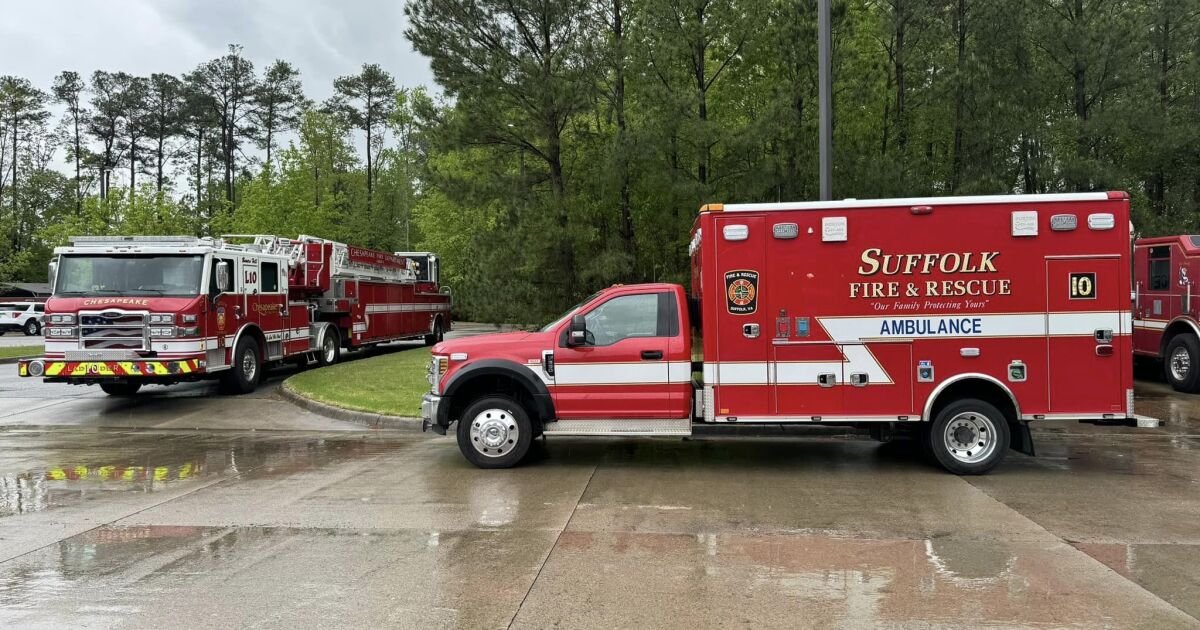
A new program in Suffolk aims to provide an alternative emergency response for residents experiencing a mental health crisis.
It’s called “Medical Access and Resources for Communities,” or MARC, and is part of the city’s implementation of the Marcus David Peters Act.
“The spirit of the Marcus Alert Act was that the behavioral health response should not be primarily a law enforcement response,” said Stacey Young, Western Tidewater’s director of acute care crisis services. “So while law enforcement is always our partner, they’re not necessarily always in the lead.”
The bill, signed into law in 2020, is named after a Black biology teacher who was shot and killed by Richmond police during a mental health crisis in 2018. It establishes a statewide Marcus Alert System and requires local governments to create procedures for screening 911 calls about nonviolent behavioral health crises and directing them to local or regional crisis centers.
Starting in July, emergency responses to mental health crises will be led by Suffolk’s MARC team, made up of two people – a Western Tidewater mental health clinician and a Suffolk Fire and Rescue Service paramedic – who will initially work 40 hours a week.
Capt. Ray Willett, MARC coordinator for the Suffolk Fire Department, said that while MARC teams are sometimes accompanied by an officer for safety, these mental health partners are intended to provide a third option between going to the hospital or a police visit alone.
“(Clinicians) will be working with paramedics,” Willett said, “and they’ll also be working with (patients) to find the best place for that person, because it’s not necessarily the back of a police car or the emergency department.”
That could be something like residential treatment. For more severe cases and non-violent patients, the co-responders can also transport the patient to Suffolk’s Crisis Reception Center for treatment.
“We want to be proactive,” Willett said, “and as much as possible, we want to keep patients out of the hospital and keep them safe at home.”
The MARC team responds to crises that fall under levels 2 and 3 of the Marcus Alert Framework: Level 1 involves calls that can be handled by the local crisis call centre over the phone, while a level 4 crisis involves violence and results in a police-led response for safety.
“We’re designed for Level 3,” Willett said, “where someone is not violent, they’re not homicidal, but they have suicidal thoughts and they have the means to carry them out.”
Additionally, Willett sees the MARC team as a new way to connect people to social services and resources.
“People who are elderly and at home can’t go out and they have no one to call for help so they call 911,” he said. “We want to be that connection.”
In addition to helping callers with mental health concerns, Willett said they are in contact with various food banks and other service providers who want to be on a list that community rescuers can contact to help those in need.
“We don’t duplicate services,” Willett said. “Our goal is to go into someone’s home, assess them, and within 60 days, hand them off to someone else who can continue this care.”
Young said there are tentative plans to expand the program and there is space for a second MARC vehicle at the Godwin location in Western Tidewater.
