

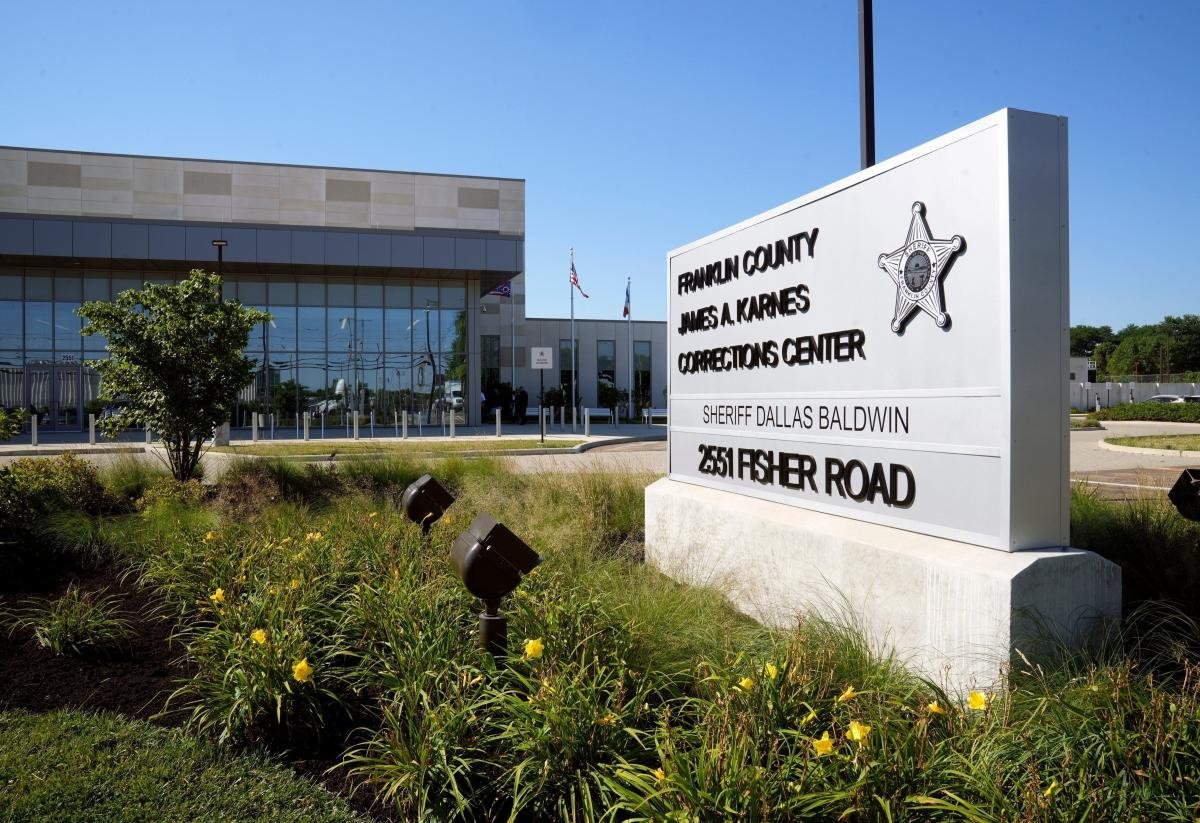
Franklin County Sheriff Dallas Baldwin walked down a wide, bright hallway in the new $350 million jail and opened the door to a medical wing that looks just like an emergency clinic.
Examination rooms with privacy curtains, flat-screen TVs in the waiting room broadcasting healthy lifestyle messages, blood collection rooms, X-ray services and a pharmacy are also on site.
Down the hallway is an 80-bed unit for the medical management of opioid addicts, with open views, private counseling rooms, medical equipment and Gatorade stations, all designed to allow guards to monitor people suffering from withdrawal symptoms.

On any given night in Ohio, about 16,500 people are in prison and 300,000 are incarcerated in jails each year. Jails hold people with sentences of less than 12 months who are awaiting trial immediately after arrest.
Corrections officials in Ohio and across the nation are struggling to deal with complex medical conditions, addictions and serious mental illness. At least 220 people will die in Ohio custody between 2020 and 2023. Nearly one-third of the deaths were drug-related and 29% were suicides.
Baldwin and Chief Deputy Jeff Stobart said the county designed and built the new jail with these challenges in mind.
“I think this jail was created to provide the best possible care. That’s our policy. Anything we can think of, anything we can provide, we’ll do. If these same people were on the street, they wouldn’t get this kind of care,” Baldwin said. “When they come here, they get the best care we can provide.”
Once completed, the jail will replace two older facilities and will be able to house up to 2,200 inmates. Franklin County plans to close the jail on Jackson Pike once the new jail is fully built and staffed.
Franklin County has the largest prison system in Ohio, housing 20,000 inmates each year. It has the highest number of in-custody deaths of any county in Ohio since 2020, with 25.
Prison Construction Boom: Beds Added Across Ohio
Sheriffs, mental health advocates, lawmakers, families and others disagree about the best way to address these issues: by upgrading or expanding jails, reducing the prison population, redirecting people with serious drug and mental health problems to better care and providing better care inside prisons.
Some Ohio sheriffs are rethinking their approach to corrections, paying more attention to behavioral health needs, drug addiction and medical care, and some counties are spending millions of dollars to overhaul their jails or build entirely new ones.
With a $2.5 million grant from the State of Ohio, the Hamilton County Justice Center has converted office space into recovery pods with natural light and more comfortable mattresses for people recovering from addiction.
Hamilton County Sheriff Charmaine McGuffey has created a new position for the jail’s first addiction coordinator, who will connect inmates with resources and treatment. McGuffey said she wants all inmates in the recovery pod to sign a commitment to addiction treatment.
Starting in 2021, the DeWine administration has allocated $175 million in state funds to help county jails renovate or replace. Some of the new jails will expand bed capacity. In Gallia County, for example, $5.5 million in state funds helped build a new 120-bed facility, replacing an 11-bed detention center that had been in use since 1964.
So far, 23 prisons have received state funding to renovate, expand or replace them, and now some lawmakers are considering allocating another $250 million for prison construction and renovation.
For many counties, the only way to meet state standards governing space requirements for inmates is to renovate or expand. For example, the new Franklin County Jail replaces the jail on Jackson Pike, where inmates report there aren’t enough beds and they have to sleep on concrete floors.
Calling for an end to mass incarceration
But adding more jail beds is controversial, and criminal justice reformers want to reduce the number of people in jail through bail reform, diverting people to treatment services, or both.
LaTonya Goolsby of the Cuyahoga County Jail Coalition said the focus should be on diverting people from prison and getting them the mental health and drug treatment services they need. She also said a culture change is essential within the prison.
“We know very well that it’s not the buildings that are killing people. It’s the culture of the correctional officers that is killing people.”
Joel Proulx, a professor at the University of Dayton and member of the Montgomery County Jail Coalition, said he would like to see more alternative response options so that putting at-risk people in jail isn’t the default.
“I think we still incarcerate too many people, especially people who are detained pretrial for reasons that don’t pose a threat to themselves or others. I mean, even in a country like ours, prisons should be very small,” he said.
Gary Daniels, chief lobbyist for the American Civil Liberties Union of Ohio, said punishing people for drug addiction or mental health issues doesn’t work, and neither does mass incarceration.
“We need fundamental reforms in how and why we incarcerate people here in Ohio and across the United States. The war on drugs in Ohio is not over and has barely eased in years,” Daniels said. “We have an incarceration-first policy when it comes to responding to these people.”
Bail (either money or conditions) is intended to ensure that a defendant will appear in court. In some cases, if the defendant is particularly dangerous or a flight risk, the judge may decide to hold the defendant in custody until trial.
Reformers have long tried to nudge the state toward less reliance on bail, a system in which wealthy defendants can post bail and be released while poorer ones remain in jail, arguing that reducing reliance on bail would be fairer and reduce the cost of incarceration on taxpayers.
But in 2022, Ohio voters approved a constitutional amendment that would make bail more difficult in serious crime cases.

Prisons are de facto mental hospitals
Kirsten Sjoberg of the Ohio Disability Rights Association said more than half of people in prison have serious mental illnesses, in part because society criminalizes mental health-related behaviors. Without adequate community mental health care and effective crisis response systems, people end up locked in prisons, she said.
“There just isn’t enough. There isn’t enough community-based, voluntary, trauma-informed mental health care that people would actually want, need and use,” Sjoberg said.
Training law enforcement in crisis intervention, adding specialty courts focused on the mentally ill and providing better care behind bars are all part of the mission of Step Up, a nationwide program to keep people with mental illness out of prison.
As a justice on the Ohio Supreme Court, Evelyn Lundberg Stratton used her influence to focus on mentally ill people trapped in the criminal justice system. She eventually took early retirement from the bench to work full time on the issue as director of Ohio’s Stepping Up Initiative.
Stratton can easily outline a menu of solutions.
-
Don’t send people in mental crisis to jail. Ohio needs more crisis centers for these people.
-
Prisons must provide appropriate mental health treatment, including medical management of withdrawal symptoms, administering psychotropic medication and providing therapy.
-
Security guards should be trained in crisis intervention techniques.
-
Prisons will need to help people get Medicaid coverage when they are released.
-
Ohio needs more housing to support people as they leave prison so they don’t become homeless and return to prison.
Stratton said the state currently provides funding to county jails for assisted drug treatment and reimbursement for psychotropic medications, which are often very expensive.
Ohio should also apply for a federal waiver that would allow people in prisons and jails to receive Medicaid coverage, which would shift the cost from counties to the federal government, Stratton said. Ten states have already applied, but Ohio is not one of them.
Ohio Medicaid Commissioner Maureen Corcoran said her team is working on what it would take to apply for a federal waiver and what the benefits would be. She noted federal rules prohibit cost-shifting and require prisons to become Medicaid providers. “It’s kind of a whole learning process, especially learning from other states that are a little further along, as all of the Medicaid paperwork is taken into account,” Corcoran said.
But Governor DeWine wants to focus on improving utilization of Ohio’s 1,100 state psychiatric hospital beds and making them more available to those who need them. Currently, 93 percent of the beds are filled by people who have been sent to psychiatric hospitals by court order to be restored to competency and stand trial. Stratton said some of these patients could potentially recover with outpatient treatment, which could free up state beds for others who need them, including people currently incarcerated in prison.
Governor DeWine appointed a task force of experts to begin studying the issue in early April, and the group is expected to issue recommendations by fall 2024.
Laura Bischoff is a reporter for the USA Today Network’s Ohio bureau, serving the Columbus Dispatch, the Cincinnati Enquirer, the Akron Beacon Journal and 18 other affiliated news organizations across Ohio..
This article originally appeared in the Columbus Dispatch: Is recovery possible in prison? Advocates aren’t convinced
