

Editor’s note: The following are some of the class projects that first began in Professor Adam Kuban’s classroom at Ball State University in the fall of 2021. Professor Kuban continued the project this spring semester, asking students to find sustainability efforts in the Muncie area and pitch their ideas to Ron Wilkins, interim editor of The Star Press, Journal & Courier. Palladium Items. This spring we will feature stories about health care.
MUNCIE, Ind. — Mental Health America is one of the leading nonprofit organizations that helps people struggling with mental health issues and also advocates for better research and policy changes regarding mental health.
Before the pandemic, Mental Health America saw roughly 1 million visits per year. In 2020, that number rose to 2.6 million.
Brandi Christiansen, president and CEO of Mental Health America’s Wabash Valley region, has seen an increase in mental health concerns among young people, especially in rural areas of Indiana.
Rural youth are even more affected because they have found it harder to connect with their peers both during and after the pandemic, she said.
“When you’re different, whether that’s LGBTQ or[Black, Indigenous, people of color]in rural communities, you have issues specific to adolescence and you feel disparity and lack of representation in rural communities where you don’t get support,” Christiansen said. “And if they can find that support, it’s not from people who look like them or understand their cultural influences, which is a critical part of their[mental health]recovery.”
In 2021, Mental Health America collected data on 725,949 people who underwent depression screening in 2020. Among small to mid-sized counties, Indiana’s Switzerland and Ripley counties had some of the highest numbers of people who frequently think about suicide or self-harm among ages 12 to 17, according to the screening. Indiana was also the fourth-highest state for reported frequency of suicidal ideation.
Christiansen said laws enacted before the pandemic have added fuel to the fire: Many young people were already facing these mental health issues before the pandemic, but now they’ve escalated into a much bigger problem, she said.
“We’ve been hosting youth summits here in Tippecanoe County for the last five years, and what we’ve seen in a post-pandemic world is a lack of trust,” Christiansen said. “Young people are saying they want to trust adults, they want someone they can talk to, but they don’t know who to trust.”
Why young people struggle
Christiansen explained that he believes the political climate during and after the pandemic has left young people unsure of who and what to trust.
“They are [teenagers] “Kids are watching us,” she says. “They see the problems of adults, they internalize them, and they don’t want that for themselves. They become hopeless because the adults around them seem so hopeless. It’s hard for kids to find resilience when they’re in a dark place.”
Christiansen encourages anyone who thinks they may be experiencing any kind of mental health crisis to take the mental health assessment available on the MHA’s website.
It’s better to be safe than sorry, and there are more resources available to help people in the early stages of a mental health crisis than to seek help before it’s too late, she said.
One mental health resource in Lafayette is Roots to Rise, a private clinic founded by Sarah Boulack.
As a licensed mental health professional with more than 15 years of experience working with children and adults, she has seen an increase in anxiety among children in the wake of the pandemic.
She believes the pandemic has made people more aware of the mental health crises they or their children may be facing.
Bowrak said parents come to her desperately seeking help for their children, and therapy may have been their last resort.
“I see a lot of kids with anxiety,” Bowrak says, “and it can manifest in a variety of ways that don’t look like anxiety, like behavioral issues, frustration, kids experiencing grief or loss, or even kids having to work through past trauma.”
Play therapy is often effective with young children
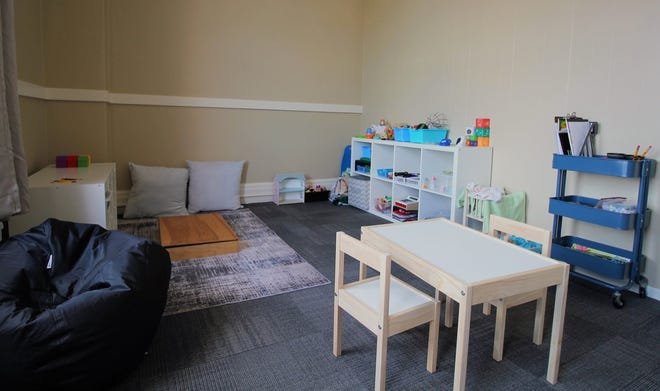
When working with young children, Bowruck uses play therapy as a way to treat patients rather than diagnose them, and he says it’s more effective than trying to get young children to talk about their problems.
Play therapy involves observing how patients interact with certain toys or items while they are playing, and it also allows Boulak to teach children appropriate coping skills in a non-directive way.

According to a 2023 article from the Centers for Disease Control and Prevention, anxiety can manifest in a variety of ways in children.
Children can be very scared when separated from their parents. They may have a variety of phobias. Even when going to school or thinking about the future, children can experience feelings of fear and may experience strong feelings of fear.
Signs of depression in children
According to the CDC, signs of depression in children include self-harming or self-destructive behaviors, changes in sleep patterns, not wanting to do or enjoy fun activities, and even changes in eating habits. Children may be labeled as troublemakers or lazy, but they could be showing signs of depression.
Cole Ramsey, a senior at Western Boone High School, has experienced his fair share of mental health crises at school.
“Unfortunately, Western Boone High School has had several student deaths related to mental illness, and it’s been going on since I was in seventh grade,” Ramsey said. “It was a really hard time for kids during the pandemic year, and that was the first time that mental illness really hit kids in my grade hard.”

Finding Solutions in Boone County
Ramsey describes himself as someone who lends a hand when he can: When he sees a problem, he wants to find some kind of solution.
That’s why he founded the Boone County Advocacy Committee.
The committee serves as a way for students to make their voices heard by school officials, as well as their county and state representatives, and to change certain policies that they believe are harmful to students.
“It started as a group for kids to talk to school administrators and share issues they were having,” Ramsey said, “students could talk about stress from academic workloads or even home life issues like thoughts of suicide or depression. I wanted it to be a resource for school administrators, and it morphed into collaboration with county and state officials.”
Ramsey has been meeting with stakeholders for about a year since the group was launched and has seen positive results and attention given to the group.
Ramsey said things tend to move slowly in this regard in the early stages, but other committees have already begun to form in surrounding schools.
“The ultimate goal of this work is to make a difference at the county, school and maybe even state and national levels,” Ramsey said. “There is a national mental health crisis facing young people, and Indiana in particular has really struggled with it. I want to see this improved before I become an adult and have a family of my own.”
Ramsey is now working with other schools in Zionsville and Lebanon to start their own advocacy group, which he hopes will help combat the statewide mental health crisis. He hopes that one day a regional conference can be held where representatives can come together to discuss the issues at these schools and help set young people on a better path to the future.
