

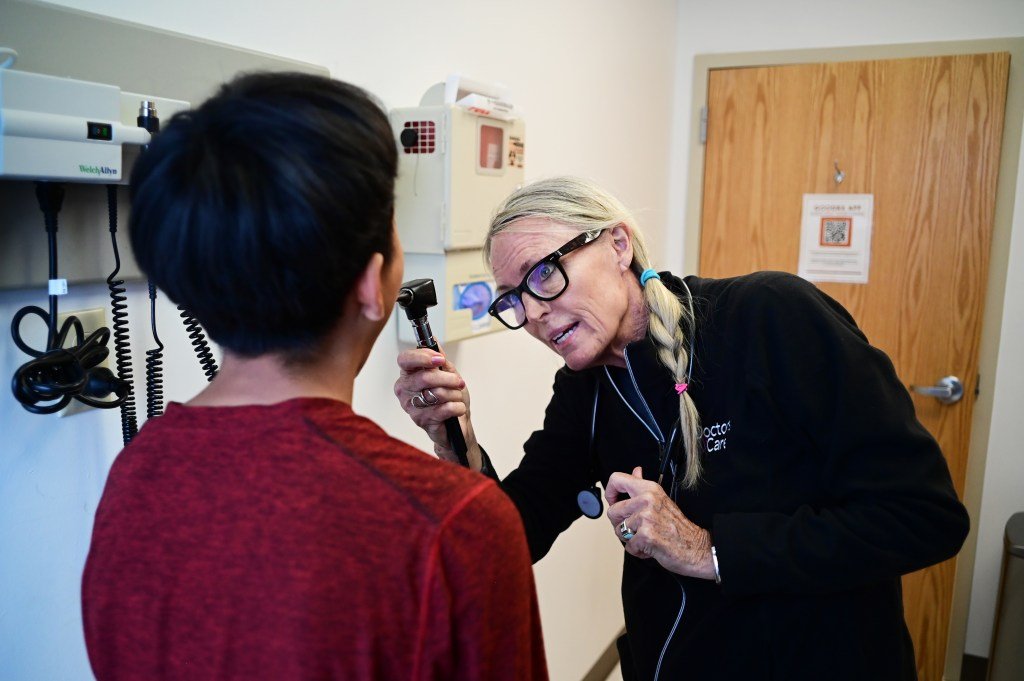
Certified physician assistant Sue Covington, right, examines a patient at Doctors Care Clinic in Littleton on Thursday, May 30, 2024. (Photo by Hyun Chang/The Denver Post)
Colorado clinics have seen an increase in uninsured patients since Obamacare took effect a decade ago, and some clinic leaders say they need to prepare for a future in which even more people will be uninsured.
Colorado, like many other states, is nearly finished with the process of ending Medicaid coverage for people who no longer qualify. During the COVID-19 public health emergency, the state suspended the process of having recipients prove they still had enough income to qualify.
Of the half-million people who lost their Medicaid coverage in Colorado, most never returned paperwork or never completed the process, and so far the state doesn’t have data on whether those people found other coverage.
After the ACA went into effect in 2010, state and federal governments assumed that uninsured rates would continue to fall, and that’s largely what happened, said Phyllis Albritton, managing consultant for the Colorado Safety Net Collaborative, which represents unfederally funded clinics that primarily serve the uninsured.
As a result, governments and nonprofits have begun dedicating fewer resources to serving the uninsured and focusing on other areas such as meeting patients’ economic and social needs, she said.
“The policy framework has been that everybody can get insurance, and we don’t have to worry about people who are uninsured,” Albritton said. “We have to accept that there are going to be people in Colorado who are uninsured.”
Despite public perception that anyone can get insurance at affordable premiums through the individual market, people often can’t afford their copays when they get sick or injured, said Dr. Bebe Kleinman, CEO of Doctors Care in Littleton, which treats the uninsured and those on Medicaid.


She estimates that about 20% of her clinic’s patients are uninsured, the highest rate since key provisions of the ACA took effect in 2014.
“This is a strange development from our intention to close this facility, because under the ACA the number of uninsured was supposed to drop dramatically,” Kleinman said.
An analysis of the national employer-based insurance market found that the average worker pays a $1,735 deductible for individual coverage, and people employed by small businesses generally have higher deductibles.By contrast, the nonprofit KFF reports that about half of all Americans would not be able to pay a $500 medical bill immediately, and about one in five would not be able to pay it even with a payment plan or borrowing from family.
Some newly uninsured patients qualify for Medicaid but fill out the paperwork incorrectly or can’t find help in a language they understand, Kleinman said, along with former Medicaid recipients who now make too much and new immigrants who qualify and can afford it but don’t know how to buy insurance.
“The burden is so great that people end up uninsured,” she said.
Albritton said other low-income clinics that don’t receive federal funding are also seeing an increase in the percentage of uninsured patients compared to before the ACA, when about 15 percent of the population was uninsured. Clinics that do receive federal funding (federally qualified health centers) also report budget strains as some of their patients drop out of Medicaid and become uninsured, she said.
Colorado’s uninsured rate hovered around 6.5% from the passage of the ACA until the COVID-19 pandemic, but fell to 4.6% in 2023 due to a freeze on Medicaid withdrawals caused by the pandemic.
In Colorado, the rollback of Medicaid as the public health emergency ended was mostly completed in April, but some people with disabilities were given extra time to prove they still qualify. People who lost their insurance can re-enroll within 90 days through a fast-track process that could see some people get back on Medicaid this summer. People who missed the 90-day deadline can still re-enroll, but the process is more cumbersome.
As of March, the number of people enrolled in Medicaid was down about 514,000, or about 29%, from May 2023. At the same time, enrollment in the Marketplace increased by just under 16,000, and enrollment in Child Health Plan Plus increased by more than 38,000. Data on how many people have signed up for employer-sponsored health insurance or become uninsured is not yet available.


Steps states can take to help
Albritton said the state could offset some of the rising costs of caring for the uninsured by finding a more stable source of revenue for its Primary Care Fund, which is currently funded mostly by tobacco taxes. Fewer people smoking would mean less money available to distribute to safety-net clinics based on the number of appointments they make to uninsured people, he said.
Health policy was not a focus of this year’s legislative session, but lawmakers did pass a stopgap budget to support Denver Health, the state’s only urban safety-net hospital.
The Legislature also allocated funding to allow county and state agencies to boost staffing and help people renew their Medicaid coverage or find alternative coverage, said Rep. Shannon Byrd, a Westminster Democrat who chairs the Joint Budget Committee.
The state has already taken additional steps, such as automating enrollment for children who are eligible for Child Health Plan Plus, which has a higher maximum income threshold than Medicaid, making re-enrollment as easy as possible and working with partners to navigate people’s insurance options, she said.
Bird said most people probably have affordable insurance options available to them, but may not know what they are or how to sign up. The Budget Committee will meet between legislative sessions to keep a close eye on the issue and take action if it determines the agency needs more resources to help people choose insurance options, Bird said.
“My hope is that all the good work being done by the (Department of Health Policy and Financing) will reverse this trend and help those who don’t have access to insurance,” she said.
No one knows yet whether the number of uninsured patients will continue to grow, plateau or even decline as people realize they’ve lost their insurance. Denver Health, which has a disproportionate share of uninsured patients, reported that the increase in its uninsured population began to level off this spring.
“The increase in uninsured patients has plateaued, suggesting that the majority of patients who faced disenrollment as the (public health emergency) was lifted have now disenrolled,” an anonymous Denver Health spokesperson said in an email.
The most recent data from other hospitals is from December, when the Colorado Hospital Association reported that about 10% of emergency room visits that month were uninsured, compared with an average of about 7% from 2019 through mid-2023.


“The status quo is not sustainable.”
Mental health providers are also feeling the financial hit.
Chiara Kuenzler, president and CEO of Jefferson Mental Health Center, estimates the number of uninsured patients has increased by about 60%, blowing a hole of more than $7 million in her budget for the fiscal year that ended June 30. The center doesn’t turn away uninsured people, but it’s running low on reserves and administrators will be forced to cut some services for everyone if nothing changes, she said.
“We don’t know if, how or when cuts will be made, but the current situation doesn’t make it viable,” Kuenzler said.
In the region that includes Jefferson County, the group that administers Medicaid had predicted a drop of about 16 percent, or 33,000 people. But it actually fell by about 74,000, or 37 percent, Kuenzler said. Some federal and state funds go toward paying for health care for the uninsured, but those funds aren’t growing as quickly as the uninsured’s need for behavioral health services, he said.
Statewide, community mental health centers face a combined gap of at least $24 million between the funding available to care for the uninsured and the cost of providing that care, said Kara Johnson Hufford, CEO of the Colorado Behavioral Health Council.
The Colorado Department of Behavioral Health found about $1 million in surplus funds to help, but it still leaves a big budget hole, she said.
Kristen Bates, deputy director of Medicaid for the Colorado Department of Health Policy and Financing, said the state has implemented a new Medicaid payment model for community mental health centers that will cover some of the costs of treating uninsured people. The department is also continuing to work with providers to re-enroll eligible patients, she said.
“Keeping Coloradans covered and providing insurance to people is a critical priority,” she said.
The Behavioral Health Department is also working on additional one-time funding to help tide over providers in “areas” of the state where Medicaid dropouts are higher than average, said Erin Wester, deputy director for systems and programs.
Enrollment numbers should start to stabilize in the near future, she said.
“We’re all working together to try to find a solution,” Wester said.
Sign up for our weekly newsletter to get health news delivered straight to your inbox.
