

CINCINNATI — As Mental Health Awareness Month draws to a close, doctors are urging parents to take a closer look at symptoms their children are exhibiting and how they may be related to a mental health disorder.
A teenage girl explains how her severe anxiety and depression manifested itself as physical symptoms, and what advice she has for other parents on what to look out for.
What you need to know
- Mental illnesses such as anxiety and depression can manifest as physical symptoms such as abdominal pain and chronic nausea.
- Jade Hudson began experiencing these symptoms in elementary school, which began to affect her attendance and grades.
- Hudson was diagnosed with anxiety and depression and referred to a therapist who could help her find relaxation techniques.
- Gastroenterologists encourage parents to seek medical help if their child is experiencing these symptoms and they are affecting their daily life.
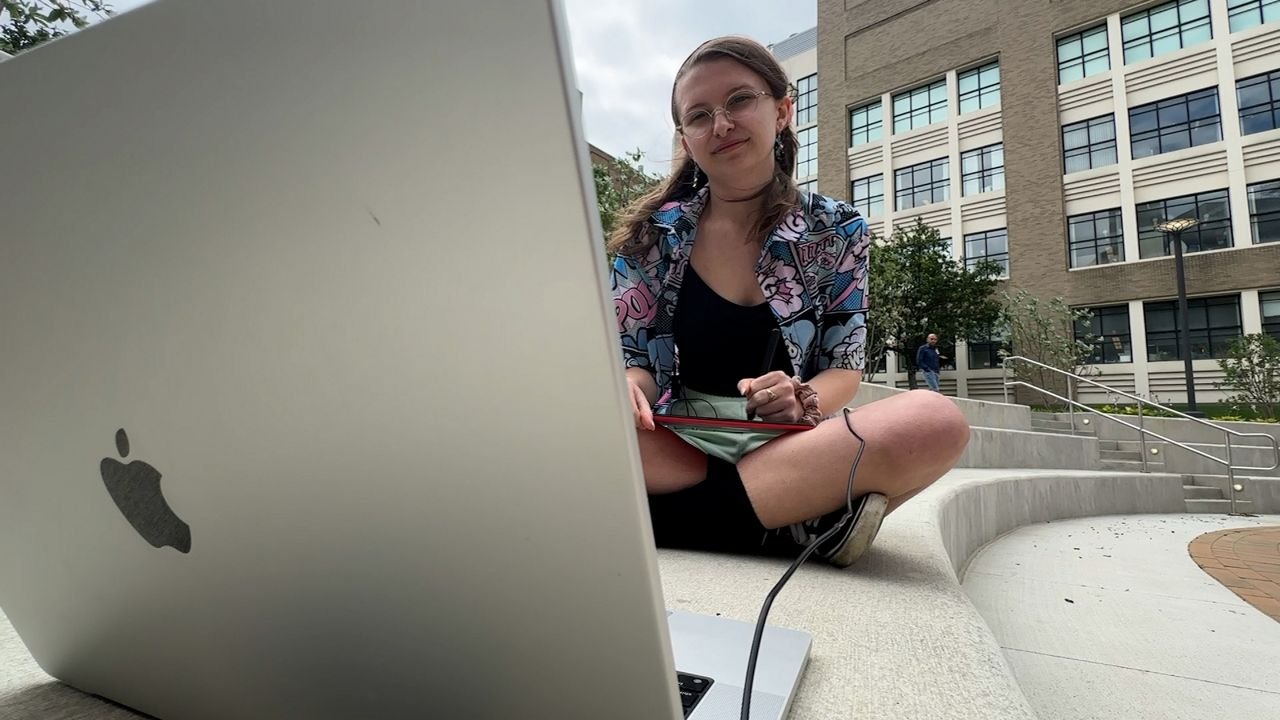
Jade Hudson feels most comfortable with a pencil in her hand. The 19-year-old started drawing at a young age.
“I really loved cartoons and stuff, so I wanted to draw that way,” Hudson said.
Hudson draws on a digital sketchpad. (Spectrum News 1/Katie Kapusta)
Now, her sketchbook has become a place of peace. Hudson had suffered from chronic nausea since she was in grade school, but she didn’t really know why.
“It was really hard going to school,” she said.
Gastroenterologists at Cincinnati Children’s Hospital strongly recommend that if symptoms begin to affect a child’s daily life, such as going to school, it’s essential to seek medical help.
“If you start to feel like GI symptoms are getting in the way of your child’s ability to function and be their best self and their best, now’s the time to see your child’s doctor. Come into our gastroenterology department,” said Dr. Caleb Graham, a gastroenterologist and associate director of residency programs at Cincinnati Children’s Hospital.
Graham said when it comes to gut health, you can’t separate the mind and body.
“I always look at it through the lens of mental health and how the body functions and plays a role in each other,” Graham says, “and we know that kids can have mental stress that manifests physically.”
That’s exactly what was happening with Hudson. She was diagnosed with anxiety and depression and encouraged to seek help from a therapist. Dr. Jillian Austin, a psychologist at Cincinnati Children’s Hospital, said she noticed a big change after working with Hudson for a few months.
Dr. Austin says relaxation techniques have been key to Hudson’s recovery. (Spectrum News 1/Katie Kapusta)
“She had social anxiety,” Austin says. “I gave her some strategies and I felt like I helped her, and then she was like a different person. She came in, she was chatty, she was full of energy, and I felt like I was finally getting to know the real Jade.”
Deep breathing was one technique that worked for Hudson, but many other relaxation techniques can help kids in this situation, and now that she’s out of therapy, she’s finding that through drawing.
Hudson hopes to grow up to be an artist or graphic designer. (Spectrum News 1/Katie Kapusta)
“These things in themselves are very calming,” Hudson said of her paintings.
She is a strong advocate of therapy for children and teens and wants parents to listen to their children’s needs.
“If a child says they need therapy, I think they should get it,” Hudson said, “especially if they’re having issues that their parents don’t see.”
Hudson said she feels like a completely different person thanks to the treatment and therapy she received at Cincinnati Children’s Hospital.
“I feel more empowered to try new things, take on new situations, improve myself and help those around me,” she said.
According to the CDC, about 6 million children between the ages of 3 and 17 have been diagnosed with an anxiety disorder. And about 3 million children have been diagnosed with depression. It’s important to seek help for your child early from your family doctor or a pediatric hospital.
