

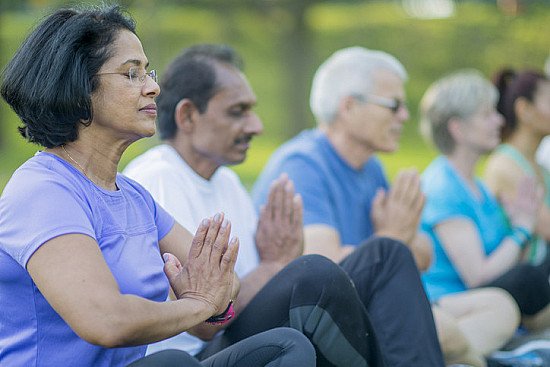

With its focus on breathing exercises and meditation (both of which help calm and focus the mind), it’s no surprise that yoga also has mental benefits, such as reducing anxiety and depression. Even more surprising: yoga may actually improve the way your brain works.
A sharper brain
When you lift weights, your muscles get stronger and bigger. When you do yoga, your brain cells create new connections, causing changes in brain structure and function that improve cognitive abilities like learning and memory. Yoga strengthens parts of the brain that play a key role in memory, attention, cognition, thinking and language. Think of it as weightlifting for your brain.
Studies using MRI scans and other brain imaging techniques have found that people who regularly practice yoga have a thicker cerebral cortex (the area of the brain responsible for information processing) and hippocampus (the area of the brain involved in learning and memory) than non-practicing people. These brain areas typically shrink with age, but older yoga practitioners have shown less shrinkage than non-yoga participants, suggesting that yoga may offset age-related declines in memory and other cognitive abilities.
Research has also shown that yoga and meditation may improve executive functions, such as reasoning, decision-making, memory, learning, reaction time, and accuracy on tests of mental acuity.
Improved mood
Any exercise can boost your mood by lowering levels of stress hormones, increasing production of feel-good chemicals called endorphins, and pumping more oxygenated blood to the brain. But yoga may do more: It can affect mood by increasing levels of gamma-aminobutyric acid (GABA), a brain chemical that promotes good mood and reduces anxiety.
Meditation also reduces activity in the limbic system, the part of the brain responsible for emotions. Reducing your emotional reactivity can lead to a calmer response when faced with stressful situations.
Medication and talking therapies have traditionally been the go-to treatments for depression and anxiety, but complementary therapies such as yoga can also be effective and have advantages over other complementary therapies.
A review of 15 studies published in the journal Ageing and mental healthinvestigated the effects of different relaxation techniques on depression and anxiety in older adults. In addition to yoga, the interventions included massage therapy, progressive muscle relaxation, stress management, and listening to music. All techniques provided some benefit, but yoga and music were the most effective for both depression and anxiety. And yoga seemed to provide the longest-lasting benefits.
Yoga has been found to be effective for post-traumatic stress disorder (PTSD) in several small studies. Yoga is not used alone, but as an add-on treatment to reduce intrusive memories and emotional arousal, and to produce calmer, more steady breathing. Deep, slow breathing activates the parasympathetic nervous system, which leads to a more calm state.
Discover the healing power of yoga in “Intermediate Yoga,” a special health report from Harvard Medical School.
Image: FatCamera/Getty Images
