

These challenges have long been considered separate, but through the Nourishing Next Generation Agrifood Breakthroughs Innovation Challenge, USDA and FFAR hope to encourage early-stage researchers and innovators to see them as interconnected and propose compelling solutions that “support sustainable food production, promote human health, and reduce inequalities while enhancing real-world nutrition security,” according to USDA.
“When we look at climate, nutrition security and equity through the same lens, we realise that we cannot tackle one challenge without seriously considering its impact on the other two. [of this challenge] “It’s about bringing together partners and experts who are often thought of as part of different systems, encouraging them to take a systems approach, to work together and foster new ideas about how we address these three challenges in our union,” USDA Secretary Tom Vilsack told attendees at the USDA’s Agri-Food Innovation Symposium, “Harvest of Hope,” in Washington earlier this week.
“We have to make big bets in this field. We have to revitalize research and support the next generation now to help solve these problems,” he added.
“If I could tell you today what those proposals would be, they’re not thinking big enough.”
To that end, he explained, USDA and FFAR are seeking early-career scientists, researchers and innovators who can focus on new discoveries and drive transformative research that addresses climate, nutrition security and equity.
The competition will award teams between $300,000 and $500,000, up to $2 million total, including $1 million allocated by Congress to the Office of the Science Secretary from the U.S. Department of Agriculture and the remainder from private sector partners.
The winner “will integrate nutrition security and human health with the need to produce food in a climate-smart way and will address food access and food production challenges from the perspective of social equity, justice and opportunity,” Vilsack said.
He added that he hopes the competition will “stimulate interdisciplinary and multidisciplinary relationships and connections among experts that can help innovate in agriculture,” promoting innovation and finding new ways to leverage existing technologies.
“We want to see people come together and propose ideas that are likely to fail, are risky, but have the potential to be transformative,” Chavonda Jacobs-Young, USDA’s chief scientist and undersecretary for research, education and economics, told FoodNavigator-USA. “Today, I can tell you what these proposals will be, and I’ll tell you they’re not thinking big enough. So we want to see proposals from people who sit down and say, ‘That’s crazy. Let’s try it.'”
The awardees will also identify and support dynamic and disruptive technologies in nutrition security that align with USDA’s three-year Science and Research Strategy, released last May, which prioritizes five areas: accelerating innovative technologies and practices, advancing climate-smart solutions, enhancing nutrition security and health, fostering resilient ecosystems, and translating research into practice.
Of those priorities, Jacobs-Young said she hopes applicants will address the fifth goal: “translating research into action.”
“This is what I want to see [with] These proposals [that] “They’re proposing something big, but at the same time, we think they’re thinking with the end goal in mind: How are we going to impact people’s lives? How are we going to provide nutritious food to more people? How are we going to improve the quality of life for Americans? How are we going to protect the environment?” she said.
The deadline to apply for the Innovation Challenge is July 29. Those interested in learning more about the challenge and the application process can visit the USDA/FFAR Innovation Challenge page.
Jacobs-Young added that innovators, researchers and scientists with ideas that don’t fall within the challenge’s guidelines can also work with the USDA.
“We’ve been incredibly blessed with three major bills, particularly the Inflation Reduction Act, that have provided significant funding for climate-smart agriculture. USDA has numerous programs, and even if a program doesn’t fall into the Innovation Challenge we announced today, there are countless opportunities to engage and collaborate with USDA and our teams across the country,” she said.
Symposiums stimulate interdisciplinary networking and brainstorming
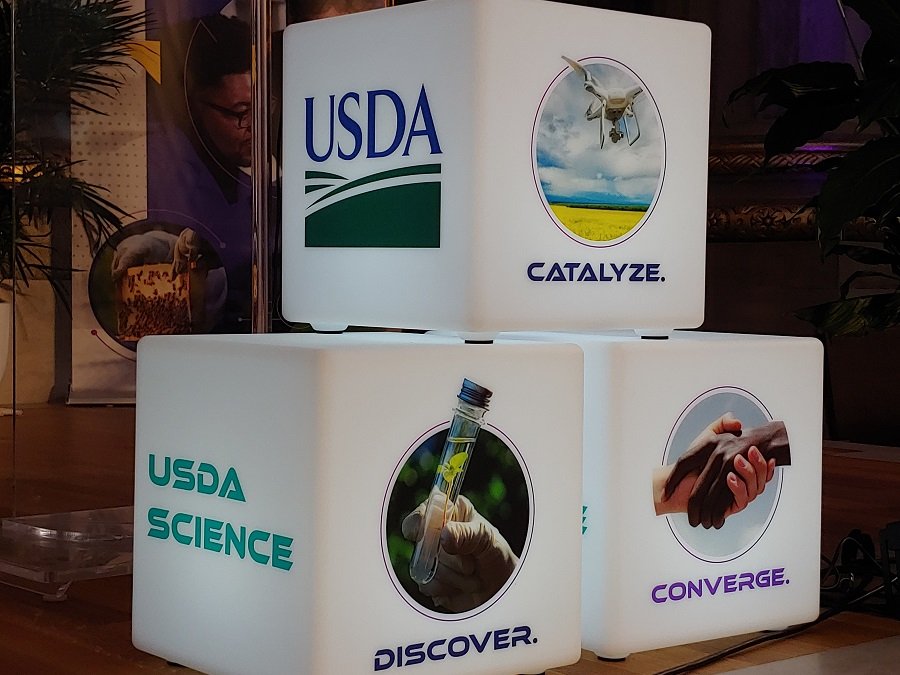
To jumpstart the interdisciplinary and cross-sector networking and brainstorming that USDA leaders called for to address nutrition security, climate change and equity, the agency convened stakeholders across the agriculture and food industries for a dynamic symposium focused on innovating scientific solutions and nourishing people and the planet.
Speakers included Lisa Dyson, CEO of Air Protein, who discussed how her food tech startup creates versatile, functional protein powders and other ingredients using only air, water and energy. The company’s main ingredient is 80% protein and also contains vitamins and minerals, such as vitamin B12, that are hard to get on a vegan diet. The powders also have desirable functional properties, such as retaining oils and water to provide hydration.
Other presenters joining Dyson during the event’s “Inspiration Discussions in Emerging Agriculture (IDEA)” showcase included USDA research geneticist Ed Buckler, who spoke about advances in plant breeding and genetics; Leanne Gluck, head of education innovation at Farm-ng, which is rethinking farm equipment with automation and accessibility in mind; and Anuja Jaitley, founder and chairman of Umby, which is tackling inequality by pairing the purchase of an umbrella with a year of health, life, agriculture and accident insurance to families in need.
Ietef “DJ Cavem” Vita, rapper, activist, educator, vegan chef, and CEO of Plant-Based Records and Eco-Cultivator, encouraged attendees to “put your hands up” as he sang about nutrition access, equity, and the impact of the future of agriculture. We also interviewed chef Jumoke Jackson (aka Mr. Foodtastic) and Luke Black Elk, board member of Makoce Ikikcupi.
Jacobs-Young added that the symposium is “a really inspiring opportunity to bring together lots of different people from different places to think outside the box about challenges that we’ve been facing for a long time and to work together on some of the “very bold goals” we have for agriculture.”
