

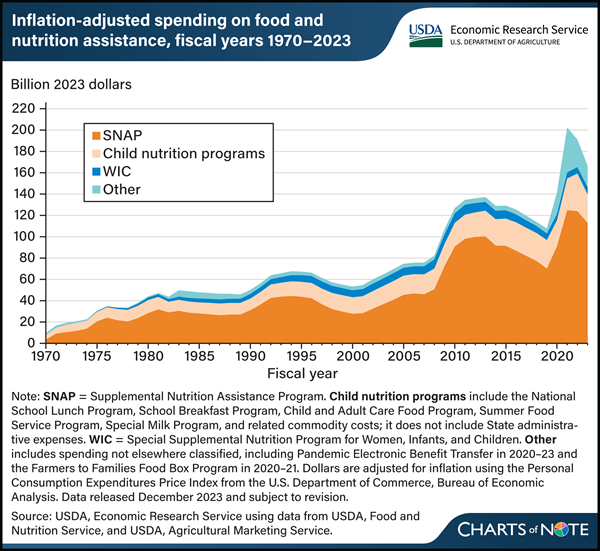

Federal spending on USDA food and nutrition assistance programs totaled $166.4 billion in FY2023, down 13 percent from $191.1 billion in FY22 and down 18 percent from the FY2021 peak of $202.4 billion when adjusted for inflation to 2023 dollars. In FY2023, spending on the Supplemental Nutrition Assistance Program (SNAP) decreased 9 percent from the prior year’s inflation-adjusted amount to $112.8 billion, despite increases in participation and maximum benefit amounts. The decrease occurred due to the nationwide end of emergency allocations that had temporarily increased benefits for all recipients to at least the maximum for their household size since March 2020. Spending on the Special Supplemental Nutrition Program for Women, Infants, and Children (WIC) totaled $6.6 billion, up 11 percent from FY22 inflation-adjusted spending, reflecting increases in program participation and food costs per participant. Total spending on child nutrition programs was $26.9 billion in FY2023, a 24% decrease from the previous year’s inflation-adjusted total. FY2023 marked the child nutrition program’s first full fiscal year of operation after a federal waiver allowing schools to provide free meals to all students and increasing federal reimbursement per free meal expired at the end of June 2022. Total spending on other programs in FY2023 decreased primarily due to lower spending on Pandemic Electronic Benefit Transfer (P-EBT) in its final year of operation. This chart is based on data available as of December 2023 and appears in the USDA Economic Research Service’s “Status of Food and Nutrition Assistance: Fiscal Year 2023 Annual Report,” released in June 2024.
Download larger version of the chart (2048 x 1884, 96 dpi)
