

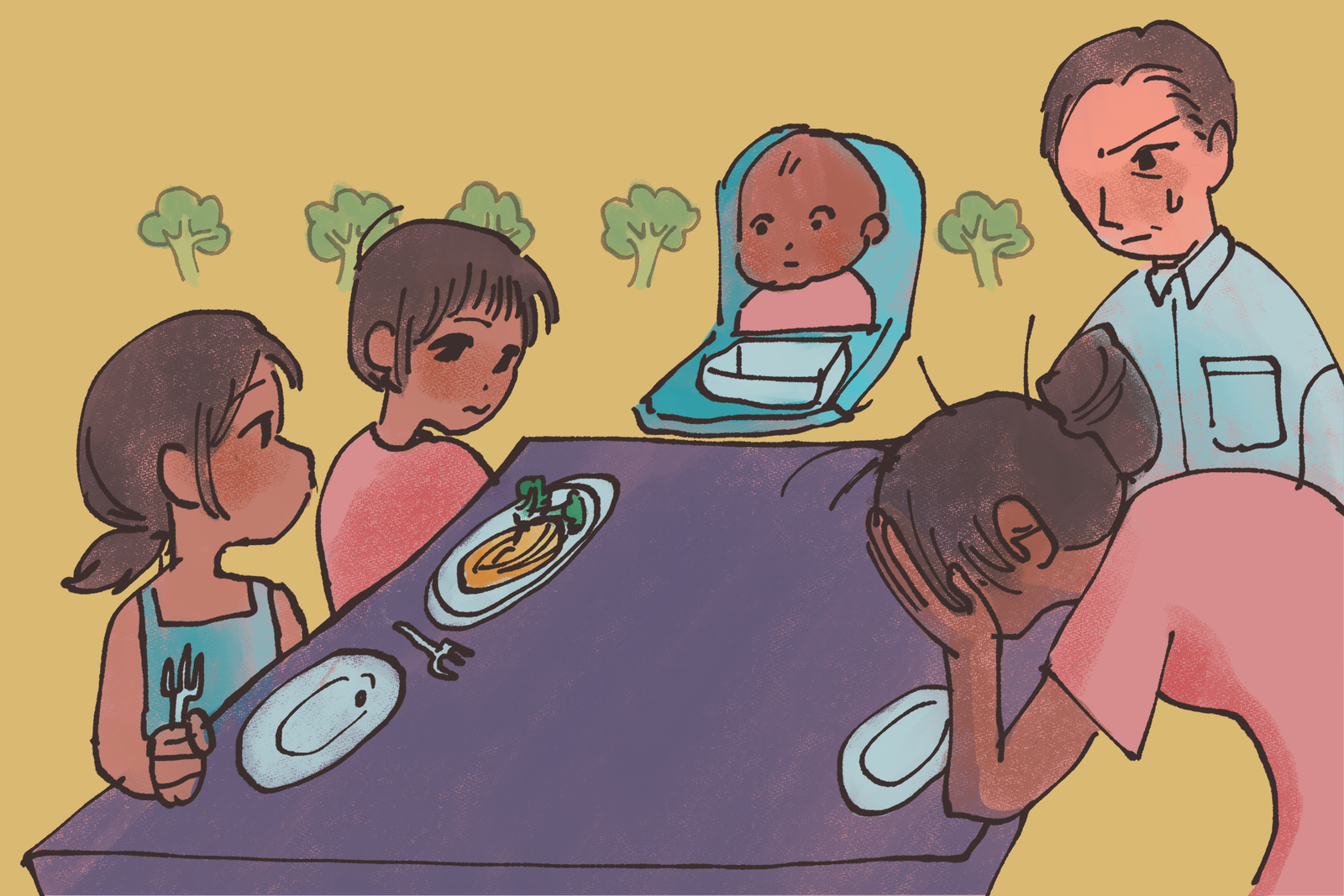
In April, the C.S. Mott National Children’s Health Poll released a report on the challenges of getting kids to eat healthy foods and the pros and cons of common family feeding practices. The report was based on responses from 1,083 parents with at least one child between the ages of 3 and 10.
Survey questions focused on what parents consider to be a healthy diet, the diets parents practice, foods parents avoid or seek out while grocery shopping, strategies to get children to eat fruits and vegetables, and portion sizes.
Aria Grabowski, a nutritional epidemiology student at Rackham High School, told The Michigan Daily that early childhood is a critical time for establishing healthy eating habits because food aversions and preferences begin very early in life.
“Food aversions are actually a very normal behavior, and your child’s instinct is to want to make sure it’s safe and OK,” Grabowski says, “but we know that this is the lowest in infants, who are the most likely to try and (enjoy) new foods, and that carries over into the rest of their lives. So it’s really important to establish those eating habits in infancy and establish the foods they like.”
Grabowski explained that at a certain age, societal pressures start to affect a person’s natural body signals regarding hunger and fullness.
“Another important thing to think about this is that kids are born with a sense of hunger,” Grabowski says. “So they know when they’re hungry. They know when they’re full. They’re very sensitive to that. This actually starts to wane around age 9, at which point social pressures start to come into play: ‘This looks really tasty, my friends are eating this, I want to eat that,’ so by helping them develop healthy habits early on, you’re giving your kids the tools they need to navigate the pressures they’re going to face later in life and allowing them to have them.”
The poll found that one in eight parents force their child to eat everything on their plate. Susan Woolford, co-director of the National Children’s Health Poll, explained what happens when parents do this in an interview with The Daily.
“We want children, and adults, to be able to recognize and listen to their body’s cues to know when they’re full or want more,” Woolford says. “So, for example, if you force a child to finish their plate, they may eat more even when they’re full. This can lead to poor eating habits that can lead to overeating and ultimately weight gain.”
The poll found that 61% of parents said that if the rest of the family didn’t like what they had eaten, they would make something different for their children – and Woolford explained that this could be harmful in the long term.
“I think this is concerning because oftentimes when parents give their child alternative foods to suit their preferences, they’re not as healthy as the options that were offered to other children,” Woolford says, “and in that case, parents often do the same thing, because they worry that if they feed their child, they’re not going to get the nutrients they need. But by giving them alternative foods that are less healthy, the child is actually not getting the nutrients they need.”
Additionally, 19% of parents surveyed said they reward their children for finishing their vegetables. Kate Bauer, an associate professor in the School of Public Health’s Department of Nutrition Sciences, explained the negative impact of this trend.
“Sweets are evolutionarily inherently very attractive,” Bauer says, “so they override a child’s sense of fullness. So we’re all like, ‘Oh, actually, I could have a little bit of dessert,’ and that’s fine, but when that happens over and over, kids stop paying attention to their own hunger cues and become very dependent on external cues like, ‘Did Mommy give me something? Did the ice cream truck go by?’ We lose that internal sense of hunger and fullness.”
Bauer also said there is a lot of pressure on parents to be perfect in every aspect, especially when it comes to their children’s health and nutrition. Social media contributes greatly to this stress because it allows people to control how their family life is perceived, she said.
“I think parents are really stressed, especially if they have the time and space to stress,” Bauer says. “It’s a double-edged sword of, ‘Oh, yeah, your child’s, toddler’s, feeding is really important,’ and then parents panic because their child is not eating amazingly well and they’re not eating colorful things. A lot of this is also on social media. It’s not just teenagers who are exposed to social media. There are moms who have fancy homes and fancy food. And I think a lot of the stress is socially imposed once parents have the basic resources to feed their children.”
Bauer stressed that there are a number of larger socio-economic reasons that reduce the ability of many parents to establish healthy eating habits within their families.
“I don’t blame these parents, given the poor diet in low-income areas,” Bauer says. “They may not have a grocery store nearby, they may work two jobs and not have time to cook, or when it comes to food prices, processed foods may be much cheaper and more time-efficient.”
Daily News reporter Greta Fear can be contacted at gcfear@umich.edu.
