

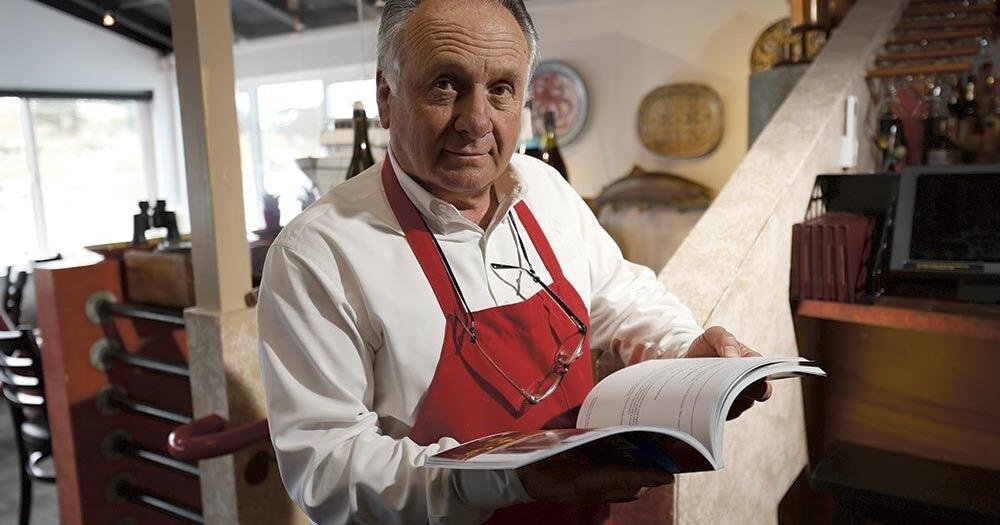
As Susan Culcasi tells the story, her husband’s family was treated to meatloaf every Tuesday. When Jim and Susan opened Rosine’s in Monterey in 1980, the dish made it onto the restaurant’s menu.
They named the restaurant after Jim Culcasi’s mother, known for her touch in the home kitchen. A few years ago, as they made preparations to compile a second cookbook – one which would include family recipes as well as restaurant favorites – they asked her to look over the recipe for the popular meatloaf served at Rosine’s.
The culinary matriarch studied the line items, scowled, reached for a pen and began making changes with a terse, “I don’t put mushrooms in my meatloaf.”
Family recipes vary, and cookbooks have generally served as guidelines adaptable to personal tastes.
But as Jim Culcasi says, the cookbook bearing the restaurant’s name is a way regulars “can bring a piece of Rosine’s home with them.”
In other words, by following a recipe step by step, a home cook should be able to bring to their own dining room table a restaurant dish.
Two storied Monterey establishments published cookbooks in the fall of 2023. Jim and Susan Culcasi put together Rosine’s Cuisine: A Treasure Trove of Select Recipes from Monterey’s Legendary Family Restaurant. Meanwhile Dominic Mercurio filed Cafe Fina’s Cookbook: You Don’t Have to be a Chef to Cook Great Food, with the help of local writer Sally Baho.
Both cookbooks appeal to family, to the mystic chords of memory that resonate from the home kitchen and family gatherings. They are illustrated in part by treasured snapshots and, in the case of Rosine’s, a family tree.
“Between my uncle, John Pisto [who owned The Whaling Station and Domenico’s] and my mother, I learned a lot about cooking – my grandmother was a good cook, too,” Mercurio says. “I do not like to call myself a chef, because I had no formal training. That’s why the book is titled… ” He points to the subhead – “You Don’t Have to be a Chef to Cook Great Food” – with a grin.
IT’S MERCURIO’S FIRST COOKBOOK. There are nostalgic images and stories, along with recipes familiar to Cafe Fina regulars. Yet he includes dishes from family and friends, such as a couple of contributions from famed Oakland Raiders head coach and later television broadcaster John Madden’s wife, Virginia Fields (“Her bread pudding is unbelievable,” Mercurio says).
The restaurant still keeps Madden’s table reserved.
“When I handed [the cookbook] to mom, there were tears in her eyes,” he observes. “I didn’t do this to turn a profit. I wanted something my kids would remember about their grandparents – and me.”
People write cookbooks for different reasons. In the 1800s, chefs like Auguste Escoffier compiled recipes to share with other professional chefs in order to improve and advance the industry. Celebrity chefs – whether known for their television exploits such as Rachael Ray or acclaimed for their cooking like Thomas Keller – can expect to make some money on their titles.
But cookbook author Kristen Donnelly points out that only 20 to 30 percent of books make a profit above the advance from a publishing house. And piecing one together is a costly endeavor. There are ingredients to pay for, photographs to take, experts in layout and design to consult and more. And all of that comes only if a publisher is willing to gamble on adding another cookbook to a crowded market.
“I couldn’t find anyone to publish it,” Mercurio says. “I didn’t try, honestly.”
Both opted to self publish. And both have already sold over 600 copies – enough for the Culcasis to recoup their expenses. Mercurio opted for a more expensive product, one with color photos throughout.
Their object, however, is not profit but a connection with customers. And the books serve as a form of publicity, reminding people of the restaurants each time they scan their bookshelves.
This is the second cookbook from the Culcasis. The original Rosine’s collection came out in the late 1980s and it was due for a complete revision.
Besides, customers had been asking about the cookbook.
“We’ve been out of stock since – I don’t have a date to give you,” Susan Culcasi says, estimating that the previous edition sold out more than a decade ago.
So the lineup of recipes includes a take on French onion soup favored by one of their early patrons.
“Every recipe has a personal meaning behind it,” she adds.
It’s that connection to family, friends and restaurant guests that give these cookbooks meaning for their authors. Karen Anne Murray, who owned Eddison & Melrose, wrote Tea Table: Inspiring Teatime Creations from California’s Central Coast, which came out not long before she retired from the tea room.
“People would come by and get signed copies,” she recalls. Murray continues to host recipe talks and book parties around the country. “I’m having fun with the book. It was definitely worth it.”
CREATING THESE COOKBOOKS WAS ESSENTIALLY A LABOR OF LOVE – and it requires quite a bit of work. There are photo shoots to arrange, copy must be proofread, decisions on layout and cover art need to be made (The Wecker Group in Monterey helped the Culcasis with this process). And the authors must commit to a lot of time in the kitchen.
“Every recipe was tested,” Susan Culcasi says. Her observation is echoed by Jim: “Tested and tested and tested.”
The Rosine’s owners had been through the process once before. Even so, it took them a year to sort recipes and agree on design. Putting the book together took Mercurio a year-and-a-half. And though this is his first cookbook, having helped test 86 recipes for John Madden’s Ultimate Tailgating guide, which hit shelves in 1998, Mercurio understood the commitment.
“I knew what I was getting into, recipe-wise,” he says.
It’s not a straightforward step translating a recipe perfected for the restaurant kitchen for a home cook. The team at Cafe Fina, for instance, prepares marinara in 10-gallon batches. Herbs and spices release their flavors differently at that scale compared to simmering a few cups of sauce.
Restaurants approach entrees differently, as well. The recipes are broken down into stations and adjusted for timing to the table.
Chefs also have access to a roster of purveyors. When Charlie Trotter, the famed chef of Charlie Trotter’s in Chicago, released his eponymous cookbook in 1994, the recipes dictated which farm or ranch one was to gather ingredients from (cookbooks from celebrity chefs were not always consumer-friendly).
Fortunately, all the testing was with the home cook in mind. Jim Culcasi would never stoop to a box of grocery store cake mix at Rosine’s. The cookbook, however, allows one to take shortcuts – and they’ve already sorted out the compromise. For example, the chocolate-peanut butter cake recipe calls for two boxes of cake mix, then tells you how to improve upon it.
But in the many distinctions between a professional and home kitchen lie most of the time and effort involved.
“I always said I wanted to write a book,” Murray says. “The problem is I’m not a recipe chef. It’s all in my head.”
It’s that same impulse that tends to throw me off, even with the book open on the counter in front of me. I first started to cook from scratch in the 1970s. It didn’t take me too long to ignore recipes altogether and just wing everything – often to decent outcomes.
I set out to prepare a dish from both the Cafe Fina and Rosine’s books to see if an undisciplined cook could pull it off. But there is a lesson for those of us who play loosely in the kitchen: When you intend to follow a recipe, take care to read it ahead of time and comprehend what is involved.
For the entree picked from Cafe Fina, I had glanced at the recipes involved – meatballs, marinara sauce, finished dish – enough to fill out a grocery list. On this particular Monday, I made it home at 4:30pm to get started, with the Weekly’s photographer, Daniel Dreifuss, scheduled to arrive at 5pm and victims – make that guests – staff writer Agata Pop˛eda and associate editor Erik Chalhoub – at 6pm.
Only after arranging the ingredients I would need for the first step did I notice the line recommending that the marinara simmer for an hour.
It’s something that I really should have prepared a day in advance. And it’s probably what families did before people became accustomed to a routine of instant gratification. This is a recipe that asks for patience and draws the family into the kitchen.
ROSINE’S CHOCOLATE PEANUT BUTTER LAYER CAKE IS THE RECIPE THAT CAUSED ME THE MOST TREPIDATION. I had to borrow springform cake pans. There were unmastered techniques to worry about, such as keeping an even keel while slicing cakes horizontally into four rounds. A lot could go wrong. While the box said to bake for 23-28 minutes, the middle of each was still wet after 30. And after 35.
Fortunately, they didn’t burn. And after allowing them to cool, I acted on a tip and stuck toothpicks around the edge of each, halfway up the side. I deemed one of the cake tops flat enough that there was no need to even it out.
Yes, the stack leaned a bit. But it held together.
Frosting the cake is apparently also a technique that needs to be mastered. It’s not a pretty sight. If Jim Culcasi spread a bumpy, rutted layer of chocolate cream on a cake at Rosine’s, he would instantly scrape it off and start over. I’ll just live with the motto, “Mistakes were made.”
After frosting the top I glanced again at the recipe, satisfied that I had done everything. Then I noticed the “frost the sides” directive. No mention of the top. Oh, well. I did think to prepare the layer cake a day in advance.
Fortunately, none of my shenanigans disturbed the flavor of the cake.
From the Cafe Fina list I prepared Pasta Gianna, a dish named after Mercurio’s granddaughter. This is a rich, hearty and satisfying dish – meaty, with the rasp of garlic ever present, tingles of basil, an earthy undertone, pops of grassy sweetness from the peas, a creamy calm of mozzarella throughout – a lot going on. In the book, Mercurio notes, “It’s all my favorite things in a pasta.”
No, the cake did not meet Rosine’s appearance standards. But the layers of chocolate, peanut butter and cream were divine. As Pop˛eda – herself an accomplished home baker, who can also make cakes look good – later informed the staff, “It’s a goooood cake!”
“We keep hearing that it’s exactly the same [as the restaurant],” Susan Culcasi observes.
Yes, the flavors might be the same. But to visit Cafe Fina or Rosine’s adds more layers to the experience. There’s something compelling about service, about the atmosphere of a restaurant – not to mention the inescapable allure of that dessert case at the entrance of Rosine’s.
There is another tradition, said to be shared by cooks and chefs alike. Many tales of a grandmother passing on a treasured recipe end in chagrin, when the recipient realizes the wise cook omitted a key ingredient or deliberately misstated the amount of spice to add. And even when they passed down an accurate account, the recipes often included gray areas. Just how much is “a pinch” or “a generous amount”?
Murray compiled her recipes during the pandemic and they were all new – 22 fresh ideas, tested on her husband and son. There is nothing in the book from her tea shop.
“I don’t want to give anything away,” she admits.
Mercurio struggled with the idea of sharing, particularly when it came to family favorites. “The minestrone soup, the marinara sauce – those were hard to give away,” he says. Then he offers a shrug of resignation. “But these days you can look up anything you want.”
The advantage of cookbooks, particularly the new one from Rosine’s and Cafe Fina, is that they also tell stories, and bring traditions to mind. And if you can’t make it look the same, the flavors take you to the places they wish to share.
“The support from customers and family is amazing,” Mercurio says. “But I don’t know that I could do it again.”
