

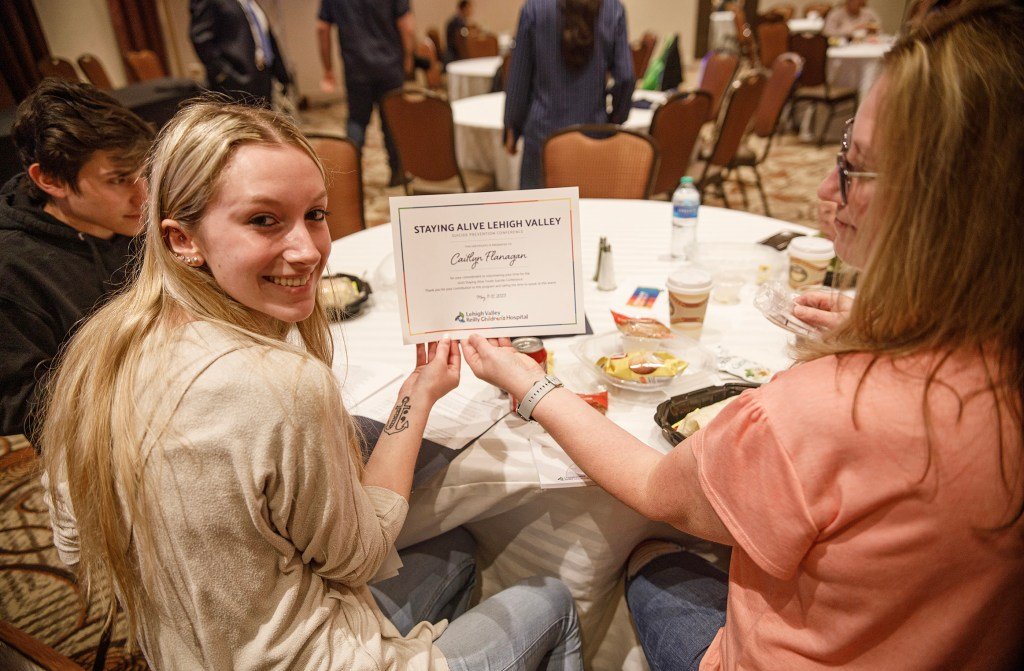
Caitlin Flanagan shows off her certificate for the Staying Alive program hosted by LVHN’s Riley Hospital for Children in Bethlehem on Friday, May 12, 2023. The program featured a panel of teens providing educational conferences focused on informing adults in our community about youth suicide prevention and pediatric mental health, as well as the struggles of growing up in today’s world. (Jane Therese/Special to The Morning Call)
Since the COVID-19 pandemic, there has been a significant increase in awareness of mental health issues affecting children, resulting in a decrease in the stigma surrounding these issues and increased attention and resources towards diagnosis and mitigation.
It may seem inevitable, then, that there will be a backlash against this new focus.
Recently, researchers in the UK noted that areas where awareness programs are implemented appear to have increased rates of reporting of mental health-related problems, which may be higher than simply identifying previously undiagnosed disorders. The researchers propose a provocative hypothesis called “prevalence inflation”: awareness programs, especially those aimed at young people, may lead people to misinterpret mild symptoms as more severe than they actually are.
This hypothesis was brought to light last month in The New York Times by an article headlined “Are We Talking Too Much About Mental Health?”, which suggested that school-based mental health awareness campaigns may actually be making things worse for kids.
As an organization whose mission is to help address mental and behavioral health challenges among young people, we are concerned by these conclusions.
The “prevalence inflation” hypothesis has unfortunate parallels to a time when the stigma surrounding mental illness meant that many families were ashamed to seek help for their children. As I mentioned earlier, we have made great strides in breaking down that stigma. Parents and families now understand that not only are mental health concerns legitimate, but that they can find help to address their loved one’s suffering.
But when school personnel, families, and students are led to believe that symptoms may not be real, the result can be a reversal of hiding or denying the problems their children are having until they become too bad to hide or deny.
Here’s an analogy: When a child displays physical symptoms suggestive of diabetes, a pediatrician’s response is to order tests and, if the diagnosis is confirmed, present the family with options. But imagine what would happen if that doctor spent valuable time trying to determine whether exposure to information about diabetes was contributing to that child’s suffering, instead of providing the care and support needed.
This is not to say that we should not evaluate the outcomes of intervention programs and efforts; we should be prepared to rethink our approach if outcomes are lacking. For example, building a new infrastructure of school-based assessment and intervention programs is likely to be less effective than supporting and expanding resources that are proven to address both the identification of individual mental health issues and, where needed, appropriate interventions.
However, introducing the concept of “prevalence inflation” into policy discussions could be seen as calling into question the entire premise of mental health interventions, thereby reversing progress against stigma and increasing barriers for young people to receive the help they need. While we appreciate that researchers emphasize the need to reevaluate interventions they deem problematic rather than eliminating them, let’s be realistic: For young people who find value in an intervention, pausing a program will have the same impact as eliminating the intervention.
And there are lots of them. KidsPeace’s flagship publication, Healing Magazine (www.healingmagazine.org), has just published its Spring/Summer 2024 issue, which features a special section on young people’s own views on mental health challenges. There was a clear consensus among contributors that there needs to be more, not less, discussion about mental health issues among young people and young adults, and that the priority should be removing barriers to the help children need.
They also note that student-led programs in schools, such as the work of organizations like Aevidum and Bring Change 2 Mind, could play an important role in ensuring future interventions effectively meet the needs of this population.
When reading young people’s submissions to Healing Magazine, one thing is clear: the genie has come out of the magic lamp. They have no intention of going back to the days when they were afraid or embarrassed to say they needed help. If we’re serious about helping them address their anxieties and secure more successful, happier futures, we must follow their lead and continue to normalize the discussion of mental health in America.
Michael W. Slack is President and CEO of KidsPeace.
