

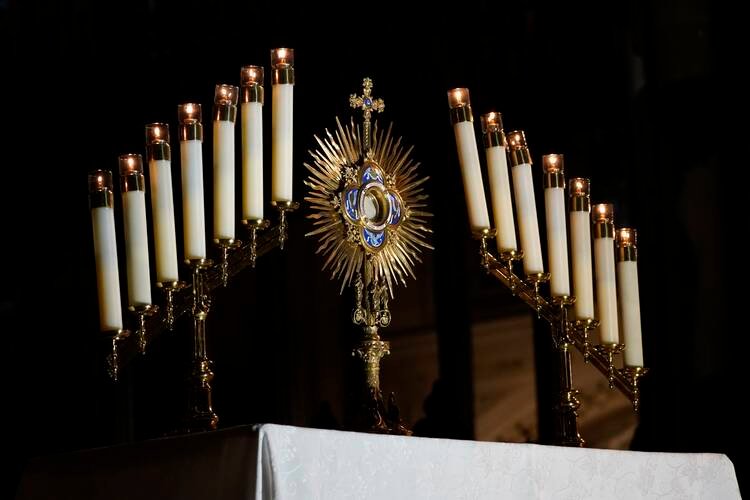
“Please come to my heart at least spiritually, because at this time I cannot receive you sacramentally.”
How many of you remember this prayer? During the coronavirus pandemic, it was recommended for those who were unable to attend Mass remotely from their homes and receive Holy Communion with their church congregation. It is called prayer for “spiritual communion.”
How should we understand this prayer? What does it mean?
It shows that the physical and sacramental reception of the consecrated host is primary, and that spiritual communion is secondary, a plan B that is activated in an emergency. It seems there is. In any case, the word “”at least ‘Spiritually’ identifies a lower class of participation and communion, a class that is permissible but not entirely ideal. When compared to “spiritual” communion, “sacramental” communion is to be preferred, as prayer implicitly suggests.
Is the specific, gradual order of sacramental and spiritual communion reflected in a broader traditional understanding of the Eucharist? Not so, according to St. Bonaventure, an inheritor of the ancient Augustinian tradition. Quite the opposite.
In fact, for Bonaventure, it is the heart that receives the Eucharist. The most appropriate way to partake of the Eucharist is not simply physically, with the mouth of the body, but rather “with the mouth of the heart.” Eating wholeheartedly means reflecting on and “chewing” the food you are given, and “taking in” or swallowing the food “with charity.” In other words, eating wholeheartedly requires faith and charity. Therefore, participating in the Eucharist requires intention, awareness, and prayerful preparation.
For Bonaventure, therefore, to eat spiritually is to approach the eating of the Eucharist with faith and, ultimately, with charity in the heart. Therefore, participation in the “Sacrament of Love” is above all spiritual. Otherwise, a person only physically eats with the mouth. But simply eating the body of Christ physically does not bear fruit. Bonaventure writes:
Our ability to fruitfully receive Christ is in the spirit, not the flesh, and in the heart, not the stomach. But the heart can reach Christ only through understanding and love, faith and charity; faith gives the light to recognize Christ; charity gives the zeal to love Christ. Therefore, if anyone wishes to approach this sacrament in a worthy manner, he must spiritually feed on Christ by chewing on it with the knowledge of faith and receiving it with loving devotion.
And now, several years into the pandemic, as we prepare for the Eucharistic Conference in the United States, the emphasis is on: realistic presence. You need to be careful here. Over-emphasis or myopic focus can be distracting and even misleading. As Bonaventure emphasizes, Christ invites us to a “spiritual banquet” where we eat “spiritual food.” The food you eat is not “butcher’s meat.” Rather, it is spiritual food that must be eaten spiritually and ultimately in the Spirit. In the words of St. Francis of Assisi, “It is the Spirit of the Lord that lives in the faithful and receives his body and blood. All others who do not share in this same Spirit and seek to receive him A person eats and drinks judgment against himself. [see 1 Cor 11:29]” Augustine also complements this view. “We eat and drink in order to partake of the Spirit…that we may be refreshed by the Spirit.” The purpose of the Eucharist is spiritual communion, mediated and communicated by the true body and blood of Christ. Thing.
Is this goal not reflected in the official opening remarks at Mass? The priest greets the congregation: “The grace of our Lord Jesus Christ, the love of God, and the communion of the Holy Spirit be with you all.” This early invocation of the Holy Trinity, based on 2 Corinthians 13:13, indicates in itself how to understand and approach the mystery of the Eucharist. The grace of Christ reconciles us to the Father. In this the love of God the Father, who “so loved the world” (John 3:16) is revealed. So ultimately we are invited and drawn into this love, the communion of the Holy Spirit. Therefore, at the beginning of the Mass, the fullness of the Eucharist, the “communion of the Holy Spirit”, to which we are called is revealed.
The finality of the Eucharist in terms of Holy Communion and the Holy Spirit is also present in Bonaventure. His use of the traditional three-fold sacramental structure in his theology of this sacrament makes this finality clear. This triple sacramental structure is the symbol itself (sacrament tantum)”, “Symbols and Reality (sacramento and res)” and “fulfillment of reality (Restantum). ” How does Bonaventure understand this Eucharistic structure?
First, there is the “symbol itself.” This is an externally created element: bread and wine. In other words, bread and wine constitute the basic signs of the Eucharist. Second, the “sign and reality” is the true body and blood of Christ. Bonaventure thus understands the true body and blood of Christ as both a reality and a further sign. Third, “the fullness of reality”: this is the mystical communion of the body, of which the true body and blood of Christ are the signs. This Communion is therefore the ultimate reality of the Eucharist, signified and mediated by the true Body and Blood of Christ. Therefore, as Bonaventure teaches, the mystical union of the bodies is “the one ultimate meaning” of the Eucharist. What this means is that Christ’s true body and blood are, precisely, do not have The goal of the Eucharist. But it is the center of the Eucharist. And as the center (Moderate (in Latin), it is mediates.
The theology and function of epiclesis (prayer invoking the Holy Spirit during the Eucharistic liturgy) are relevant here. Pope Benedict XVI, in his post-synodal apostolic exhortation, The Sacrament of Caritatis, explains epiclesis as follows:
It is a plea to the Father to grant the gifts of the Spirit so that the bread and wine may become the body and blood of Jesus Christ and that “the whole community may become more and more the body of Christ.” The Spirit that the celebrant invokes in response to the gifts of bread and wine placed on the altar is the same Spirit that gathers the faithful “into one body” as a spiritual offering pleasing to the Father.
He goes on to say: “It is significant that the Second Eucharistic Prayer, invoking the Paraclete, formulates the prayer for the unity of the Church as follows.”May we all be gathered together by the Holy Spirit as we share in the body and blood of Christ.These words describe how we response The essence of the sacrament of the Eucharist is the unity of the faithful in the Holy Communion of the Church. ” of responsetantumThe fullness of Eucharistic reality is realized by the gift of the Holy Spirit, which draws us into the communion of the mystical body. In effect, a double epilepsy occurs. The first is the transformation of the gift of bread and wine. The second, prepared by the first, transforms those who share body and blood.
Emphasizing the presence of Christ therefore fails to clearly cultivate the fullness of the presence of Christ in its mediating significance beyond itself, and actually undermines it. we ask: So, what we should emphasize is existence as a being. genuine However, as a real being mediate• In this way, attention will be paid to Christ’s Eucharistic Presence insofar as it mediates that ultimate reality. response tantum Sacrament, Mystical Communion of the Body. Otherwise, Bonaventure, quoting from St. Augustine of Clairvaux and St. Bernard, said of the apostles before Christ’s ascension: “The apostles’ love for the body of Christ prevented the coming of the Holy Spirit.” Words have meaning here. They were so focused on the physical presence of Christ that they failed to realize the intimacy in the fellowship of the Holy Spirit that awaited them.
How does Bonaventure understand this final? response Of the sacrament? His distinction alluded to above between “sacramental” and “spiritual” meals is helpful here. According to Bonaventure, unlike ordinary physical eating, in which “the person eating transforms the food into himself,” spiritual eating involves a different dynamic. “For food is more valuable, more perfect and complete.” Therefore, it is we who are transformed and incorporated into food, rather than the other way around. ”
Eating spiritually brings us into the mystical body of Christ. How will this mystery unfold? Ultimately, for Bonaventure, the answer lies in philanthropy. In his own words: “This sacrament contains in this way the true and immaculate body of Christ. [ut] It pervades our very being, unites us with one another, and transforms us into it through the most fiery acts of charity. ” Therefore, we should not celebrate the Eucharist Simply because It contains the body of Christ. Rather, we celebrate the Eucharist because the true body of Christ is diffused, unified, and transformed through love.
The emphasis on charity connects Bonaventure’s Eucharistic theology with the theology of the Holy Spirit, which is “charity and comes through charity.” In fact, when Bonaventure receives the Eucharist, he advises us to “be drunk with the charity of the Holy Spirit.” This connection with the Holy Spirit is not surprising. St. John Paul II intuited something similar in his own encyclical on the Eucharist, “The Eucharistic Church.” As a “seal” in the sacrament of Confirmation. ”
Moreover, for Bonaventure, the mystical union of the body belongs in a special sense to the mission of the Holy Spirit, who was sent by Christ on the day of Pentecost and given to kindle in the disciples a heart of charity. Ta. Therefore, just as the incarnate mission of Christ culminates at Pentecost rather than the Ascension, so the Eucharist culminates in the gift of the Holy Spirit. The sacrament of the Eucharist is spiritually mediated and draws us into the communion of the Holy Spirit, the union of love that constitutes the life of the Church.
To end this reflection, instead of praying to receive the Eucharist.”at least Spiritually, “Rather, let us ask God for help.”More than anything Mentally. ” May this year’s Eucharistic Conference promote and foster a new faith not only in the true Body and Blood of Christ, but also in the Mystical Body, the gift that flows from it.“Gathered together by the Holy Spirit.” May it be a celebration of the full reality of the Sacrament of the Eucharist, the Sacrament of Charity.
