

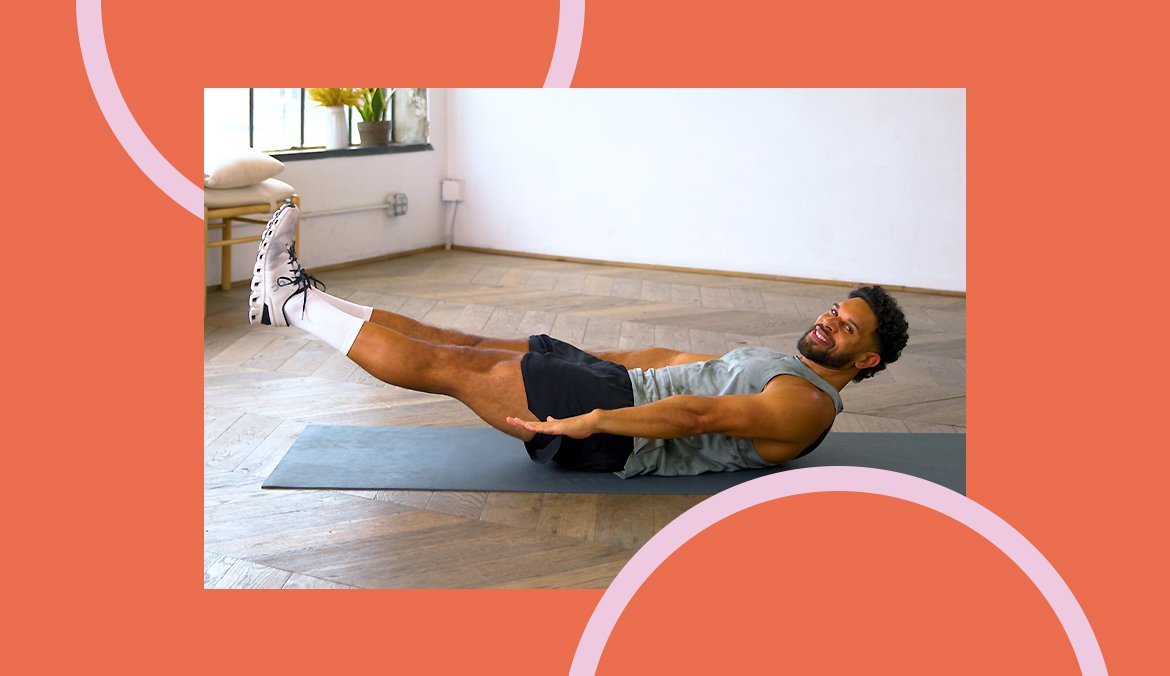
Traditionally used as a warm-up exercise, this move is “primarily a breathing exercise aimed at strengthening and developing breathing capacity, control, and endurance,” says Cassandra Cotta, a certified Pilates instructor and founder of The Pilates People in New York City.
But this total-body workout requires no equipment and also targets your core, legs, and arms, improves posture and spinal stability, and is a great cardio workout, too.
Here’s how to implement this two-minute core activation exercise into your next Pilates session.
How to do 100 Pilates exercises with perfect form every time
- Lie on your back with your knees bent and your feet flat on the floor.
- Extend your arms up towards the ceiling at shoulder height, palms facing down.
- With your feet together, use your core to lift your legs into a tabletop position: feet off the mat, knees over your ankles, and ankles in line with your knees, forming a 90-degree angle.
- Curl your head, neck, and chest into a “crunch” position, then reach your arms toward your legs, extending them at a 45-degree angle. If you feel any strain on your lower back, Cotta suggests lifting your legs a little higher, returning them to a tabletop position, or lowering them to the floor.
- Keeping your wrists and fingers straight, breathe in for a count of five and out for a count of five as you move your arms up and down quickly.
- Repeat the breathing pattern 10 times to reach 100.
- Bend your knees into a tabletop position with your head, neck and shoulders on the floor, or bring your knees to your chest for a restorative stretch.
What muscles does Pilates 100 work?
Pilates 100 usually starts off a session, but can also be done as a standalone core exercise.
Related article
This move targets several muscles in your torso, including your transverse abdominis, rectus abdominis, internal obliques, and external obliques, says Cotta. The arm movement engages your triceps, while the extended leg position activates your inner thighs, quads, hip flexors, and glutes.
“The combination of all these movements makes this one of the very few cardiovascular exercises in the traditional Pilates canon,” Cotta says.
The biggest benefits of Pilates 100
There’s a reason this core-strengthening exercise is a staple in Pilates classes of all kinds.
1. Build core strength
“A weak core can put pressure on the spine, leading to poor posture and back pain,” says Kari Arnold, M.D., certified Pilates instructor and owner of Sati Yoga & Wellness in Atlanta.
Pilates 100 strengthens your core by targeting and strengthening your deep abdominal muscles, reducing stress on your joints, ligaments and tendons during everyday movements, helping to prevent injury.
2. Improve spinal alignment and posture
Did your posture slouch while reading this? Yes, there’s hope for the chronically hunched. The 100 reverses the effects of the dreaded “tech neck,” caused by your shoulders and upper body rounding forward while on screen.
This move “builds strength in your abdominal and back muscles, creating a strong internal corset that protects your spine and improves alignment,” says Dr. Arnold. The result? Better posture, even after you get off the mat.
3. Improve breathing control.
Because of stress, anxiety, or just work, most of us aren’t conscious of our breathing during the day. The specific breathing patterns in Pilates 100 “deliver oxygen to the tissues, improve respiratory control, calm the nervous system, and reduce stress,” says Dr. Arnold.
Controlling your breathing also improves performance and control in other physical activities such as running and weightlifting.
“At Pilates 100, no pain is good and actually means more results.” —Cassandra Cotta, Certified Pilates Instructor
Variations that make Pilates 100 more accessible or challenging
The most traditional version of this move involves lifting your head off the mat and extending your legs to a 45-degree angle, but here are some variations that will work your core in the same way.
1. Head-down Pilates 100
If the classical position strains your neck, lower it onto your mat, placing a towel or blanket behind your head for extra comfort and support.

- Lie on your back with your knees bent and your feet flat and pressed flat on the mat. Keep your head down or place a towel or blanket under your neck for support.
- Extend your arms up towards the ceiling at shoulder height, palms facing down.
- With your feet together, use your core to lift both legs into a tabletop position, or a 90-degree angle.
- Extend your arms straight and reach them toward your feet, extending your legs at a 45-degree angle.
- Breathe in for a count of 5 and out for a count of 5 as you vigorously pump your arms up and down.
- Repeat 10 times until you reach 100.
- Bend your knees and rest on the table.
2. Pilates 100 with feet on the floor
Dr. Arnold recommends this variation for people with lower back pain or tight hip flexors.

- Lie on your back with your knees bent and your feet pressed firmly into the ground.
- Extend your arms up towards the ceiling at shoulder height, palms facing down.
- Lift your head, neck and chest off the floor as you reach your straight arms to the other side of the room.
- Keeping your arms and wrists straight, breathe in for a count of five and out for a count of five as you move your arms up and down.
- Repeat 10 times until you reach 100.
- Rest your head on the mat.
3. 100 Pilates Exercises with Props
Want to up the intensity? Place a small Pilates ball or ring between your ankles. “This will engage your inner thigh adductors and deep pelvic floor muscles,” says Dr. Arnold. You can also add resistance to your upper body by holding small weights or a Pilates fitness ball in each hand.

- Lie on your back with your knees bent and your feet pressed firmly into the ground.
- Hold weights in your hands, palms facing down, and extend your arms up toward the ceiling at shoulder height.
- Engage your core to lift your head, neck, and chest off the floor and reach your straight arms across the room.
- Extend your legs up to the ceiling and lower them to 45 degrees, tightening the posts evenly on both sides.
- Keep your arms and wrists straight and breathe in for a count of 5 and out for a count of 5 as you move your arms up and down, moving a prop with each beat to engage your legs and core.
- Repeat 10 times until you reach 100.
- Lower your head and legs down onto the mat with control.
4. Leg Down Pilates 100
The lower your legs are, the more of a burn you’ll feel in your core, says Cotta, but be careful not to go so low that your lower back hurts or arches off the mat.

- Lie on your back with your knees bent and your feet flat on the floor.
- Extend your arms up towards the ceiling at shoulder height, palms facing down.
- Engage your core to lift your head, neck, and chest off the floor and reach your straight arms across the room.
- Extend your legs toward the ceiling and lower them as far as you can without arching your back.
- Keeping your arms and wrists straight, breathe in for a count of five and out for a count of five as you move your arms up and down.
- Repeat 10 times until you reach 100.
- Rest your head and feet back in their original position.
Common mistakes to avoid
With swinging arms, lifting heads and breathing cues, Pilates 100 is an intense and complex movement even for those with extensive Pilates experience.
Some people may feel strain in their neck while doing this exercise because their abdominal muscles are misaligned or not working properly, says Arnold. If that’s you, she suggests moving your shoulder blades off the mat and tucking your chin slightly in toward your chest to relieve pressure on your neck while engaging your core. If you still feel strain in your neck, try keeping your head down or using a towel or other support.
The precise breathing technique for this movement can stump beginners, especially when moving the arms and lifting the legs and head.
“Some people who are new to this exercise take a short breath in, hold it, and then quickly exhale,” says Arnold. “Remember to breathe in for five counts and out for five counts. This breathing pattern is important for oxygenating the tissues and engaging the transverse abdominis.”
It won’t hurt, but flailing your arms by bending your elbows and wrists will take some of the intensity out of the exercise, so to get the most out of it, remember to keep your arms straight from your shoulder blades to your fingertips, Cotta says.
Safety tips to remember
As with any exercise, if you experience pain or tension while performing Pilates 100, it is important to reduce the intensity or modify the movement.
“If your back hurts, it could be that your extended legs are too low, causing your lumbar spine to come off the floor,” says Cotta. Her simple fix is to move your legs to a more supportive position, like on a table or even on the floor.
You can also prevent neck strain by tucking your chin toward your chest, rather than pointing your head toward the ceiling or resting it on a mat or support.
But the most comfortable position varies from person to person, so it’s best to choose what works best for you, Cotta says.
“When it comes to Pilates 100, no pain is a good thing and actually means more results,” she says.
