

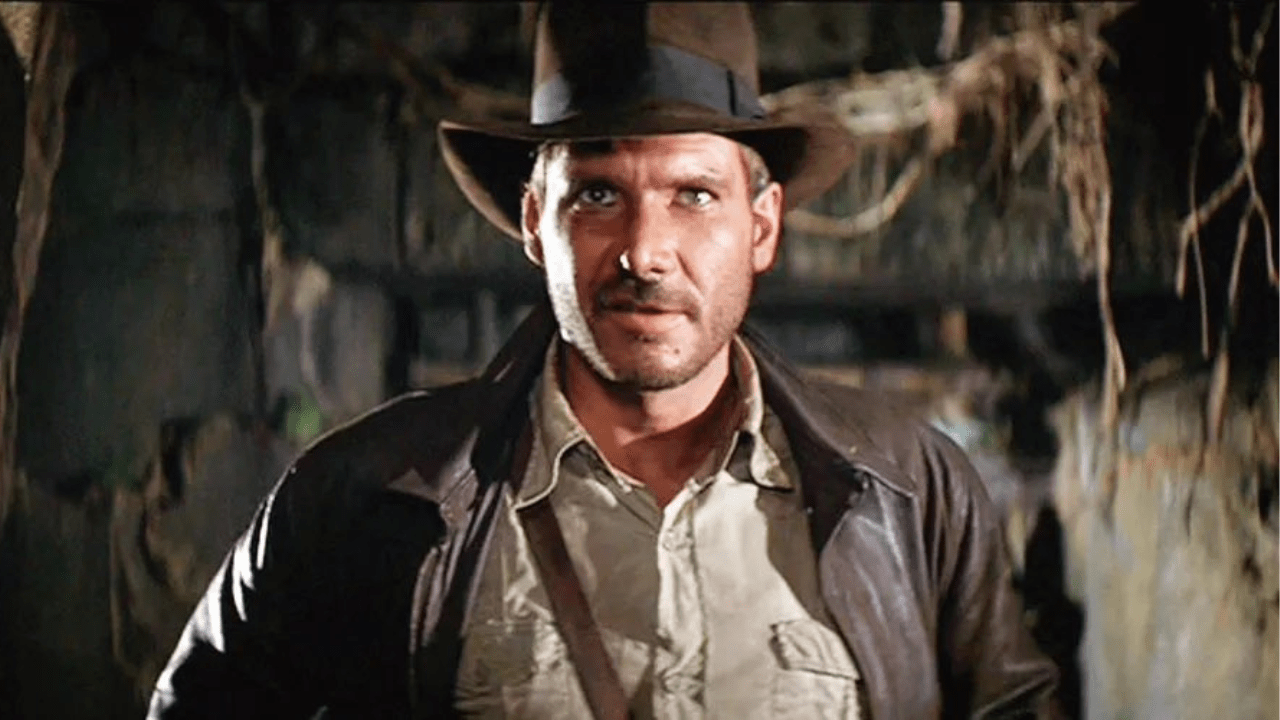
Let’s look at the characters. Indiana is essentially a scientist and a materialist. He is guided by the altruistic ideas of the Enlightenment and believes that the past should be put in a museum. He sees himself as the man at the end of history who puts all the pieces together.

Harrison Ford as Indiana Jones in Raiders of the Lost Ark (1981, Lucasfilm)
The first film builds on this premise and then spends its entire run time refuting Indiana’s view. History isn’t a dead thing that can be stored in a museum. History is alive and it affects you. You are not above history, but rather a participant in it. History is not an equation to be solved.
The story culminates with the revelation that the Ark of the Covenant is indeed a spiritual force, not just a dusty relic to show off to tourists, and at this climax of the story we learn that the Ark has a power of its own. But how do Indiana and the story interpret this?

A scene from Raiders of the Lost Ark (1981), Lucasfilm
Read: Indiana Jones and the Dial of Destiny director James Mangold admits he originally planned a different ending and previously denied filming multiple endings
Their response is to sweep this spiritual force under the rug with a shrug and an implicit hubris of, “Well, one day science will figure out what that crazy ark was all about.”
Indiana doesn’t gain a spiritual dimension; he simply moves on to his next adventure.

A scene from Raiders of the Lost Ark (1981), Lucasfilm
And this is something you see in every movie. Legend of the Temple of DoomWhat did Indiana gain from having paganism confirmed as a real dark force with real powers? Apparently he forgot about it, because in Raiders of the Lost Ark, he was back to his cynical ways again.
The Holy Grail is the most interesting of the three because of its similarity to a Christian heroic archetype (at least as far as modernists can follow), but this too is very strangely subverted by atheistic tendencies.

A scene from Indiana Jones and the Temple of Doom (1984), Lucasfilm
Read: Exclusive: New Indiana Jones attraction coming to Disney’s Animal Kingdom
The quest for the Holy Grail is supposed to be about finding spiritual enlightenment. But the movie ends with the Grail being thrown away. The metaphor is confused. Should we forgo ultimate spiritualism for earthly relationships? Both are good, so the movie just works a little awkwardly.
But time and again, the film doesn’t know what to do with spiritual reality. Every time it does feature it (often in a surprising way), it’s relegated to the sidelines as the series tries to return to the secular. All the series manages to do is gloss over it in the final act.

A scene from Indiana Jones and the Last Crusade (1989, Lucasfilm)
I love Indiana Jones, I really do, but I wonder about the version of the story where Indy learns something.
Where is the story of someone succeeding in bringing back the Holy Grail and shaking the whole world? What happens when the secular world finally falls apart?

A scene from Indiana Jones and the Last Crusade (1989, Lucasfilm)
Let me be clear: I don’t want Indiana to proselytize in an embarrassing way when a character says to the camera, “Christ is my Lord and Savior.” No. I understand that these things require subtlety, but there are ways to do this with just a few, unobtrusive hints.
Literally something as small as Indiana muttering a plea to God for help would make a difference, but as it stands, the scene is awfully close yet remains frustratingly vague.

A scene from Indiana Jones and the Last Crusade (1989, Lucasfilm)
Next article: Indiana Jones and the Lost Fate: Forbes uses tax documents to discover Indy lost over $100 million
**Editor’s note: The content of this article originally appeared on X and is reprinted with permission from the author.**
