

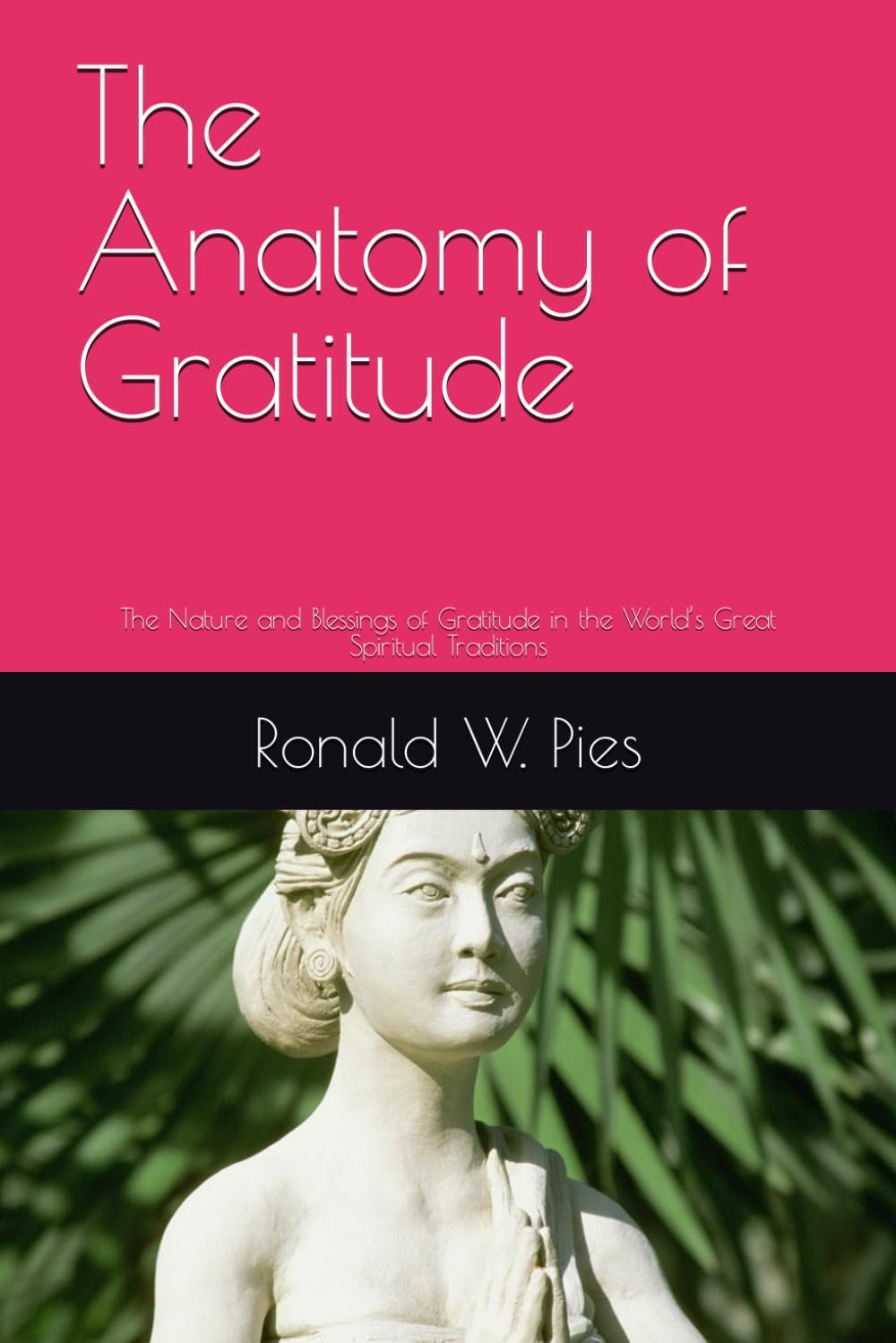
Anatomy of Gratitude: The Nature and Blessings of Gratitude in the World’s Great Spiritual Traditions by Ronald W. Pais
Book review
Anatomy of Gratitude: The Nature and Blessings of Gratitude in the World’s Great Spiritual Traditions
Written by Ronald W. Pais
Independently published in 2024. 151 pages
Reviewed by Daniel Morehead, MD
O thank you, where are you?
We live in very ungrateful times. This is to be expected in the current situation. An era characterized by a zeal for reform is unlikely to stop and appreciate all the heritage it has inherited. At times like these, individuals emphasize current problems and focus on righting past injustices. Naturally, they lack the complementary instinct to focus on how much they have or how much they are given. This is not to shame our current focus. We just want to note that when he has one focus, he inevitably lacks the other focus. By definition, it is impossible to focus on everything at once.
At the same time, there is another obvious reason for the relative lack of gratitude in our time. It’s just that we have too much. It is true that we have intolerable poverty, and we desire such a prosperous society. However, taken as a whole, our culture has a richness that cannot be compared by the standards of world history. And the glorious situation we currently live in, given the fact that we have almost no limits on food availability, mobility, access to knowledge, and the ability to satisfy most other human desires. It’s natural to lose sight of it. Paradoxically but axiomatically, people who have less, or who continue to have less, will certainly be more grateful for what they have. Those of us who have never lacked anything lack the awareness that we have everything we need and more at our fingertips.
Finally, it is inevitable that our material wealth is accompanied by spiritual emptiness. Although we are materially rich, we are clearly spiritually poor. This era is characterized by polarization, conflict, division, and a hopeless grasp on all sides. None of this speaks to a great spiritual development in our culture. Insofar as a healthy spirituality inspires us to grow in virtue and maturity, our ingratitude is at the mercy of the outward focus and chronic distractions demanded by our technology and our indulgences. may be some.
What kind of book is this?
With such thoughts in mind about our lack of gratitude and spirituality, Ronald W. Pais’ book has come at a strangely appropriate time. I say “weird” because it’s hard to categorize the genre or even the purpose of this book (more on this later). On the other hand, I wonder if there could have been a better time for a book that explicitly addresses “the nature and blessings of gratitude in the world’s great spiritual traditions.” Whether we consider ourselves religious or even spiritual, the spiritual traditions of humanity are a repository of collective wisdom, refined over countless generations. Everyone can admit that it is a way of dealing with the human condition that has been. Even though circumstances have changed over time and life today is indistinguishable from the pre-modern past, it remains true that human nature has not changed. The human condition is still the human condition. We are in danger of forgetting this.
Of course, gratitude is not completely forgotten in our day and age. As psychiatrists, most of us are somewhat familiar with positive psychology and its power to influence both human well-being and mental health. Cultivating gratitude plays an important role in this sub-discipline. Cultivating an attitude of gratitude benefits your general well-being and mental health.1,2
Perhaps surprisingly, Pais spends little time on positive psychology. He focuses entirely on the subject of gratitude in religious traditions. The book is structured according to his five religious traditions that are common to us: Judaism, Christianity, Islam, Hinduism, and Buddhism, with the final chapter on gratitude in Stoicism. Each chapter begins with a brief introduction to each religion/philosophy, followed by appreciative examples from primary sources drawn from both ancient and modern authors belonging to the tradition. Pais displays a truly impressive breadth of scholarship in these pages, and I can’t imagine any potential reader not finding a number of new authors, citations, and terms within these pages.
So, at first glance, Anatomy of Gratitude sounds like a very academic endeavor. After all, who can boast of gratitude and expertise in all of these complex and nuanced traditions? So, seeing that the text is only 130 pages long in large print font? I was shocked. It’s surprisingly short for a subject like this. Therefore, the purpose of a book like this is not like a comprehensive survey or deep analysis of the subject. It’s much simpler and at the same time much more important.
What kind of person am I?
Although Pais is a colleague and friend, I did not ask him about the main points of his book. Instead, I read it, meditated on it, and puzzled over it. This book sits on my bedside table, and it’s a thin book consisting primarily of enlightening quotes about gratitude, with an introduction, commentary, and conclusion. Not much else. But by the time I got to the last chapter on Stoicism, I think I started to understand it. This work is more similar to the work of Marcus Aurelius than a contribution to scholarship. meditation: A series of concise and thoughtful reflections on the nature and desirability of gratitude. When you understand Pais’ book, its purpose is very similar to the writings of Marcus Aurelius.
The purpose of such work is not to become an expert in the subject matter, or even more knowledgeable. You can say something very bold, but the point is to become a better person. The important thing is to allow ourselves to be enriched by these traditions and the much wisdom that is all around us and before us. What matters is that we feel our hearts warming and expanding through our own experience of gratitude and the spiritual cultivation of this virtue. Rather than lecturing or frowning, Pais acts as a kind of happy teacher who wants to guide us through all the great works of art in the gallery and find joy and enlightenment with us in the process. By doing so, we invite you to join us in this undertaking.
In that spirit, it seems trivial to criticize or evaluate various aspects of this book as good or bad. I think it would be more honorable to make an effort to share that virtue. To that end, I’ll simply end this review by listing some of my favorite “meditations” from the book, and leave it up to you to decide if that’s the right decision.
The first concerns recommendations found in several traditions. That is, we must always consider ourselves guests of this world.So, “What does a good guest say?” “How hard the host is for me. How much meat he serves. How much wine does he serve before me? How many cakes did he put in front of me? And he went through all this trouble for me. What would you say? “What difficulties did my host experience?” [only] One piece of bread and one piece of meat. I’ve only had one glass of wine. All the difficulties experienced by the host are only for his family. ”
The second is a reminder of what can happen when we live a life of acceptance and mindful gratitude. “Every day brings countless gifts: life, love, sustenance, shelter, challenges, friendship, and an opportunity to remember our debts.” When we look within ourselves. At a basic level, we strive to remember that there are forces in our lives beyond ourselves…and do our best to give back by being patient, helpful, and caring. Masu. ”
If only we could all go and do the same. Because, in the words of the Stoic philosopher Seneca, “mankind’s greatest blessings are within us and within our reach.”
Dr. Morehead He is a psychiatrist and training director for general psychiatry training at Tufts Medical Center in Boston. He is a frequent speaker as a mental health advocate and author of the following books: The science of overcoming stigma: Mental health education and advocacy., published by the American Psychiatric Association. Contact him at dmorehead@tuftsmedicalcenter.org.
References
1. Portocarrero FF, Gonzalez K, Ekema-Agbaw M. A meta-analytic review of the relationship between dispositional gratitude and happiness. personality and individual differences. 2020;187:111380.
2. Iodis JA, Malouf JM, Schutte NS. The association between gratitude and depression: A meta-analysis. International Journal of Depression and Anxiety. 2021;4(1):1-12.
