

A work by Pier Luigi Zoccatelli, who died last month, may provide a guide to the Venetian artist’s greatest masterpieces.
Massimo Introvigne

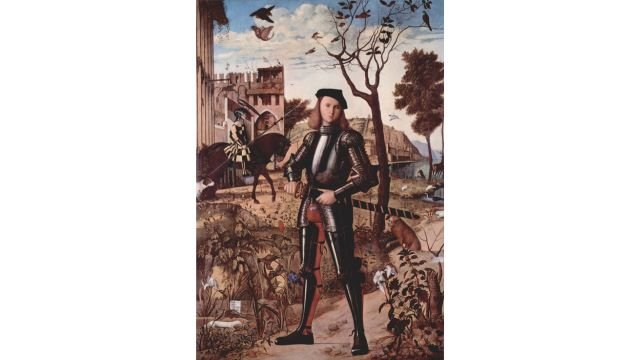
When a major exhibition of Vittore Carpaccio (1465-1525 or 1526) traveled from Washington, DC to Venice last year, it was missing one notable painting: “Portrait of a Knight” or “Young Knight in a Landscape” from the Thyssen-Bornemisza National Museum in Madrid. The Spanish museum had planned to mount a special exhibition in 2022 after restoring the painting. It was allowed to travel to Washington but not to Venice.
This was a pity, because from many points of view, including the painter’s relationship to religion and spirituality, “The Knight” is Carpaccio’s most important work. It is also a work that can only be understood by referring to medieval bestiaries and herbariums, which explain the symbolic meaning of each animal and plant. This was of great importance to the recently deceased Pierre Luigi Zocatelli (1965–2024), who studied and translated into Italian the works of the French symbolist Louis Charbonneau-Rasay (1871–1946). These studies are the key to understanding “The Knight” and many other works of art, and this article was dedicated to him a few days after Zocatelli’s death. In fact, I had the opportunity to discuss Carpaccio’s “The Knight” with Pierre Luigi some years ago, and my comments below owe a lot to these conversations.
First of all, the portrait reaffirms Carpaccio’s archaism: he is the last painter of the Middle Ages, rather than the first of the Renaissance, as the English Pre-Raphaelites understood him. In fact, he died poor and almost forgotten, because the new tastes of the Renaissance failed to grasp his greatness, which was only rediscovered centuries later. The work is a wonderful summary of medieval chivalry and the taste for symbols drawn, especially from the animal and plant kingdoms.
Critics have rightly accepted that this is not a portrait of two knights, or of a knight and his squire, but of one knight. The two paintings depict the same knight, but at two different stages of his journey. We see him riding out of a Venetian fortress, ready for battle, and in the foreground he is sheathing his sword. The close-up figure, considered the first portrait in the history of Western art, is painted with extraordinary quality, and some might even think it alludes to the fact that the knight is dead: he puts his sword back into its sheath and departs from this world. In this case, the motto of the Breton order of knights, the Ermine, “revived” in Carpaccio’s time by King Ferrante I of Naples (1424-1494), “malo mori quam foedari” (“I would rather die than dishonor myself”), is used to illustrate the point. [my honor]The word “Death” inscribed in a cartouche next to the ermine animal could indeed refer to the protagonist’s death in battle, but it could also simply be that his mission is accomplished and he returns his sword to its sheath.

The painting is a great allegory of the Christian “militia” and chivalry: the sea and the pool are only the first allusions to the countless trials and hardships that Christians must endure before reaching their goal.
A rich array of animal and plant symbolism is added: in the upper left corner, a wounded heron, symbol of suffering, is seen. This animal is dying, a further symbol of the knight’s death. The heron is attacked by a hawk, symbol of the pitfalls of evil. Another hawk, perched on a tree on the right, is a “bird of the air” invoked by Jesus Christ himself, threatening a sparrow, symbol of the soul.
Carpaccio’s message is that history is indeed rife with evil, corroding souls, even the very soul of the knight, who encounters a peacock, a symbol of pride, on his journey. The peacock, or pride, threatens to penetrate the innermost recesses of the mounted knight’s soul, and further to the left, a riderless horse, hanging as an inn sign, symbolizes unbridled and unrestrained passion. At the two trees on the right, a rabbit and a hare flee, representing the temptation to become cowardly and flee in the face of danger. The vulture and the deer at the water’s edge represent decadence and death. The frog and the toad hiding in the grass near the ermine at the bottom left represent temptation in its most base and vulgar form.
But little by little, in confronting vices and temptations, the knight also overcomes virtue. The ermine is a symbol of purity; the ancients believed that this animal would rather be captured and killed than hide and sully its pure fur. The deer, to the right of the second tree, represents meekness and tenacity in the face of adversity. The stork, flying between the two trees, represents the “pietà” of filial piety: unusually among animals at the time, it was believed that storks looked after their parents as well as their young. The duck represents serenity and tranquility. All this is not a more or less fanciful interpretation, but is derived from medieval bestiaries, with which Carpaccio was obviously well acquainted.
That the painter invites us into the dramatic vision of the story is confirmed by the contrast between the two dogs, the good white dog that accompanies the knight and the aggressive red one to his right. They are symbols of the good and bad angels, alluding to God and the devil who confront each other in the story. The evil “great dog” could possibly allude to the title “Great Khan” given to the Turkish Sultan in honor of the Mongols (“Khan” sounds like “staff” or “dog” in Italian). In this case, the battle the knight fights is specifically the war between Venice and Turkey. But for Carpaccio, this is only one episode in a drama that always operates in history and transcends individual events.

The plant symbolism, too, is uniquely rich and, typical of medieval taste, even more difficult to understand today. Not surprisingly, it was this very feature of Carpaccio that excited the Pre-Raphaelites, who tried to reproduce it in works such as Ophelia by John Everett Millais (1829-1896), a veritable botanical treatise.
However, in Carpaccio’s work, there is the problem that many plant symbols have ambiguous meanings. Take for example the very conspicuous flower at the knight’s feet, the red anemone, which since ancient mythology has been considered an omen of death. But at the same time, in Christian symbolism, like the purple worn by the cardinal, it signifies blood shed for the faith and readiness for martyrdom. The gladiolus signifies violent death, but also the suffering of the Virgin of Sorrows. On the right, not far from the evil dog, there is a daffodil, which in Greek mythology is the flower of Proserpina, the queen of the underworld, and therefore associated with hell. And next to the ermine is the lily, the symbol par excellence of chastity, which contrasts with the bramble, which symbolizes disorder. There are also chamomile flowers, which represent tranquility, and the blue periwinkle, which in the Middle Ages was considered the flower of loyalty and heaven.
Thus, in a single painting, Carpaccio has offered us a culmination of chivalry based on a dramatic vision of history. Life is a military affair, the life of a knight a journey, a journey full of obstacles and trials, but with virtue and heaven itself as a help. Finally, having defeated the enemy, perhaps the Turks, and perhaps at the expense of his own life, the knight lays down his sword. His battle is over, and perhaps with him the Middle Ages, a dying world that Zoccatelli studied with passion and ability and of which Carpaccio is its final narrator.
