

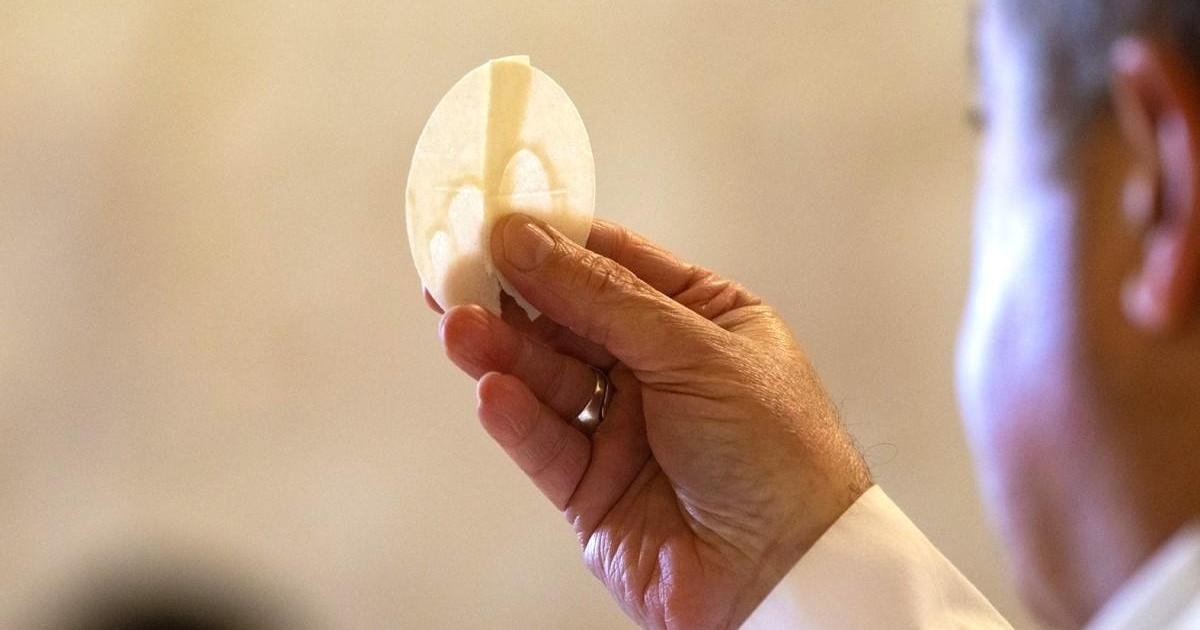
“The Eucharist entrusts us to the poor. To truly receive his Body and Blood offered for us, we must recognize Christ in the poorest of the poor, that is, in our brothers” (Catechism of the Catholic Church, 1397). This passage conveys an important message for us today about the celebration of the Eucharist: an encounter with the Risen Christ who gives us the strength to go out of ourselves and open our hearts to others in love.
The Eucharist helps us to see the face of Christ in everyone, everywhere and in everyone, especially in our poor and marginalized brothers and sisters. In the Last Supper, and especially in the ritual of foot-washing recorded in the Gospel of John, Jesus wanted to show his Apostles, and us, that living a true “Eucharistic life” means precisely living a life of service to others, especially those who are most in need: “You call me Teacher and Lord; and as I am, so am I. For if I, the Lord and Teacher, have washed your feet, you also ought to wash one another’s feet. I have set you an example, that you should do as I have done to you” (John 13:13-15).
St. John Chrysostom makes it clear: “Do you want to honor the body of Christ? Do not ignore him when he is naked. Honor him in silk garments in the temple, but do not ignore him when it is cold outside and he is undressed. He who said, ‘This is my body,’ is the same who said, ‘You saw me hungry, and gave me no food,’ and ‘Whatever you did to the least of my brethren, you did to me…’ It is of no use having a pile of gold cups on the communion table when your brother is dying of hunger. Satisfy his hunger first, and with what is left you can decorate the altar” (Homily on Matthew 50:3-4).
Caring for the vulnerable and oppressed calls us to heal wounds with concrete acts of love, but it also requires us to seek and address the root causes that generate exclusion, poverty, hunger and a lack of respect for the dignity and life of every human being.
We cannot be indifferent to suffering, we cannot allow someone to spend their life as an outcast.– Pope Francis, Fratelli Tutti
Promoting justice is a requirement of our eucharistic identity. Pope Francis writes: “We cannot be indifferent to suffering. We cannot allow someone to spend their life as an outcast. Instead, we should feel indignant, step out of our comfortable isolation, and be challenged to be transformed by contact with human suffering. That is the meaning of dignity.”Fratelli Tutti68)
Today we are called to renew our commitment to active participation in Sunday Mass and to living a Eucharistic life. The Eucharist is not a reward for the perfect; it is nourishment for those who are weak and who want to be strengthened by God’s grace. We do not come to the Eucharist with a selfish desire to receive a reward, but with a spirit of generosity and a willingness to offer ourselves in solidarity with the poor and the marginalized, and to be a visible sign of mercy, love and justice.
Archbishop Joseph Galea Kurmi is Auxiliary Bishop of the Archdiocese of Malta.
j.galea.curmi@maltadiocese.org
Independent journalism costs money. Support Times of Malta. The price of a cup of coffee.
Please support us
