

image:
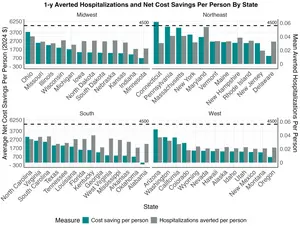
Estimated net impact per patient per year of implementing medically tailored meal programs in each state. Blue bars show average annual cost savings in 2021 dollars. Grey bars show number of hospitalizations averted.
View more
Credit: Shuyue Deng, Gerald J. and Dorothy R. Friedman, School of Nutrition Science and Policy, Tufts University
Chicago (July 1, 2024) — Programs that provide medically tailored meals (MTM) to people with diabetes, heart disease, or other dietary conditions that limit their ability to perform daily activities could result in significant savings in health care costs, according to a new study looking at U.S. states. Researchers used computer models to estimate the benefits of such programs minus the costs of implementation, and found that while there was wide variation across U.S. states, nearly all saw overall net cost savings.
“By conducting a comprehensive analysis that accounts for the diversity of state health care systems and patient demographics, this study highlights the potential economic benefits of MTM,” said lead author Shuyue Deng, a doctoral student at the Gerald J. and Dorothy R. Friedman School of Nutrition Science and Policy at Tufts University. “Preliminary results indicate that MTM could significantly reduce health care costs and hospitalizations in nearly all states.”
Deng will present his findings at NUTRITION 2024, the American Academy of Nutrition’s flagship annual meeting, taking place in Chicago from June 29 to July 2.
Diet influences the severity and course of many chronic diseases, including diabetes, heart disease, cancer, chronic kidney disease, and HIV, yet it can be difficult for patients to obtain and prepare the foods they need to best manage their disease. MTM programs deliver prepared meals directly to patients’ homes. Meals are selected and prepared according to customized meal plans designed by dietitians based on each person’s health and nutritional needs. Such programs have been proposed and pilot tested in various geographies, but are not currently widely implemented in the United States.
By helping patients eat the diet that’s best for them, MTM can help prevent the worsening of chronic diseases and reduce the need for costly hospital visits and treatments. Additionally, meal delivery can increase patients’ independence and quality of life, and is especially helpful for people who have difficulty with everyday tasks like shopping and cooking. Costs associated with MTM include the cost of preparing and delivering meals, the cost of hiring a dietitian, and the administrative costs of managing the program.
To estimate the overall economic impact of MTM in each state, the researchers analyzed data on nearly 7 million US adults with diet-sensitive chronic conditions and used computer simulations to model how implementing MTM for these patients would change annual health program costs, hospitalizations, and medical costs in each US state, compared with a baseline scenario of current care without MTM. The researchers estimated the impact based on previously reported MTM programs that provided approximately 10 meals per week, on average, for eight months per year.
After accounting for implementation costs, projections indicate that all states except Alabama would realize net cost savings with MTM. Connecticut ($6,219) was projected to see the largest net annual cost savings per patient treated, followed by Pennsylvania ($4,370), Massachusetts ($4,251), and Arizona ($3,889). Oregon ($651) and Alabama (-$214) were projected to see the lowest net annual cost savings per patient treated.
The differences in state projections are due in part to differences in baseline health care costs and the number of people eligible for MTM. The researchers also assessed the number of patients eligible in each state. For example, in a study of people with chronic conditions that limit their ability to perform daily activities and who have dietary restrictions, they estimated that California had the highest number of patients eligible for MTM treatment (more than 1.22 million people) and Alaska had the lowest (about 17,800 people).
“These variations across states can provide useful information for state-level policymakers and health plan administrators,” said Dariush Mozaffarian, M.D., a cardiologist, public health scientist, and director of the Food is Medicine Institute at the Friedman School. “Our new findings highlight the potential benefits of incorporating MTM into state-level health strategies, such as Medicaid 1115 waivers (in lieu of services), Medicare’s Shared Savings program, Accountable Care Organizations, and private insurance plans.”
To further refine their estimates and inform decision-making, the researchers plan to explore additional factors that may contribute to variation in program costs, such as differing food costs across states.
Deng The research will be presented at a Policy and Regulation Poster Session on Monday, July 1, from 12:45 to 1:45 p.m. CDT at McCormick Place.Abstract; Presentation details).
This release may contain updated figures or data that differ from the summary filed.
Please note that although the abstracts presented at NUTRITION 2024 were evaluated and selected by an expert committee, they have not undergone the peer review process typically required for publication in a scientific journal. Therefore, the presented research findings should be considered provisional until a peer-reviewed publication has been published.
About NUTRITION 2024
NUTRITION 2024 is the flagship meeting of the American Academy of Nutrition and the premier educational event for nutrition professionals worldwide. NUTRITION brings together laboratory scientists, clinicians, population health researchers, and community intervention investigators to identify solutions to today’s greatest nutrition challenges. Our audience also includes undergraduate, graduate, and medical students who are emerging leaders in the field. NUTRITION 2024 will be held June 29-July 2, 2024 in Chicago. https://nutrition.org/N24 #Nutrition2024
About the American Society for Nutrition (ASN)
ASN is the preeminent professional organization for nutrition researchers and clinicians worldwide. Founded in 1928, the Society brings together top nutrition researchers, health care professionals, policy makers, and industry leaders to advance nutrition knowledge and applications. ASN publishes four peer-reviewed journals and provides education and professional development opportunities to advance nutrition research, practice, and education. Since 2018, the American Society for Nutrition has produced NUTRITION, the world’s leading annual conference for nutrition professionals. http://www.nutrition.org
For more breaking news from NUTRITION 2024, visit https://www.eurekalert.org/newsroom/nutrition2024/home
###
Disclaimer: Neither AAAS nor EurekAlert! are responsible for the accuracy of news releases posted to EurekAlert! by contributing institutions or for any use of information provided through the EurekAlert system.
