

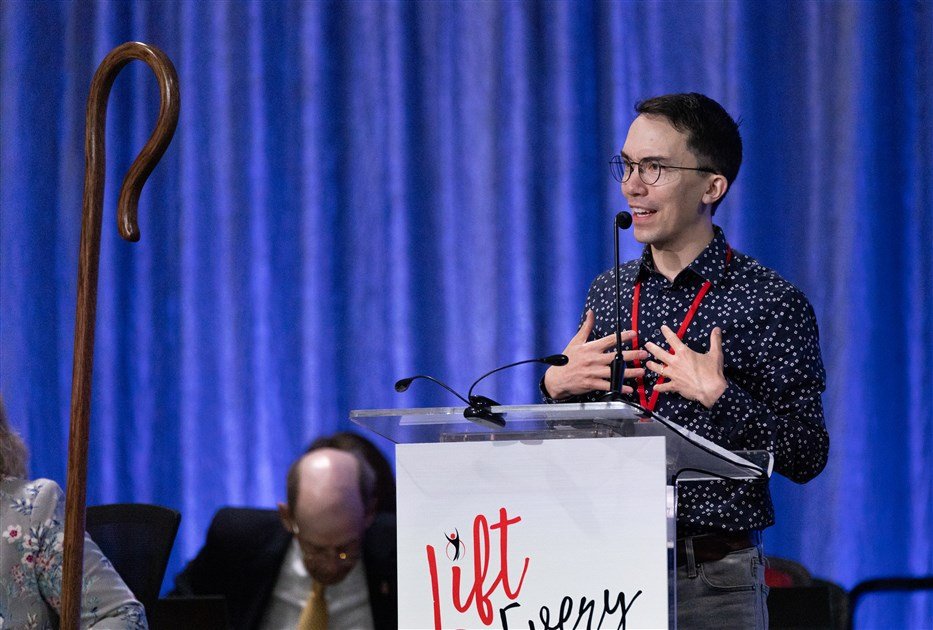
Rev. Tyler Sitto, church founder and pastor of New City Church (NCC) and its affiliate Minneapolis Northeast UMC, outlined the “Illuminating Spiritual Innovation” study by Harvard University’s Sacred Design Lab, which included 100 interviews from 37 countries and many faiths and sought to understand what spiritual innovation looks like today.
Rev. Sitto gave examples of what each of the study’s four themes looks like from the perspective of The United Methodist Church.
Mind Technology
The study looked at examples such as a website where people can book a blessing at any of 3,600 temples across India.
United Methodist Church Perspective: At NCC, preaching team member Jean Carlos has an active following on TikTok. He can reach 10 times more people on TikTok than he can in his actual church. Carlos gets messages from people in Alabama who don’t have a safe, trustworthy church nearby, but can engage with their faith through Carlos’ TikTok. Circle is an app that serves as a “community plaza” for NCC members. It’s a different use of technology than one person broadcasting a message on TikTok, and it provides deeper community care.
Sitt asks us to consider how we can leverage our Methodist traditions on social media. It’s not enough to say, “My church needs to use social media to reach young people.” We should ask, “What are the micro-changes we are inspiring?” and “What are we inviting people to do?”
Resistance Restoration
This theme is essentially about decolonising faith – for example in New Zealand, where indigenous communities are bringing historically banned religious practices into the mainstream.
United Methodist perspective: Billions of dollars worth of church property will change hands in the United States over the next decade. As we ask how we can maintain the spiritual witness of Christianity while reducing and transforming the number of physical church buildings, we have a unique opportunity to center decolonization and land restitution movements. Sitt recommends the book “Gone for Good: Negotiating the coming wave of church property transition” by Mark Elsdon.
Embodied Experience
The study discussed the “Extreme Ways of the Cross”, in which tens of thousands of Roman Catholics in Poland walk 40km at night, each carrying a cross to holy sites along the way. Sit noted that while the influence of technology is expanding into our lives, there is an ever-increasing desire for physical and spiritual experiences.
United Methodist perspective: Sitto described the Incarnation Fund, which helps BIPOC members of NCC have access to therapy, spiritual direction and nature-based retreats from BIPOC therapists and specialists. Only 2.7% of mental health clinicians in Minnesota are Black, and BIPOC people who seek care from others who share their traumatic experiences of racism typically have to pay out-of-network fees. This fund fills that gap. It’s not charity, it’s a mental health compensation fund, and it’s a step toward making things right in our community, Sitto said.
Secular Spirituality
Our culture is exploring mindfulness-like practices, but for better or worse, they are being taken out of their original spiritual context. For example, the Skylight app offers daily meditations that are not religious, are funded by the Mormon Church, and are supposed to pave the way to God for the next generation.
United Methodist perspective: Sitto suggests praying about what you would not compromise on to become a United Methodist minister, and what you would be willing to compromise on. Can you fund an experimental ministry? Can you renegotiate what you consider secular?
“Tyler reminded us that digital evangelism and embodied experience are not an either/or thing. To be the church, we need both online community building and digital evangelism, but we also need to recognize that people are craving physical, embodied experiences that bring them closer to God and one another,” said Walker Brault, one of the Minnesota delegates.
Finally, Sitto called on all those who lead churches and communities to “pray to define the moment we are in.”
Additional resources:
*Minnesota Department of Health Health Care Worker Survey, October-December 2021
Carla Hovde is the communications specialist for the Minnesota Annual Conference of the United Methodist Church.
