

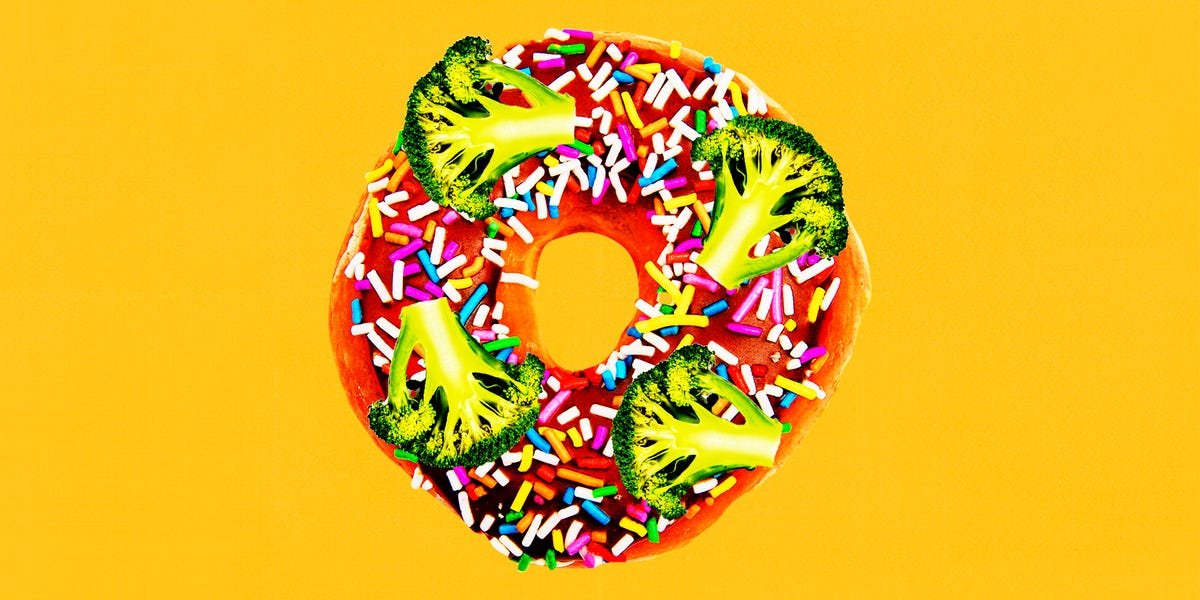
- Groundbreaking research suggests that a diet of ultra-processed foods can cost you around 500 extra calories per day.
- Scientists are trying to understand why this happens.
- They are developing new recipes for ultra-processed foods in the hopes of making them healthier.
It’s been five years since nutritionist Kevin Hall made a startling discovery that changed the way we look at ultra-processed foods.
Hall housed 20 people, 10 women and 10 men, in a tightly controlled metabolic ward at the National Institutes of Health and monitored their diet for a month. The subjects were fed only fresh, unprocessed foods, like Greek yogurt with fruit and nuts for breakfast and stir-fried broccoli and beef for dinner. For the other half of the month, the subjects received the same amount of calories and macronutrients each day from factory foods like turkey bacon, English muffins, and chicken nuggets.
By the end of the month, the evidence was conclusive and definitive: people who eat ultra-processed foods unintentionally take in more calories and gain weight. It was the first randomized controlled study of its kind, and it changed the way we looked at ultra-processed foods. With “whole food” and “plant-based” eating all the rage and “clean” eating more fashionable than ever before, people were actively trying to limit their intake of processed foods.
But despite knowing that an ultra-processed diet is costing people about 500 extra calories a day, Hall doesn’t believe convenience foods should be avoided altogether.
“What we’re trying to understand is what it is specifically about ultra-processed foods that leads to overconsumption and weight gain,” Hall told Business Insider.
He wants to understand exactly why ultra-processed foods work the way they do, and what can be done to make them healthier.
“If you can avoid it, that’s great, but most people can’t,” he said.
So over the past year, he has been systematically inviting 18 volunteers to try newly formulated ultra-processed foods at a special lab in Bethesda, Md. By the time the study finishes in 2025, at least 36 people will have eaten the revised foods and been monitored for weight gain and hormone changes.
Hall is testing two big ideas in the hope that by incorporating some of the basic concepts of nutrition science into ultra-processed foods, we might be able to get smarter about their presence and make on-the-go meals healthier.
Ultra-processed foods attack your brain
We’ve known for some time that ultra-processed foods are linked to all sorts of adverse health outcomes, including increased premature deaths and increased incidence of strokes and heart attacks.
And refined carbohydrates (white bread, sugar), syrup-filled drinks (soda, juice), and ultra-processed meats (hot dogs) have been found to be some of the most dangerous foods in this category.
But whether packaged, ultra-processed foods as a whole are inherently bad for us is still an open question.
One thing that separates many ultra-processed foods from whole foods is their calorie density: Ultra-processed foods are higher in calories per bite and less fiber than fresh foods. One reason why an ultra-processed diet may lead to overeating is because each bite is rich and high in fat, yet doesn’t make you feel very full, says Hall.
Hall’s second big hypothesis is that people end up eating more of ultra-processed foods because they’re “so tasty” – that is, they’re rich in appealing combinations of fat and salt, fat and sugar, carbohydrates and salt.
Very few things in nature are that tasty to humans. One of nature’s few “super tasty” foods is breast milk. “Breast milk can be sweet and fatty,” Hall says. Perhaps evolution has taught us that these unusual types of foods are irresistible; it’s a survival instinct innate to us.
When you cook at home, it’s nearly impossible to include as much sodium and fat as ultra-processed foods mixed in a factory. Combo meals made at home can still be very tasty, but the sugar and oil tend to clash with water-rich vegetables and grains. Hall’s landmark 2019 study found that while only about 40% of foods in an unprocessed diet were very tasty, about 70% of foods in an ultra-processed diet were “very tasty,” especially those with high salt, sugar, fat, and carbohydrate ratios.
If the easiest, cheapest, and quickest way to get dinner was to pile a plate of temptingly tasty but low-nutrient foods, that’s exactly what you’d do. The question is, is there anything we can do to make those super tasty foods less harmful?
Change the composition of your plate
In his new experiment, Hall is trying a few different approaches to study the link between ultra-processing and weight gain.
One idea is to reduce the “very tasty” foods in ultra-processed foods: That way, participants might consume more calories per bite than when eating unprocessed foods, but they’d be (presumably) less likely to overeat because the foods would be less appealing.
Another idea is to cut calories by simply adding a few non-starchy vegetables to your plate of ultra-processed foods.
“For example, you’ll eat more salads,” he says.
If including vegetables in convenience foods standardizes the amount of calories people consume, it could change the way we think about our processed food choices — and, if manufacturers are willing, how they make them.
Can fast food be healthy food?
Hall is also trying more precise methods in his experiments: He is dissolving fiber supplements into some of the ultra-processed foods, such as adding fiber powder to packaged yogurt, to see whether this will curb overeating and improve health.
It’s a simpler idea, and if it proves promising, it could be adopted by the food manufacturing industry. (Large food companies like Nestle have already reformulated some packaged foods, like frozen pizza, to increase the fiber and protein content for patients taking appetite-suppressing GLP-1 drugs like Ozempic.)
If ultra-processed foods could actually be improved for health, imagine something more ideal than just adding a bit of fiber to frozen pizza or yogurt. What about shelves of packaged foods with more beans, nuts, and seeds and less sugar? UPF could take cues from traditional diets that we know work, like the Mediterranean diet, rich in olive oil, lentils, chickpeas, and citrus fruits. All of these are relatively long-lasting foods that experts agree are good for your heart and longevity. You could also eat rice and beans out of a bag, or enjoy vacuum-packed vegetables as a side instead of potato chips. These would be healthier choices than high-fat pastries and other “plant-based” treats, whether homemade or factory-made.
No matter how processed your diet, Hall says, “everything we’ve known for years” is worth considering: Look for nuts, seeds, whole grains like oats and quinoa, black beans, hummus, lentils, and, of course, fresh, unprocessed vegetables and fruits whenever possible. Avoid sugary snacks and refined grains — “all things that are already discussed ad nauseam in the Dietary Guidelines.”
