

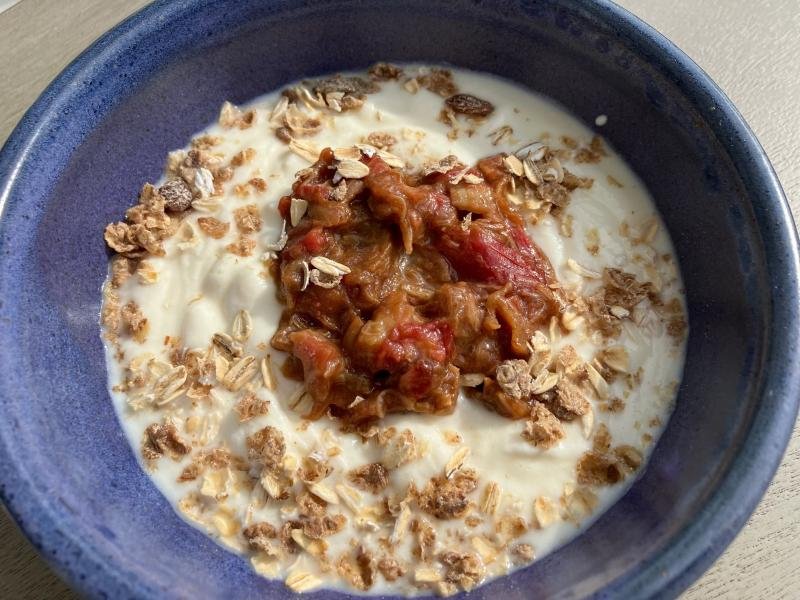
The rows of rhubarb stalks in the produce section of Roy’s Market are a reminder that the growing season has begun and harvest is underway. Rhubarb’s season is short, from late April to early June, and its distinctive colour is vibrant red. However, the flesh beneath the stalk’s thin outer layer is often bright green. And when the rhubarb compote shown here was cooked, it appeared more green than red.
Why is rhubarb green? It’s not a sign of ripeness or readiness to harvest, but rather of a variety that is growing in popularity. The base of the stalk is a deep reddish hue, while the rest of the plant is a much lighter shade of red. It turns out the change in color is due to a preference for certain varieties that hit the market earlier, have higher yields, and are less fibrous than their crimson cousins.
Rhubarb has been around for centuries. The plant is native to Siberia and grows from an underground rhizome, producing a celery-like stalk. Some wild species have been used in traditional Chinese medicine for millennia, and thanks to Marco Polo, this useful medicinal plant was brought to Europe in the 13th century. By the 1600s, rhubarb was being cultivated in England, where the fleshy garden variety was considered a desirable food.
The rise of cottage gardens across the UK and the cool climate that’s perfect for growing rhubarb have seen a resurgence of interest in this ancient fruit. There are now festivals, artisanal varieties for sale, and a range of special covers on the stems that allow them to grow in the dark, which limits photosynthesis and produces a sweeter, more tender plant. Forced rhubarb can grow up to two feet above the ground in just four weeks.
Although botanically it is considered a vegetable, legally it is considered a fruit, due to a 1947 New York court case that ruled that rhubarb was based on how it was cooked (presumably because importers successfully lobbied for a lower tax burden), but the way rhubarb is used seems to justify its classification as a fruit.
Almost stringy when raw and soft and juicy when cooked, rhubarb is often used in pie fillings and jams. Its strong flavor can be mellowed by baking or stewing with lots of sugar. This strong sourness, even when fully sweetened, and the poisonous heart-shaped leaves, mean that rhubarb is inedible until you get used to it. One surprising feature of uncooked rhubarb is that it becomes soft and sweet when mixed into cupcake or scone batters.
Going back to the simple compote in the photo, I made this with a few cut stems, less than half a cup of sugar, and a little apple juice. After a quick simmer, I let the mixture sit for a few minutes to thicken. At this point, I put a little on my morning yogurt, sprinkling some granola on top. If you want to vary the flavor, consider adding vanilla extract, cinnamon, and nutmeg.
If you want to use the compote on savory dishes like grilled chicken or pork, mix it with balsamic vinegar and chopped shallots. A final use for the compote is as a delicious appetizer with Camembert cheese; the creamy cheese and tart rhubarb are a perfect pairing.
Basic rhubarb compote
4 rhubarb sprigs
1/3 cup sugar
1 glass of apple juice*
Cut off the bases and tips of the stalks and wash thoroughly. Cut the stalks in half lengthwise, then crosswise into 1/2-inch pieces. If the outer layer feels fibrous after the first few cuts, peel it off with your fingers. Place the rhubarb and remaining ingredients in a saucepan and bring to a boil over medium heat. Stirring occasionally, simmer until the mixture has a soft jam-like texture, about 15 minutes. Remove from heat and let the compote sit for about 5 minutes until it thickens before using. *Note: If desired, add 1/2 t vanilla extract and/or 1/2 t cinnamon.
Baked Camembert with Rhubarb
1 cup rhubarb compote
Camembert cheese 5 inch
Preheat oven to 350 F. Place cheese in a round baking dish. Spread generously with rhubarb compote. Cover and bake for approximately 30 minutes until cheese is soft. Serve warm with thinly sliced baguette or crackers.
Flavourful Rhubarb Compote*
4 rhubarb sprigs
1 finely chopped shallot
2 tablespoons sugar
1 glass of orange juice
1 tablespoon balsamic vinegar
A pinch of salt
Cut off the bases and tips of the stalks and wash thoroughly. Cut the stalks in half lengthwise, then crosswise into 1/2 inch pieces. If the outer layer feels fibrous after the first few cuts, peel it off with your fingers. Add the rhubarb and remaining ingredients to a saucepan and bring to a simmer over medium heat. Stirring occasionally, simmer until the mixture has a soft jam-like texture, about 15 minutes. Remove from heat and let the compote sit until it thickens, about 5 minutes before using. *Note: Serve as a sauce for grilled meats or poultry.
Rhubarb scones
2 cups flour
2t baking powder
1/4 tsp salt
1/4 cup sugar
1/2 tsp cinnamon
1/2 cup butter
3/4 cup fresh cream
1/2 cup chopped rhubarb
Preheat oven to 400°F. Line a baking sheet with parchment paper and set aside. Sift dry ingredients into a mixing bowl. Using a pastry blender or your fingers, blend in butter until it resembles coarse cornmeal. Fold in cream and rhubarb, taking care not to overmix. Roll dough into balls, place on a floured surface and roll out to 1-inch thickness. Using a sharp knife or biscuit cutter, form 12 scones. Arrange in a single layer on a baking sheet. Bake for about 15 minutes until golden brown. Serve warm with butter or clotted cream.
