

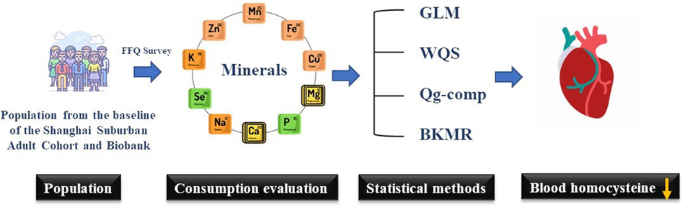
In this study, we confirm our original hypothesis that mixed mineral intake is associated with a lower risk of hHcy. First, the results of conventional multiple linear regression showed that eight minerals were associated with lower blood Hcy concentrations, and the results of conventional multivariate logistic regression also showed that eight minerals were associated with lower hHcy risk. Second, using three innovative machine learning methods, we found that mixed mineral intake was associated with lower blood Hcy concentrations and lower hHcy risk. In any case, there is a growing body of literature focusing on the relationship between nutrients and health indicators, and this study highlights the relationship between minerals in nutrients and hHcy risk.
In the traditional multifactorial model, the eight minerals associated with lower blood Hcy concentrations were calcium, phosphorus, potassium, magnesium, iron, zinc, copper, and manganese, while the eight minerals associated with lower hHcy risk were calcium, phosphorus, potassium, magnesium, iron, zinc, selenium, and copper. Traditional multifactorial models have been widely used in previous studies, mainly due to the ease of data processing and ease of interpretation of results. However, due to the high correlation between these minerals, it is not appropriate to include each mineral simultaneously in one model. Therefore, including only one mineral in a model without considering the effect of other minerals may generate false positives or false negatives, reducing the reliability of the results. In addition, nonlinearities and interactions may exist between minerals, and the joint effect of mixed minerals on hHcy risk is not available in traditional models, so innovative methodologies need to be used in this field as soon as possible.
WQS and Qg-comp are novel approaches that have been used to answer questions related to mixed exposures, allowing for reporting joint effects and the weighting of each exposure in the joint effect. [32]In this study, both WQS and Qg-comp reported a negative correlation between higher intake of mixed minerals and lower risk of hHcy. The most negatively weighted minerals in the WQS model were calcium and copper, and manganese in the Qg-comp model. Considering the influence of other minerals, the two new methods show higher sensitivity to the results compared with the traditional models.
BKMR is another type of machine learning method to analyze the relationship between mixed exposures and health. In addition, it outputs univariate effects and interactions in parallel to reporting the joint effects and weights of single exposures. The results of the BKMR model in the current study suggested that higher intakes of nine minerals, except sodium, reduced the risk of hHcy, leading to higher weights of the joint effects. The univariate effects findings also indicated that higher intakes of phosphorus, zinc, copper, and magnesium reduced the risk of hHcy when controlling for the levels of each of the remaining minerals. There were also interactions among the 10 minerals. Thus, the new method further analyzes and interprets the data compared to the traditional model, elucidating the complex relationship between mixed minerals and hHcy.
Previous studies have used advanced statistical methods to investigate the relationship between mixed nutrients and health, although the number of studies is limited. [33,34,35,36,37,38,39,40]. Li, R. Q. et al. [34] The relationship between nutritional intake, inflammation, and depressive symptoms in older adults was investigated using BKMR, and significant associations were identified, revealing a combined effect of multiple nutrients on depression risk, and countervailing effects of pro- and anti-inflammatory diets. A Korean study assessed the relationship between nutrient intake and MetS and its components in adults aged 19–80 years (yeah= 16807) were analyzed using WQS regression, Qg-comp, and BKMR regression and found that mixed nutrient intake was associated with a reduced risk of MetS. [33]The results were statistically significant even after adjusting for basic social characteristics, smoking, alcohol intake, and family history. Minerals are an important group of nutrients, but their joint role in health effects is not well discussed today. To our knowledge, there is only one literature that evaluates the relationship between mixed minerals and health with advanced statistical methods. [36]We assessed the relationship between six minerals (iodine, selenium, zinc, calcium, magnesium, and iron) and maternal thyroid function in 489 pregnant women in Hangzhou, China. The results showed that the concentrations of mixed minerals were negatively correlated with TSH and positively correlated with FT3 and FT4, with iodine contributing the most. For the first time, this study used three advanced statistical methods to find a negative correlation between mixed minerals and the risk of hHcy, and revealed the existence of interactions between mixed minerals.
Normal metabolism of Hcy in the body is usually kept at low levels, but when Hcy metabolism is impaired, the concentration of Hcy in the blood increases and reaches a state called hHcy. [41]Disturbances in Hcy metabolism can lead to redox imbalance, increased oxidative stress, endoplasmic reticulum stress, and altered DNA methylation, ultimately affecting the expression of genes associated with various diseases. [42]In the human body, Hcy is converted mainly by two pathways: the remethylation pathway and the transsulfuration pathway. The remethylation process involves the catalytic action of methionine synthase and its coenzyme vitamin B.12and betaine-Hcy methyltransferase. The transsulfuration pathway depends on cystathionine β-synthase and its coenzyme vitamin B.6 It is used to generate cysteine. Factors affecting Hcy metabolism indirectly contribute to cysteine accumulation in blood, resulting in hHcy.
Fortunately, other literature has assessed the relationship between specific single minerals and hHcy and detailed the mechanisms by which minerals may affect Hcy metabolism. [14, 15, 43,44,45]In this study, we found that increased calcium intake was associated with a decreased risk of hHcy in multivariate regression, WQS regression, and BKMR.Paraoxonase 1 is a calcium ion-dependent enzyme involved in the metabolism of Hcy. [14]Increased calcium intake may promote Hcy metabolism through this pathway, and blood calcium levels have been shown to be positively correlated with Hcy. [46]This is contrary to our conclusions and may be due to the fact that the correlation between blood calcium levels and dietary calcium intake is not direct.The results of an 8-week zinc intervention trial in postmenopausal women suggested that zinc supplementation could improve blood folate levels and reduce blood Hcy levels after zinc supplementation, and correlation analysis found a negative correlation between folate levels and blood Hcy levels after zinc supplementation. [43]The improvement of blood folate levels through zinc intake has also been confirmed in a study of elderly Australians (aged 65 to 85 years). [47]Betaine-Hcy methyltransferase, a zinc-containing catalase, plays a key role in the pathway from Hcy to methionine. [15]This may explain the mechanism by which zinc promotes Hcy metabolism.A study in elderly Spanish subjects suggested that circulating selenium may play a major role in regulating Hcy levels. [44]Similar associations were seen in the UK National Diet and Nutrition Survey. [45]This is thought to be because low selenium concentrations significantly reduce the metabolic activity of methionine synthase, resulting in reduced methylation of Hcy to methionine. [44].
This study has several distinct advantages. It is the first study to investigate the relationship between mixed mineral intake and blood Hcy levels and to report the single and overall effects, as well as the contribution of each mineral to the joint effect. In addition, three advanced machine learning methods were used, which allowed for greater control over the complex interactions between minerals than traditional models, making the results easier to interpret. Meanwhile, the results have a certain degree of reliability because we considered a large number of covariates to adjust in the model. However, this study has limitations. First, this is a cross-sectional study and could not demonstrate a causal relationship between mixed mineral intake and blood Hcy levels or the prevalence of hHcy. Although it is widely recognized that FFQs can reflect participants’ long-term dietary intake, intake is similar to external exposure in risk assessment and may not be as accurate as internal exposure. In other words, blood mineral levels are unknown in this study. Therefore, in future studies, it may be possible to examine the levels of various minerals in blood samples to first see how the concentrations of minerals in the blood are related to intake, and then combine internal and external approaches to evaluate the relationship with blood Hcy by providing a more comprehensive description of the protective effects of minerals on blood Hcy. When considering the FFQ, it is important to recognize that the reliability and validity coefficients of the FFQ reported in this study were lower than expected. This may be because the questionnaire had longer items to fill out and a longer recall period, which made it difficult for participants to complete the answers. Nevertheless, detailed food items and a sufficiently long recall period are essential to thoroughly evaluate the long-term dietary status of a population. In addition, the gender imbalance in the current study should be mentioned. The proportion of female participants was higher than that of male participants, and the prevalence of hHcy was higher in males than in females, so although the gender bias was adjusted as a covariate in the model, the impact on the results may have been substantial. Finally, the types of minerals provided by the CFCT are relatively small, and although we considered as many common minerals as possible, other minerals that we have not yet included may also have some impact on the results. Overall, a higher intake of the 10 minerals was associated with lower blood Hcy levels and lower hHcy risk, and the weight of the joint effect differed depending on the mineral.
