

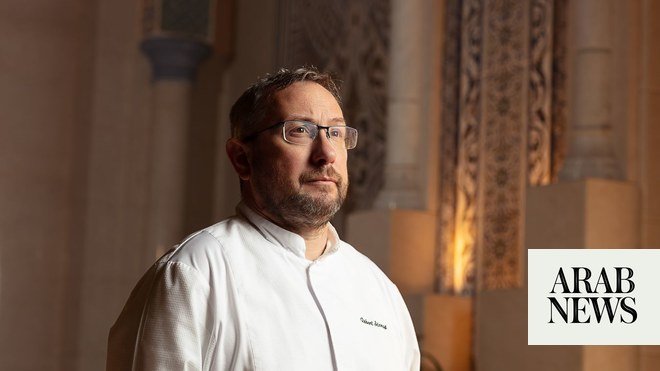
RIYADH: Robert Stirrup’s culinary journey began in his family’s suburban London home, where he performed basic tasks like helping prepare meals in a bustling kitchen on weekends, sparking a lifelong passion for cooking.
Stirrup currently serves as Director of Culinary Arts at The Ritz-Carlton Riyadh, with over 20 years of experience that includes working in five-star hotels and Michelin-starred restaurants.

Here he talks about his favorite dishes and his best tips for amateur chefs, and also shares a recipe for roasted sea bass with vegetable étouveée and herb salad.
What’s the biggest mistake you made when you were starting out?
Probably one of the biggest things is to just keep adding flavor. When you’re not sure about the intricacies of different flavors and ingredients, just add more and more ingredients. Over time, you start to understand what goes with what. One of the big things that one of my chefs taught me when I was 19 or 20 was to really smell and taste different herbs and understand what their flavors are and what they can actually pair with.
What’s your best advice for amateur chefs?
Planning. If you don’t have a plan for how your food will look and be presented, you miss the opportunity to make a list and realize that there is a lot you can do in advance. Do a lot of things in advance, and then at the end it’s just the finishing touches: searing the meat, grilling the fish, finishing the vegetables, reheating the sauces. That way, you don’t put pressure on yourself at the last minute and panic and mess things up.
Can you make any dish instantly delicious with just one ingredient?
Citrus fruits. They enhance the flavor of many dishes and can be used in many different ways. You don’t just use lemons. You can use many different citrus herbs. You can use limes, you can use yuzu. There are many ways to add citrus fruits to enliven and freshen up a dish.
What are some common mistakes you see other restaurants making?
I always check the menu volume. When I see a menu with a large volume, I assume either the food is not fresh or the team is not skilled enough to make that many dishes. For me, a smaller menu means the team is more focused and the ingredients are fresher because they are properly rotated. I also prefer restaurants that serve a certain style of food rather than trying to be everything for everyone. I also think you can tell if a restaurant is good by how busy it is before you go in. If the restaurant is empty, I won’t go there.
Also, from a service perspective, I always try to ask my team what they would like to eat. It’s very important to have a well-trained team. And it’s very hard to find good people. But train your team so that they can be really confident when they’re talking to guests and explaining the menu. I was in a restaurant recently and they brought out the food and didn’t explain it at all. They just said, “Enjoy,” and walked away. And that changed the whole experience. Instead of them sharing a little bit of knowledge or sharing how they feel about being there and enjoying what they’re offering.
What is your favorite food?
I like the simplicity of Japanese food, it’s so simple that you can’t hide behind anything, it’s the quality of the ingredients that makes the dish.
When you have to cook something quickly at home, what do you make?
I often open the refrigerator to check what’s in it, which always makes my wife angry. I don’t like going on big shopping trips, I prefer to buy ingredients regularly and check what’s in it. I don’t think it’s necessary to combine more than three or four ingredients to make a dish, especially at home.
But I think pasta is something that anyone can easily enjoy, and you can make a variety of dishes with it.
What customer behavior annoys you the most?
I think it’s simply rude. Everyone is busy, everyone is in a rush, but the people who cook for you, greet you, serve you? They are human beings too. It doesn’t cost anything to have good manners and be polite to people. And you will get a much more enjoyable experience and they will get a much more enjoyable experience too. If something goes wrong and you want to talk to someone, you can still be polite. People sometimes suddenly get very aggressive, but I think that’s very unfair to the team who are trying their best to cook for you or serve you.
What is your favorite dish to cook and why?
I love cooking with fish. It’s very versatile, really anything: sea bass, cod, sea bream. I find good fish and fresh vegetables, cook them together, add different seasonings. I always think that if you can cook fish well, it’s a sign of a good cook, because it’s easy to screw up by overcooking it. And like I said, the less ingredients, the better.
As a head chef, what kind of person are you?
I’m pretty laid back. I’m used to having very large teams. My team is close to 150 people. In my previous job, it was close to 300 people. So I’m a team player and an empathetic organizer. I find that much more effective than screaming or yelling. Of course, there are times when I need to raise my voice to get everyone to stop and listen, but that’s very rare.
recipe

Chef Robert’s Roasted Sea Bass with Vegetable Etove and Herb Salad
Serves 2
In the case of sea bass
material: 2 sea bass fillets (180g each), 7g cumin seeds, 5g sumac, 10g dried oregano, 10g sesame seeds, salt and pepper (approximately 5g each)
Instructions:
1. Toast the cumin seeds in a dry frying pan until fragrant. Transfer to a mortar and grind with the sumac, oregano, sesame seeds, salt and pepper to make a fine powder. Reserve the excess for later use.
2. Roast the sea bass fillets seasoned with the spice blend until cooked through and golden brown.
For the vegetable etove:
material: 1/2 a large fennel bulb or 8 baby fennel (thinly sliced or thinly sliced), 1 carrot or 4 baby carrots (thinly sliced or thinly sliced), 4 baby artichokes (optional) (thinly sliced or thinly sliced), 2 banana shallots (thinly sliced), 2 garlic cloves (smashed), 10 basil leaves, 4 thyme sprigs, 100ml vegetable stock, juice of 2 lemons, 50ml extra virgin olive oil, salt and pepper (to taste).
Instructions:
1. Sauté the shallots in olive oil until transparent. Add the crushed garlic and stir fry briefly.
2. Add the carrots and artichokes (if using) along with the remaining olive oil, herbs and vegetable stock.
3. Cover with a lid or plastic wrap and simmer gently over medium heat for 10 minutes, adding lemon juice to taste.
For the herb salad:
Mix seasonal salad greens with 2g fresh dill, 2g fresh basil, and 2g fresh sorrel.
assembly:
Plate the sea bass on top of the etové greens. Serve with your favorite greens, such as asparagus or kidney beans. Serve with a fresh herb salad.
