

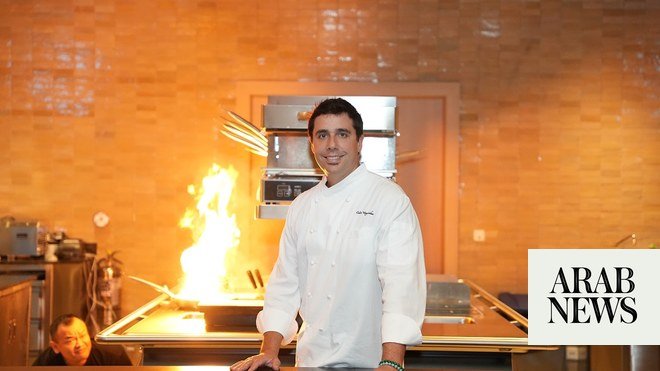
DUBAI: “My dream was never to be a footballer, a musician or a doctor,” says Cedric Vongerichten, head chef at Maritime, a French-Asian restaurant at The Edition in Jeddah. “This is what I was meant to do and be.”
It’s hard to argue: Mr. Vongerichten was born in Thailand to French parents who lived there because Mr. Vongerichten’s father was executive chef at the Mandarin Oriental Hotel in Bangkok, and by the time Mr. Vongerichten was two, his family had settled in New York, after living in Portugal and Boston.
Vongerichten said his passion for cooking began when he was eight or nine years old. “After (school), I would come home to what was then a hotel, and in my free time I would be helping out in the kitchen, making pastries. That’s all I thought about.”
He began his formal cooking lessons at the age of 14 in the South of France and has since traveled the world learning about different cuisines and cultures.
What was the most common mistake you made when you were starting out?
I guess I overcomplicate things or don’t have a clear vision for the dish. Sometimes you just need to take a step back and look at the bigger picture. The more you practice, the more things will work automatically and you won’t have to think about it any more.
What’s your best advice for amateur chefs?
At home, it’s common for the kitchen to be messy with pots and pans scattered all over the place. It makes it hard to concentrate. To be honest, cooking is 50% cooking and 50% cleaning. Keeping things clean and organized is very important. And when it comes to the actual cooking, keep it simple. People are more impressed with (good ingredients) than something overly complicated.
Can you make any dish instantly delicious with just one ingredient?
Chili. My family and I couldn’t live without it, and it makes cooking so much fun from start to finish.
When you eat out, do you ever find yourself criticizing the food?
I’d be lying if I said we didn’t. It’s part of our job. But I’m not going to be vocal about it, good or bad. I don’t want to ruin anyone else’s experience. Everyone just wants to enjoy a good dinner.
What are some common issues you see in other restaurants?
One thing I don’t really like is the lighting. I love it when the lighting works well. It creates ambiance. If it’s grey or too bright, I don’t want to stay there for long.
What is your favorite food?
We can’t live without Asian food, and we need Asian food at least once or twice a week – Japanese, Indonesian, Thai, etc.
When you have to cook something quickly at home, what do you make?
Seafood takes 15 to 20 minutes. Two nights ago I made a simple local black sea bass. Just pan-fry it, skin side down. It’s asparagus season now, so I boiled salted asparagus with olive oil and rice. Sometimes I make roast chicken for my kids. They love it. I put potatoes, onions, garlic, water, salt, olive oil in a pan, and sometimes I add rosemary. I put the chicken on top and put it in the oven for 30 to 40 minutes, depending on the size of the chicken. The juices that drip from the chicken and potatoes make the sauce naturally. It’s not too messy, and it’s very easy and tasty.
What customer request or behavior frustrating you the most?
I don’t like to say no so when it comes to requests, if I have the materials, I just go for it.The only thing I don’t like is when the service team is disrespected.
What is your favorite dish to cook and why?
It depends on the season. Right now I would say fish happens to be delicious. It’s very simple and very tasty, just with a little olive oil, a squeeze of lime juice, a little bit of salt, lemon zest and of course a little bit of chilli.
I also love bouillabaisse. It’s a Mediterranean fish soup. It takes a long time to make. You put fish on top of lobster, then more fish, potatoes, and bread. It’s got a lot of saffron in it. It’s a very fun dish. And very, very tasty.
What is the hardest dish for you to make well?
Pastry making is difficult. You have to be very precise. You have to practically measure everything in grams. And it’s totally different from country to country. First of all, because the weather is very different. There’s the humidity and temperature factor. And also the products, like the flour, are different. So you have to adapt to all this. It’s a very technical job.
As a head chef, what do you do in the kitchen?
I feel like the time has passed when chefs still yelled and threw things in France. I remember seeing that in France. But it’s definitely gone. Did I yell a little bit at the beginning of my career too? Maybe, but definitely not now. In a team, everyone reacts differently, so the way you manage people is different. Some people need more guidance, others have a more independent approach. As a manager and as a chef, you have to be flexible here. I can be laid back, but I also want great results and the right product. In the long run, I see that most people want to work with us for a long time. That’s enough for me.
Recipe: Chef Cedric’s Fritters

material:
90g all-purpose flour, 30g rice flour, 8g baking powder, 3g salt, 130g water, 25g green onions (sliced diagonally), 300g corn, 10g Fresno chili, oil for frying
Instructions:
1. Add flour, rice flour, baking powder and salt to a bowl.
2. Add water and mix well.
3. Add green onions, corn kernels, and Fresno chiles.
4. Pour oil into a large heavy-bottomed pan.
5. Heat oil until it is just smoking (350°F).
6. Pour the mixture into the hot oil, 1 tablespoon at a time, without crowding (for larger fritters, use about 1⁄2 cup batter per piece).
7. Flatten the fritters slightly with a spatula, then press the spatula against the fritters a few times to make indentations that will crisp the edges.
10. Cook until bottom is golden brown, then flip and cook until the other side is the same color (about 2 more minutes).
11. Remove the fritters and place on a plate lined with paper towels.
12. Serve hot with the spicy kecap manis (sweet soy sauce) dipping sauce and garnish with sliced spring onions.
