

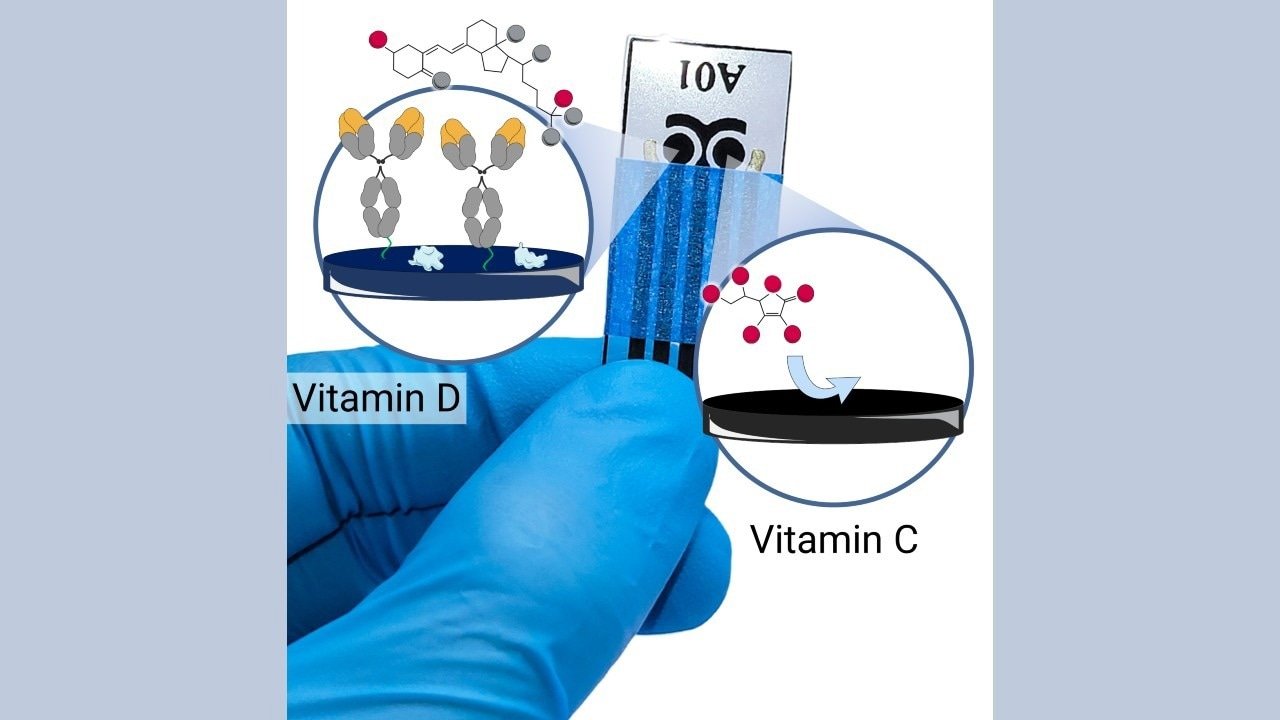
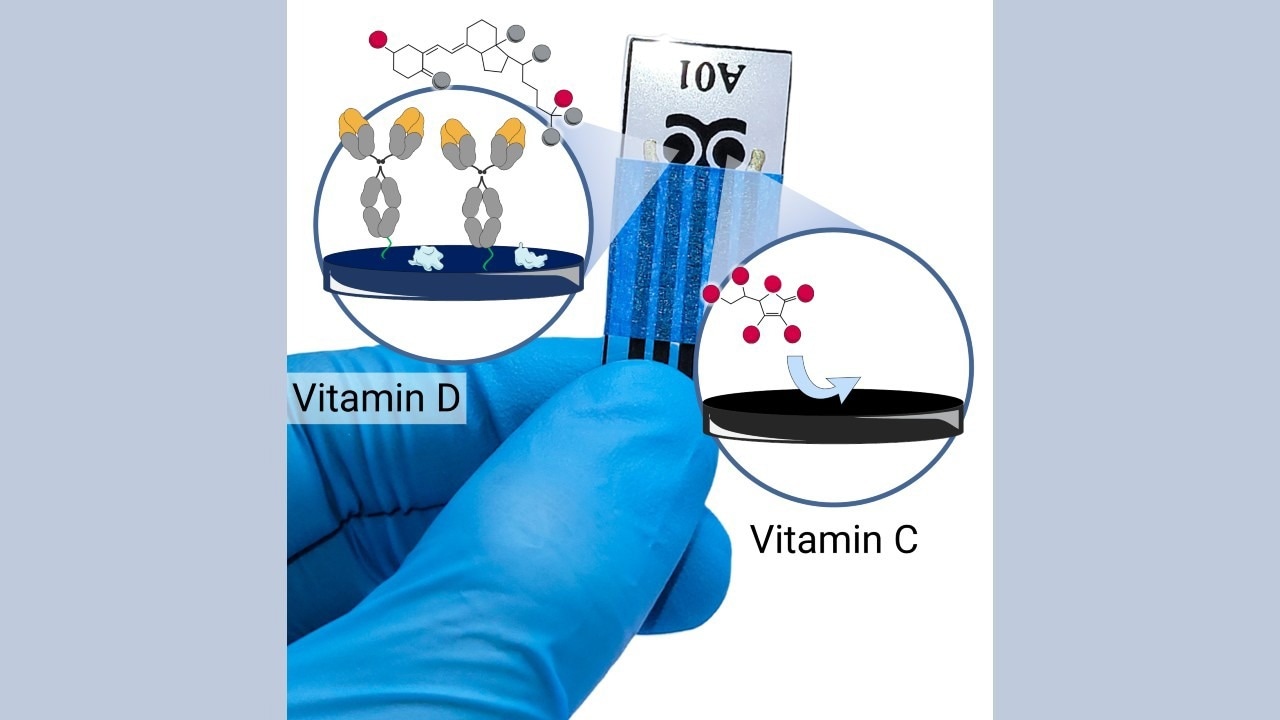
Scientists at the University of São Paulo (USP) in Brazil have created a bioelectronic chip that can simultaneously detect vitamin D and vitamin C in body fluids, according to a study published and featured on the cover of the journal ACS Applied Nano Materials. It is versatile, easy to use, and can be customized for use with wearable devices to aid in customized diets.
Vitamin C and vitamin D are micronutrients that play an important role in the immune system by participating in metabolic pathways that fight viruses and bacteria. By monitoring these vitamins, you can make sure you don’t have a deficiency or excess of them.
However, currently available solutions require the use of expensive laboratory equipment handled by highly trained personnel. This includes things like collecting blood samples and generating hazardous waste. Detecting and analyzing both vitamins in the same sample is difficult.
Researchers at the San Carlos Institute of Physics (IFSC-USP) and FAPESP (projects 22/03758-0, 22/15122-3, 19/13514-9, 22/00243-0, and 18/22214-6) , this chip simplifies the process using low-cost resources such as carbon and rapid operating protocols.
The chip is disposable and has two sensors that use electrical current to detect vitamins. In the case of vitamin C, the sensor consists of carbon nanoparticles that act as electrocatalysts. The vitamin D sensor consists of layers of graphitic carbon nitride, gold nanoparticles, and 25(OH)D.3 antibody. 25(OH)D3 It is the most abundant circulating form of vitamin D because of its long half-life.
Using the chip is easy. Users simply connect it to a small handheld electronic device similar to a blood glucose meter, insert a saliva or serum sample, and wait for the electrical current to reveal the presence and amount of the vitamin. Results he gets within 20 minutes.
By immobilizing electrochemically active species on one surface of the sensor, we were able to eliminate the need for labels and redox probes, simplifying the instrumentation, and reducing the complexity of the analysis.
Thiago Seraphim Martins, first author and researcher, Imperial College London
Mr Martins added:This could make the chip more practical and efficient, allowing it to be used directly in pharmacies, clinics, etc. It is also flexible enough to be used as a wearable device, embedded in a mouth guard or pacifier, or applied directly to the skin.”
Its selectivity and specificity make it an excellent control to assess potential interference by other substances commonly found in blood and saliva samples, such as vitamins B12, B1, B3, glucose, lactate, sodium chloride, and potassium chloride. Verified by experiment.
assignment
The biggest hurdle researchers had to overcome to design a bioelectronic chip that could detect vitamins C and D was ensuring there were no cross-reactions between the vitamins in the samples the chip analyzed. was.
Mr Martins said:Ensuring that there is no cross-reactivity between vitamins in the samples that the bioelectronic chip analyzes is the biggest hurdle researchers must overcome to design a bioelectronic chip that can detect vitamins C and D. did.”
Although further research is needed to validate the sensor, scientists believe it is possible to expand the chip’s detection capabilities to include additional biomarkers, such as those for different types of cancer. I am. They then apply for a patent and eventually hope to offer a manufacturing license for their invention.
Brazil’s National Council for Scientific and Technological Development (CNPq) further supported this research.
Reference magazines:
Martins, T.S. Such. Al. (2024) Label- and redox-probe-free bioelectronic chip for monitoring vitamin C and 25-hydroxyvitamin D3 metabolites. ACS Applied Nanomaterials. doi:10.1021/acsanm.3c05701
Source: https://agencia.fapesp.br/en
