

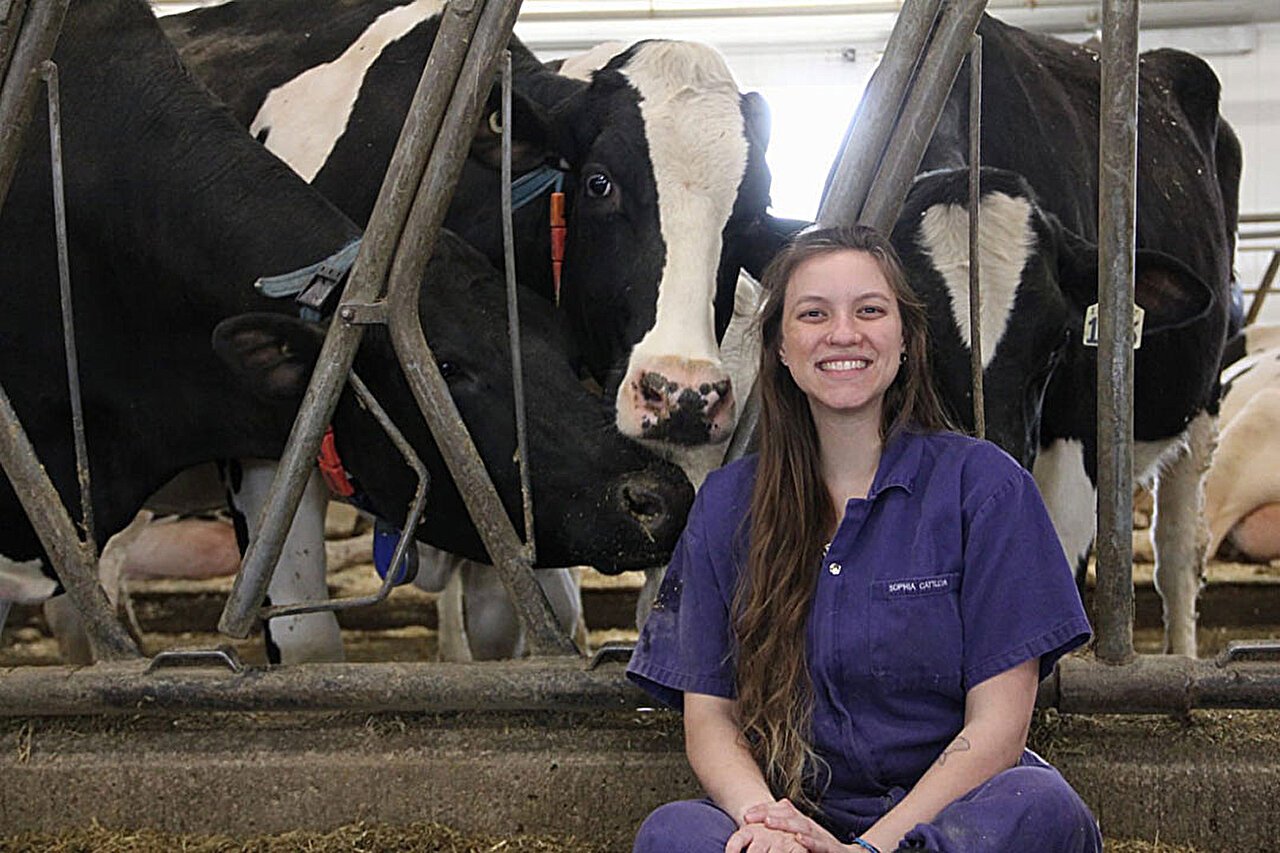
Sophia Cattleya Donde, a doctoral student in the Department of Agriculture and Bioresources at the University of Saskatchewan. Photo courtesy of the University of Saskatchewan
× close
Sophia Cattleya Donde, a doctoral student in the Department of Agriculture and Bioresources at the University of Saskatchewan. Photo courtesy of the University of Saskatchewan
Feeding livestock today is not just about dumping hay or silage into the barn and hoping it works.
It is a carefully controlled process to ensure animal health, optimize production and protect the environment.
Feeding dairy cows presents unique challenges. Increasingly, dairy cows are being milked by robots. But these robots are more than just milking machines: They also provide what Sophia Cattleya Donde calls the cows’ “dessert”: tasty, nutritious pellets.
“The robot is a complete system,” explains Donde, a doctoral student in USask’s School of Agriculture and Bioresources (AgBio), “and it runs 24/7. It’s a voluntary system, so the cows voluntarily go to the robot whenever they want to be milked.”
“The pellets are an attraction. If you give them pellets in the robot, they will want to go to the robot more often.”
But do pellets actually affect milk production? Donde decided to find out.
The diet of cows milked with robotic systems consists of partial mixed rations (PMR), which are high-quality feed-based ingredients that cows ingest in addition to pellets, meaning that pellet feeding can affect when and how much PMR a cow ingests.
Specifically, Donde studied whether the combination of starch concentration in pellets and the amount of pellets provided affected lactating cows’ performance and the nutrients consumed at any point in the production cycle.
Donde noted that there is a gap in the literature on this topic, which is important to fill.
“We find that people usually only focus on the pellets and don’t realise that the majority of a cow’s nutrition is in the barn feed,” she said.
“Most studies haven’t focused on PMR intake. They tend to focus on the amount of pellets that are in the robot.”
But as the robot’s pellet intake increases, the cow’s PMR intake decreases, she says. Here’s where the parallels between human and cow desserts come in.
“I might not eat the whole meal. Well, I don’t eat that much rice or vegetables…because I really want that cake.”
“You start replacing the main meal with dessert. It’s pretty much what cows do. They don’t eat everything from the barn that they should be eating. They eat pellets, so they eat that instead.”
So, does the starch content of pellets affect milk production?
The first part of her project was carried out last year under the supervision of Greg Penner, Ph.D., head of Centennial Enhancement’s Ruminant Nutrition Physiology Division and professor in the College of Agriculture and Biology.
In his study, Donde used two starch concentrations in the pellets: 24% and 34%. The lower starch concentration was based on the average concentration used by dairy producers in Canada.
Donde also varied the amount of pellets he fed to each cow, regardless of their production, giving some cows two kilograms a day and others six kilograms.
The results? “Starch concentration had little effect on performance.”
Not only that, but the cows generally did not consume their entire daily pellet allotment, with those in the high-allotment treatment leaving an average of 0.5 kilograms and not eating all of the PMR either. Cows fed more pellets also consumed less PMR, thereby altering their nutrient supply.
The study found that the amount of pellets the robot dispensed affected its ability to feed accurately, but the starch content of the pellets had little effect. Next studies will test whether protein affects cows’ responses.
This will be the second phase of the study and will be carried out at the Rayner Dairy Research and Teaching Facility on the USask campus. The facility has 110 cows, of which Donde plans to use about a quarter.
“We wanted to start by just looking at starch and carbohydrates. We want to understand what the best pellets are for cows and how they respond depending on what they’re eating,” Donde said.
“We can collect any pellets that the cows don’t eat, so we know exactly how many pellets the cows ate during the milking visit, which is a unique feature of our robotic milking research.”
Milking robots have changed the lives of dairy farmers: “Instead of having to set up a schedule to milk the cows every morning and evening, the robot works automatically,” says Donde.
“Instead of farmers being there for hours milking cows, they can manage their time in a different way.”
She says this doesn’t make farmers any less busy, it just gives them more time to focus on other important farm management tasks.
“A lot of farmers say the robots have given them more time to enjoy their time – more time with their families and more time to actually prepare for the growing season and silage production.”
When it comes to cows, some studies have shown that robots can improve cow health, including reducing the frequency of mastitis.
Dondé’s ultimate goal is to support robotic milking by finding ways to provide the exact amount and profile of nutrients cows need, to benefit both farmers and animals.
“Precision feeding allows us to save money while still giving our cows the nutrition they need.”
This is also good for the environment: For example, animals excrete less nitrogen if they aren’t fed too much protein, Donde noted.
“I think it’s really important that we understand what we’re doing. If we don’t understand it, how can we improve?”
