

The key to infinity in Zen Buddhism


Matthew 6:28–29 (Colloquial Translation) —
“Why, then, do you think of thoughts as clothing? Consider how the lilies of the field grow; they neither work nor spin; but I say unto you, Even the glorious Solomon was not clothed like these.”
“Very simply, Zen’s real concern is not just rationally, but deeply, that the world inside the skin and the world outside the skin are all one world, one being. It can be said that it is recognizing that you are one self.” Alan W. Watts “Buddhism as a religion in non-religion”

Matthew 7:7–8 (Colloquial Translation) —
“Ask, and it shall be given to you; seek, and it shall be given to you; knock, and it shall be opened unto you; and he that seeketh shall find; and to him that knocketh, It will be opened.”
as When society opens its doors, a story shrouded in mystery unfolds. In truth-seeking circles, the word “sheep-ru” is echoed, coined by those who criticize blind adherence to norms and advocate enlightenment. Armed with their newfound knowledge, they challenge the logic of the binary and explore the deeper algorithms that shape our world.

Matthew 5:39 (Colloquial Translation) —
“But I say to you, do not resist evil; but whoever strikes you on your right cheek, turn to him the other cheek.”
Ryokan, a master of Zen, lived the simplest life in a small hut at the foot of a mountain. One night a thief visited the hut, but found there was nothing to steal.
Ryokan came back and caught him. “You have come a long way to visit me,” he said to the wanderer. “Don’t go home empty-handed. Please accept my clothes as a present.”
The thief was confused. He took off his clothes and sneaked away.
Ryoken was sitting naked and looking at the moon. “I wish I could have given him this beautiful moon,” he murmured.

Matthew 6:34 (Colloquial Translation) —
“So do not think about tomorrow. Tomorrow must think about itself. Until then, its evil is enough.”
DDigging deeper, we are faced with the complexity of existence. Each celestial body radiates a unique frequency and reflects the magnificence of God. But in this cosmic symphony, humans often succumb to comparison and greed, despite their cosmic insignificance.
“There is a very interesting Hindu teacher named Krishnamurti, who many of you may know. He teaches people about their religious explorations, practicing yoga, reading religious books, etc. He speaks of nothing but the perpetuation of egocentrism at a very sophisticated and exalted level. He therefore assiduously avoids reading philosophical or enlightening books of any kind. Encourage them. They become devoted to reading mystery novels and are no longer devout disciples. What a wise binding! It is the same as the technique of Zen.” – Alan W. Watts. Buddhism”

Matthew 18:3 (Colloquial Translation) —
“And he said, “Truly I say to you, unless you are converted and become like little children, you will not enter the kingdom of heaven.”
IImagine a society where wealth reigns supreme, exalting money above all else. Such concepts pale in comparison to an infinite universe. But joy often blossoms in solitude, away from the hustle and bustle of society. Freed from external influences, one is freed from the burden of possessions and freed from emptiness.
Tosui was a famous Zen master of his time. He lived in several temples and taught in various regions.
At the last temple he visited, many believers gathered, and Tosui announced that he was planning to quit his speaking career completely. He advised them to disperse and go where they wished. After that, no one could find any trace of him.
Three years later, one of his disciples found him living under a bridge in Kyoto with some beggars. He once begged Momosui to teach him.
“If you could do what I did for a few days, I might do it,” Tosui replied.
There, the former disciple dressed up as a beggar and spent the day with Tosui. The next day, one of the beggars died. Tosui and his disciples removed the body in the middle of the night and buried it on the mountainside. They then returned to their shelter under the bridge.
Tosui slept soundly at night, but his disciple could not. When morning came, Tosui said: Our dead friend left some there. ” But the disciple could not eat a single bite of it.
“I said you couldn’t do it like me,” Tosui concluded. “Get out of here and don’t bother me anymore.”

Matthew 19:24 (Colloquial Translation) —
“Again, it is easier for a camel to pass through the eye of a needle than for a rich man to enter the kingdom of God.”
“If you can control your mind, you don’t need to control the rain. Even if you get wet, it’s only your mind that feels uncomfortable being wet.” – Alan W. Watts “Buddhism is a religion without religion” ”

Matthew 6:22–23 (colloquial translation) —
“The light of the body is the eye. Therefore if you had one eye, your whole body would be filled with light.” But if your eye is evil, your whole body will be in darkness. will be filled with. Therefore, if the light that is in you is darkness, how great is that darkness! ”
A university student visiting Kasan asked him, “Have you ever read the Christian Bible?”
“No, read it,” Gasan said.
The student opened his Bible and read the words of St. Matthew. Consider how lilies of the field grow. They neither work nor spin. Yet, I say to you, even the glorious Solomon was not disposed like these… Therefore do not think about tomorrow, for tomorrow will think about itself . ”
“I think whoever said those words is an enlightened person,” Ghassan said.
The student continued reading: For everyone who asks receives, and everyone who asks finds, and to anyone who knocks the door will be opened. ”
Mr. Gasan said: No matter who said that, you are not far from attaining Buddhahood. ”

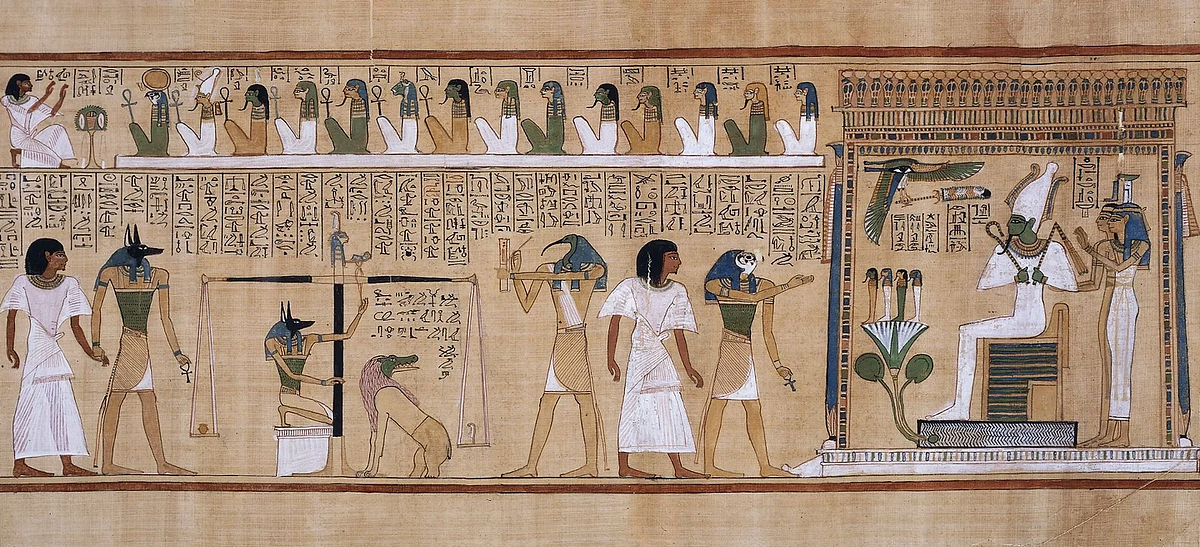
Located at the Temple of Ramesses II in Abydos]
Matthew 5:3–12 (colloquial translation) —
Beatitudes: “Blessed are the poor in spirit, for theirs is the kingdom of heaven. Blessed are those who mourn, for they will be comforted. Blessed are the meek, for they will inherit the earth.” Blessed are those who hunger and thirst for righteousness, for they will be filled with mercy.Blessed are the pure in heart, they will see God. Blessed are the peacemakers, for they will be called children of God. Blessed are those who are persecuted for righteousness’ sake, for theirs is the kingdom of heaven. Blessed are you when they persecute you and say all kinds of false and evil things against you. “Rejoice, and be very glad, for your reward in heaven is great; For the prophets were greatly persecuted.”
In Western societies, rigid scripts dictate beliefs.
1. Select the red or blue side.
2. Accept and defend your chosen side.
3. Contempt and oppose the other person.
4. Consume information that aligns with your beliefs.
5. Inculcate this culture in your children.
EWhile organizations offer diverse perspectives, the right corrodes social structures and historically ignores ordinary people. As open slavery comes to an end, we usher in an Orwellian era in which humans transcend death and become property.

Matthew 16:26 (KJV) —
“For what is a man profited, if he shall gain the whole world, and lose his own soul? or what shall a man give in exchange for his soul?”
“This is the situation of everyone who feels that life is a problem to be solved. Whether you seek to solve that problem through psychoanalysis, integration, salvation, or buddhahood, you define yourself in a certain way when you see life as a problem to be solved.” ― Alan W. Watts, Buddism the Religion of No-Religion
Kitano Gempo, abbot of Eihei temple, was ninety-two years old when he passed away in the year 1933. He endeavored his whole like not to be attached to anything. As a wandering mendicant when he was twenty he happened to meet a traveler who smoked tobacco. As they walked together down a mountain road, they stopped under a tree to rest. The traveler offered Kitano a smoke, which he accepted, as he was very hungry at the time.
“How pleasant this smoking is,” he commented. The other gave him an extra pipe and tobacco and they parted.
Kitano felt: “Such pleasant things may disturb meditation. Before this goes too far, I will stop now.” So he threw the smoking outfit away.
When he was twenty-three years old he studied I-King, the profoundest doctrine of the universe. It was winter at the time and he needed some heavy clothes. He wrote his teacher, who lived a hundred miles away, telling him of his need, and gave the letter to a traveler to deliver. Almost the whole winter passed and neither answer nor clothes arrived. So Kitano resorted to the prescience of I-King, which also teaches the art of divination, to determine whether or not his letter had miscarried. He found that this had been the case. A letter afterwards from his teacher made no mention of clothes.
“If I perform such accurate determinative work with I-King, I may neglect my meditation,” felt Kitano. So he gave up this marvelous teaching and never resorted to its powers again.
When he was twenty-eight he studied Chinese calligraphy and poetry. He grew so skillful in these arts that his teacher praised him. Kitano mused: “If I don’t stop now, I’ll be a poet, not a Zen teacher.” So he never wrote another poem.

Matthew 6:19–21 (colloquial translation) —
“Do not lay up for yourselves treasures on earth, where moth and rust corrupt, and where thieves break in and steal; but store up for yourselves treasures in heaven, where moth and rust corrupt. neither will it corrupt, neither will thieves break in.” Steal: For where your treasure is, there your heart will be also. ”
Last question:
1. How do social norms influence your beliefs and behavior?
2. Does embracing complexity deepen our understanding of existence?
3. What steps can we take to move beyond rigid social frameworks and embrace open-mindedness?
