

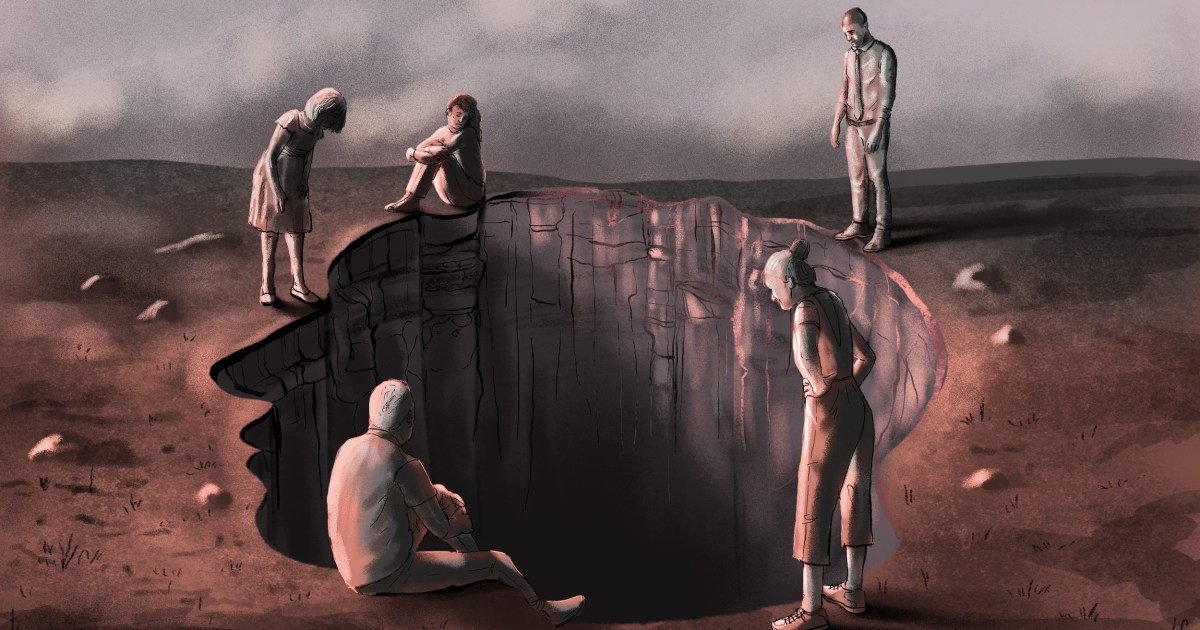
In one TikTok, a young, beautiful woman sits on a toilet and cries. The accompanying text reads, “The insecure part that no one sees.” 7.5 million views, 1.2 million likes, 5,339 comments.
In another video, a different woman is seen meditating, looking sad and worried in various clips. “Having anxiety is perhaps one of the most lonely and isolating states you can be in,” she wrote. 8.1M views, 1.2M likes, 4,028 comments.
In the third video, Jessa, who says she’s a licensed therapist, is crying in bed. “I just want to be normal,” she tells herself in a tearful, almost angry voice. “The part of anxiety people don’t realize.” 1.3 million views, 158,000 likes, 1,132 comments.
Videos spreading awareness about mental health are common and popular on TikTok: as of January 2022, videos with the hashtag #mentalhealth have garnered a total of 25.3 billion views. The social media platform has nearly 1 billion users, who spend an average of an hour and a half on the app per day, more than any other social network.
Prevalence inflation
Psychiatrists and mental health experts are increasingly concerned that spreading mental health awareness through TikTok could be counterproductive and even harmful. Their concerns are compounded by the fact that two-thirds of U.S. teens have used TikTok, and one-sixth say they use the app “almost always.” What’s more, 40% of teens start their internet searches on TikTok instead of Google.
An area of mental health that frequently gets featured on TikTok is anxiety, where videos often portray it as a debilitating disorder, when in reality everyone experiences anxiety at one time or another.
“There is no clear dividing line between those who experience ‘normal’ anxiety and those who experience ‘clinical’ anxiety. It’s a gradually changing spectrum with a thousand shades of grey. Yet this point is often forgotten in public debate,” Dr. Lucy Foulkes, a psychologist at the University of Oxford, wrote in a 2023 STAT op-ed.
“Campaigns and social media posts bombard the public with the message that there is something problematic called anxiety, and people start interpreting everything lower level as a symptom of the disorder,” she added, calling this “prevalence inflation”.
Anxiety isn’t the only mental health issue TikTok users bring up; autism, attention deficit hyperactivity disorder, borderline personality disorder, and obsessive-compulsive disorder are also commonly mentioned. And as with anxiety, many content creators encourage their viewers to self-diagnose, which is highly problematic. Research shows that Gen Z, those born between 1997 and 2012, are particularly likely to self-diagnose a mental health disorder, with one study suggesting that three in 10 members of this generation have diagnosed themselves with a mental health issue.
Foulkes is one of the most outspoken academics who argues that we have gone too far in our awareness of mental health. The New York Times In the article, she pointed out that targeted interventions in schools were either ineffective or made students’ mental health worse. Some students began to overinterpret their symptoms and perceive them as signs of mental illness. Others spent too much time ruminating on their thoughts and feelings, at the expense of their overall well-being.
Although there are few studies focusing on the effectiveness of TikTok mental health awareness videos, it is reasonable to assume that they may be worse than in-person interventions. One reason is that it is an oversimplification. In a 2022 study, researchers analyzed 100 videos with the hashtag #mentalhealth. Each video had an average of 13.4 million views. They found that almost half only reported or expressed symptoms of mental distress (like the crying woman mentioned above). Moreover, the majority were not posted by health professionals. The study confirms the fact of TikTok’s almost mythical algorithm: TikTok shows users what catches their attention, but not necessarily what is nuanced, true, or helpful.
“Therapy ‘influencers’ are flooding social media feeds with content about trauma, panic attacks, and personality disorders,” Foulkes writes. “When teens are drawn to such content in their social media feeds, algorithms serve it to them more, reinforcing the feedback loop.”
Self-diagnosis and social contagion
A study published earlier this year echoes Foulkes’ argument. Researchers from the University of Delaware analyzed 100 TikTok videos with at least 1 million views that focused on depression, anxiety, or both. They found that videos featuring personal experiences generated more engagement than videos made by health professionals. These personal experiences included descriptions of symptoms of depression or anxiety and expressions of emotion.
“Assigning common symptoms to these psychiatric disorders may lead to self-diagnosis,” the researchers wrote.
This self-diagnosis can even take the form of social contagion: A few years ago, clinicians noticed a surge in young people exhibiting strange tics. Many of these kids thought they had Tourette’s syndrome because they had frequently watched popular YouTubers who talked about the condition. When specialists told them they didn’t have Tourette’s, the symptoms disappeared.
To its credit, TikTok offers a brief but thoughtful guide to posting videos about mental health, encouraging people to share stories of “coping, hope and recovery” that may be helpful and avoid topics that may be upsetting to others, but most TikTok users are likely unaware of this resource.
In a 2023 Q&A, Emily Hemendinger, an assistant professor of psychiatry at the University of Colorado School of Medicine, highlighted TikTok’s pitfalls in spreading mental health awareness.
“Many of these TikToks attempt to pigeonhole human emotions and experiences into neat diagnostic boxes,” she said. “Trained mental health professionals would also be gathering additional information about a person’s symptoms, functioning, and history that could be misinterpreted by viewers.”
Hemminger was referring to the risk of misinterpreting normal human experience as a disorder – a phenomenon known as “pathologization.”
“You can’t always put a diagnostic label on something,” she says.
A word she sees a lot on TikTok is “high functioning.” People claim to have anxiety or depression, but also say they’re “high functioning.” But she says that’s not a clinical term; if you’re high functioning, you’re not technically anxious or depressed.
But is the tendency for young people to label themselves as “anxious” or “depressed” necessarily a problem, or are some psychiatrists overreacting by viewing it as a terminology hijacking?
Joseph Davis, a sociology research professor at the University of Virginia’s Institute for Advanced Cultural Studies, interviewed people who regularly consume mental health content on social media.
“When I asked people I interviewed if they thought they suffered from a mental illness, nearly everyone answered ‘no,'” Davis told A&S Magazine in late 2022. “We medicalize mental distress by categorizing it into flat, homogenous categories like depression or anxiety, and people really understand that. Clinical terminology has replaced our language of emotions and other ways of talking about difference.”
Davis elaborated on this point in an email interview with BigThink.
“I think there are many problems with the adoption of the vocabulary of diagnostic psychiatry by the general public. While providing a friendly community is certainly beneficial, I get the impression that the interpretation of everyday suffering on this site is typically in narrow, often biological terms, rather than in broader moral or existential terms. I worry that personal support comes at the cost of adopting an unhelpful perspective.”
Another potential problem with TikTok’s proliferation of mental health awareness videos is that it will increase demand for therapy in an already severe shortage of qualified mental health professionals in the US and UK. To be clear, some of this increased demand is coming from people who desperately need help, but a significant amount could also be coming from people who have begun to pathologize everyday emotions after watching TikTok videos.
A cynic might think that mental health professionals would welcome the extra work that comes with people turning everyday feelings into mental health problems. In a 2017 interview with the BMJ, Sir Simon Wesley, professor of psychiatry at King’s College London, said the opposite is true.
“We’re not part of a global conspiracy to make everyone have a mental health problem. We do the opposite. We say, ‘This is not a psychiatric problem,’ because we are acutely aware of the dangers of over-medicalizing normal emotional problems.”
Other medical professionals welcome the spotlight on mental health on platforms like TikTok and believe concerns about mental health over-attention are misplaced. Dr. Sasha Hamdani, a psychiatrist with a private practice in Leawood, Kansas, is one such optimist.
“Many of my patients initially considered a diagnosis because they ‘saw it on TikTok,’ but are now more open to conversations about their symptoms,” she wrote in an op-ed published last fall on the Harvard Public Health website.
Get counterintuitive, surprising and impactful stories delivered to your inbox every Thursday.
But she acknowledged that the platform hosts a lot of misinformation.
“My patients would hold up their devices to the screen to show me the latest TikToks about mental health, many of which were about potential self-diagnosis, but a lot of it was complete bullshit.”
So Hamdani joined TikTok in December 2020 to correct all that nonsense with reality, and now she has over 900,000 followers.
It has also been argued that the benefits of TikTok’s mental health awareness videos come not from the videos themselves, but from the supportive communities that emerge around them. In a 2021 study, Lindsay Gallagher, a senior at Villanova University, analyzed comments on randomly selected videos about mental illness. She found that 95% were positive. Commenters shared their own experiences, praised the content creators, suggested strategies, and posted in agreement.
“The proliferation of mental illness communities on TikTok has empowered users to share their stories, start conversations to raise awareness, and celebrate each other’s wins,” Gallagher wrote.
Declan Grubb, a fourth-year psychiatry resident at Northwestern University’s Department of Psychiatry, recognizes that users of TikTok and other social media sites will inevitably encounter mental health-related content online, which means mental health professionals need to get involved and make a difference.
“As clinicians, we should be proactive, not reactive, adopters of new technologies,” he wrote in a 2023 editorial in the BMJ.
Grubb wrote that as part of a proactive response, clinicians should form groups to work with companies to improve standards. Two things TikTok could improve on are including warnings about misleading content and letting viewers know where and how to get mental health services. He also said that mental health professionals should get on social media and create their own content.
“As clinicians, we need to ensure our patients have access to reliable content, rather than simply criticizing the various media they use,” he wrote.
If you or someone you know is struggling, it is a good idea to reach out to a mental health professional for an evaluation, and there are many public resources available to provide immediate support, including the 988 Suicide and Crisis Lifeline.
