

As anyone involved in the industry can attest, farming comes with its own challenges.
But according to Louise Saunders, that doesn’t mean you have to stress.
As a stress management trainer and coach and founder of “The Stress Experts,” she helps her clients become their own “stress experts” by providing them with the scientific knowledge and practical skills to help them deal with life’s challenges, big and small.
In this way, her clients find relief from symptoms of anxiety, depression, phobias and post-traumatic stress disorder (PTSD).
Growing up on a farm near Manitou, her journey from the field to the clinic taught her a deeper truth: the importance of managing rural stress.
The agriculture industry is full of stressors, exacerbated by farming’s unpredictable financial circumstances and an identity deeply tied to the land. Uncertainty in the industry leaves farmers susceptible to the vagaries of nature and market fluctuations. Unforeseen setbacks like consecutive poor harvest years, livestock disease or equipment breakdowns can all create severe financial strains and lead to cycles of despair.
“Stress is a human condition and is felt the same across industries, but different industries have different stressors. The key is managing the emotional upset those stressors cause,” says Sanders.
“By understanding the fundamentals of stress and armed with simple, powerful tools to overcome it anytime, anywhere, you can experience the benefits of improved resilience, including less overwhelm and anxiety, more energy, better sleep, and improved efficiency.”
For Sanders, the mission is clear: to give farmers the tools to weather the rough seas of stress. Drawing on her background in physical and complementary therapies, she dug deep into the nitty-gritty of stress management to find holistic solutions.
Sanders takes a multifaceted approach that combines science with practical skills, partnering with organizations like the HeartMath Institute to help farmers harness their natural resilience.
“There are many misconceptions about stress and the topic of stress has become stressful. Nowadays, everything is called stress. However, there is a difference between stress and a stressor. A stressor is an event, situation, or circumstance over which we have little or no control. It is outside of us. Stress, on the other hand, is a negative or ineffective reaction to an event, situation, or circumstance. It is something that we can control.”
Stress is an internal response. When traffic is backed up, your combine breaks down or your cows get stuck in the mud, you might think your only choice is to feel angry, anxious, confused or overwhelmed. But you do have choices, says Sanders.
“You feel like you have no choice because it has become a habitual response pattern. Negative reactions become second nature.”
Stressors in farming include weather, finances, policy, labor, farm transitions, succession, and even small things like sour milk or broken dishes. Anything can become a big problem.
“What if the harvest doesn’t come? You can control how you respond, but you can’t control the weather.”
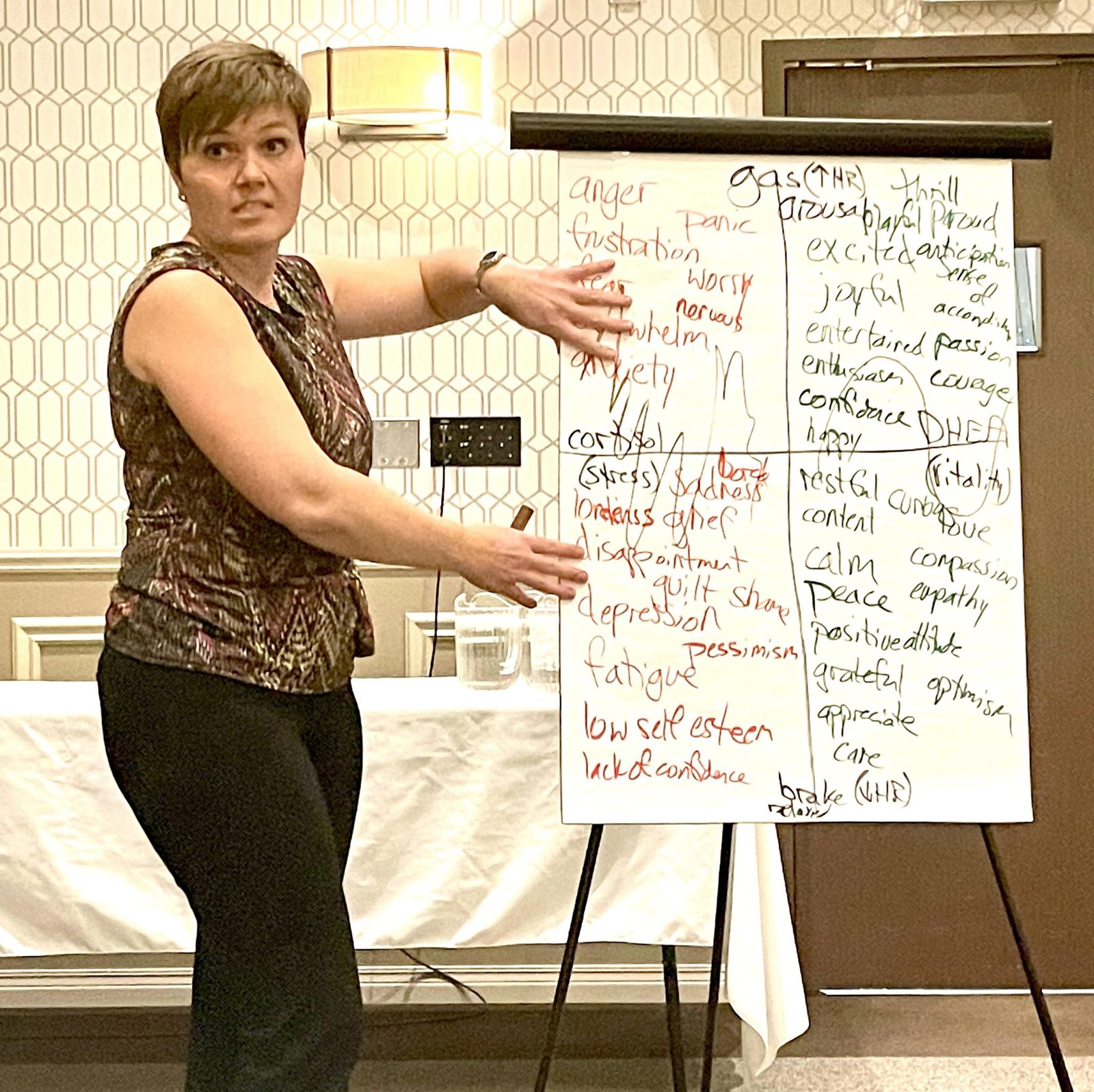
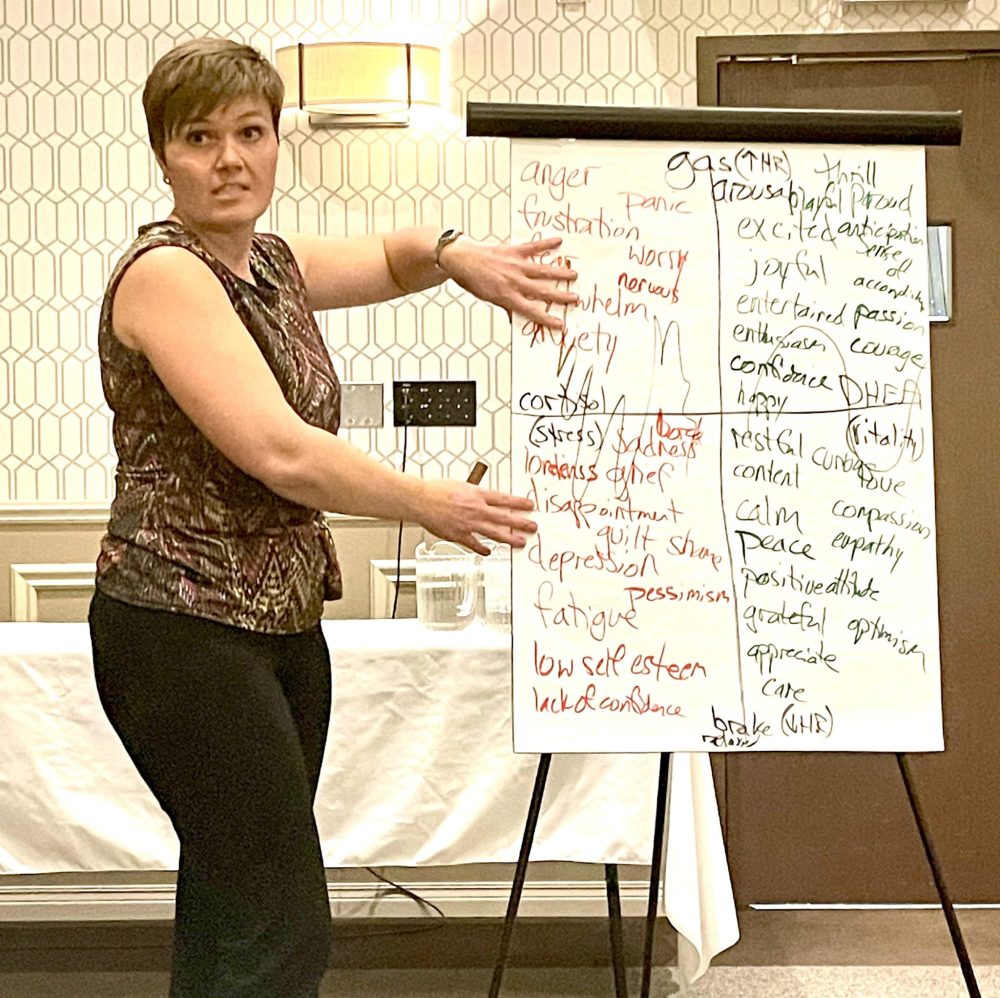
Sanders calls stress a physiological dissonance.
“The gas pedal is your sympathetic nervous system. The parasympathetic nervous system is the brake. And your heart is the gauge. That’s what HeartMath is all about. The medical world used to think that to be healthy, you wanted your heart rate to be like a metronome and constant. But now we know that’s not true. We don’t want that. We want natural variation. Your heart rate should change regardless of what you’re doing.”
The heart and brain are in constant communication, she adds: “The heart does most of the talking, and it does it in rhythm. Information from the heart is sent to the brain, which influences how the brain functions – memory, choices, creativity, emotions and relationships. People with better brains are people who make smarter decisions.”
The main driving force behind all this, she says, is
“This is something you can control. But when you experience negative emotions like fear, anger, anxiety, sadness, loneliness or worry, your brain goes offline. You can’t think clearly. You can’t make decisions. You can’t solve problems on the farm or in business. It’s like driving your inner car with one foot on each pedal. It causes wear and tear on the machinery, systems to break down, and you lose the joy of life.”
But there is hope.
“When we experience new positive emotions like gratitude, compassion, love, peace, calm, excitement, etc., our hearts create an entirely different rhythm that is sent to our brains. Our brains function more optimally. We make smarter decisions. We make plans. By choosing our emotions, we choose what goes on in our brains,” Sanders argues.
“At its core, it’s about understanding what stress is, what causes it and how it affects us. Armed with this knowledge, farmers can take back control of their emotional wellbeing.”
