

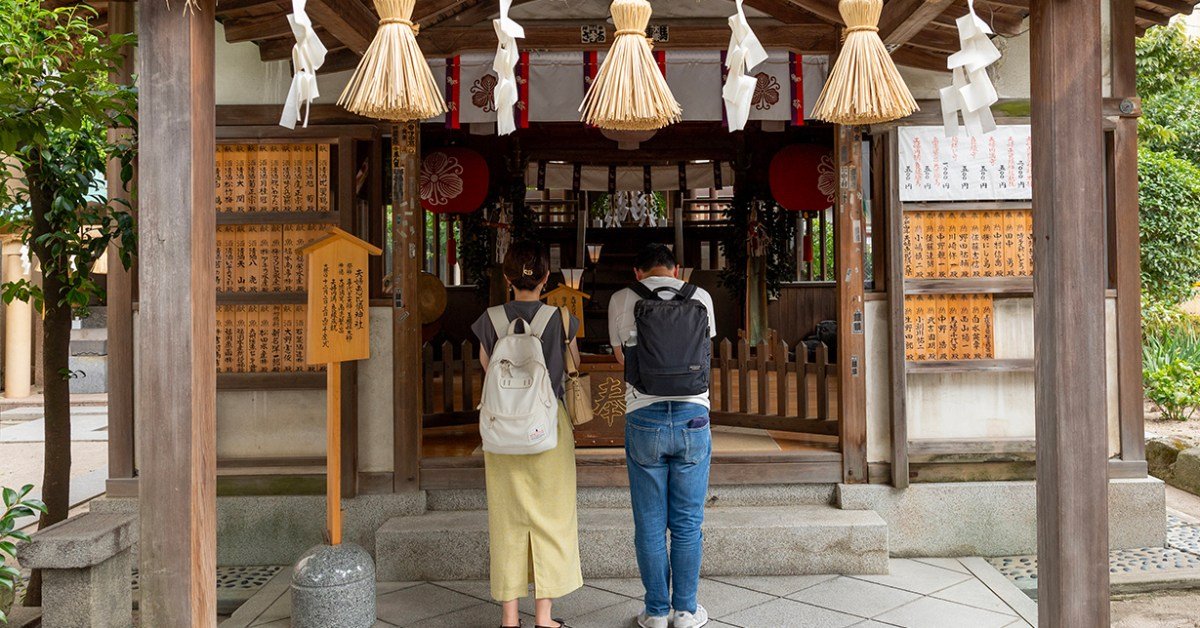
Many adults in East Asia and neighboring Vietnam have no religious affiliation, making the region by some measures one of the least religious places in the world. But many people in the region, even those without religious affiliation, have religious or spiritual beliefs and practice traditional rituals.
The findings come from a 2023 Pew Research Center survey of more than 10,000 adults in Hong Kong, Japan, South Korea, Taiwan and Vietnam. The survey builds on the center’s previous surveys of religion in China, India, South Asia and Southeast Asia.
Here are six key findings about religion and spirituality in East Asia and Vietnam.
The analysis is based on the Pew Research Center’s report, “Religion and Spirituality in East Asian Societies.” For the report, we surveyed 10,390 adults in East Asia and neighboring Vietnam. Local interviewers conducted the survey in seven languages between June and September 2023.
The interviews were conducted over the telephone in four locations: Hong Kong, Japan, South Korea, and Taiwan, and face-to-face in Vietnam.
The survey is part of the Pew Templeton Future of World Religions Project, which analyzes religious change around the world and its impact on society.
Respondents were selected using a probability-based sample design: data were weighted to account for different probabilities of selection and to match demographic benchmarks for the adult population.
For more details, see the report methodology and full research questionnaire.
East Asia is usually considered to include China, Hong Kong, Japan, Macau, Mongolia, North Korea, South Korea, and Taiwan. Geopolitically, Vietnam is often classified as part of Southeast Asia. However, we have included Vietnam in East Asia for several reasons, including its historical ties with China and its Confucian tradition. Furthermore, Vietnamese Buddhists practice the same Buddhism (Mahayana) found throughout East Asia.
Throughout this report, the term “East Asia” refers to Hong Kong, Japan, South Korea and Taiwan.
When discussing trends across the broader “region”, Vietnam is included.
For legal and logistical reasons, we did not survey several other locations commonly considered to be part of East Asia. China does not currently allow non-Chinese organisations to conduct surveys on the mainland, and public opinion polls are not possible in North Korea. A large proportion of Mongolia’s population leads a nomadic lifestyle, making it difficult to conduct a nationally representative survey. We did not survey Macau because of its relatively small population.
Most people in the region identify as either non-religious or Buddhist. The non-religious are the largest group in the three countries surveyed: roughly half or more of adults in Hong Kong (61%), South Korea (52%) and Vietnam (48%) say they have no religion, while significant proportions in Japan (42%) and Taiwan (27%) say the same.
Buddhism is also widespread in the region, with 46% of Japanese adults, 38% of Vietnamese adults, and 28% of Taiwanese adults identifying as Buddhist. In South Korea and Hong Kong, 14% of adults are Buddhist.
Many people in South Korea and Hong Kong identify as Christians, and Taiwan has a significant number of Taoists.
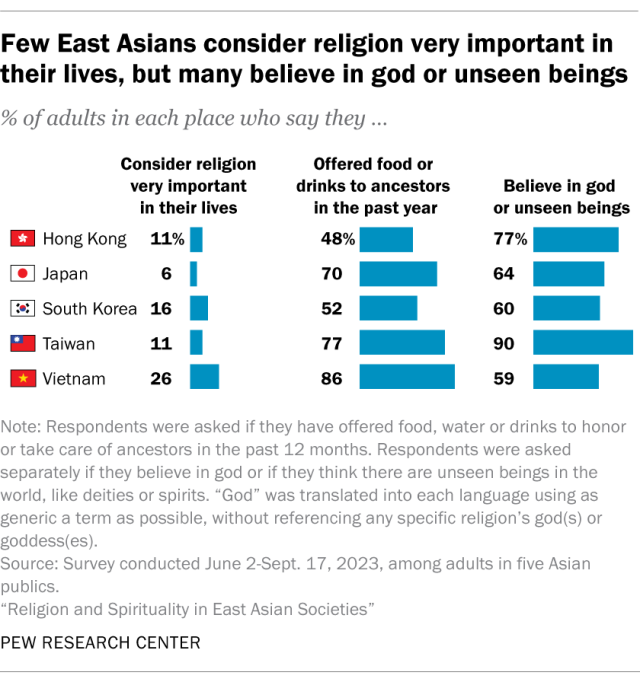
Although relatively few adults say religion is very important in their lives, many have spiritual beliefs. Fewer than 26% of adults in the five regions we surveyed say religion is very important in their lives, but most adults say they believe in God or some other unseen entity such as a deity or spirit.
Many people believe that there are invisible spirits in nature: in Taiwan, Japan and Vietnam, roughly half or more of adults say they believe that mountains, rivers and trees have spirits.
Nonreligious adults are less likely to believe in God or an invisible being than Christians or Buddhists, but in each region at least 4 in 10 nonreligious adults express these beliefs.
Moreover, non-religious people generally more Christians are more likely than non-Christians to believe that spirits reside in mountains, rivers and trees: in Hong Kong, for example, 35% of non-religious adults believe so, compared with 25% of Christians.
Ancestor worship ceremonies are attended by many people. In East Asia and Vietnam, ancestral spirits are a common focus of rituals. In every region surveyed, roughly half or more of adults said they had made offerings of food, water, or drink to honor or care for their ancestors in the past year. This practice is common among Buddhists and people with no religion.
Additionally, many adults in the region have burned incense, offered flowers, or lit candles in the past year to make offerings to their ancestors. These practices are most prominent in Vietnam, where 96 percent of adults said they had recently burned incense and 90 percent said they had offered flowers or lit a candle.
Praying and paying homage to religious figures and deities is fairly common in this region. Relatively few people in East Asia and Vietnam pray daily, whereas in South and Southeast Asia it is common, but many East Asians and Vietnamese say they pray. At least sometimesAdditionally, a significant number of people answered that they “pray to or pay homage” to religious figures or gods.
Paying respects is commonly understood in this region as an act of worship or veneration. This can take many forms, including:
- Burning incense
- Providing food and drink
- Make a wish to God
- lower one’s head
- Put your hands together
In most places except Japan, most Buddhists Kannon They pray to Jesus, the God of Mercy, and to Buddha. Nearly all Christians said they pray to or pay homage to Jesus. (The survey also found that most people pray to other religious figures, e.g. Guandi and Mazu.
People in the region generally see religion as a positive force in society. Majorities in Hong Kong, South Korea, Taiwan and Vietnam say religions contribute to society by guiding people to do the right thing. In Japan, roughly half of adults hold this position.
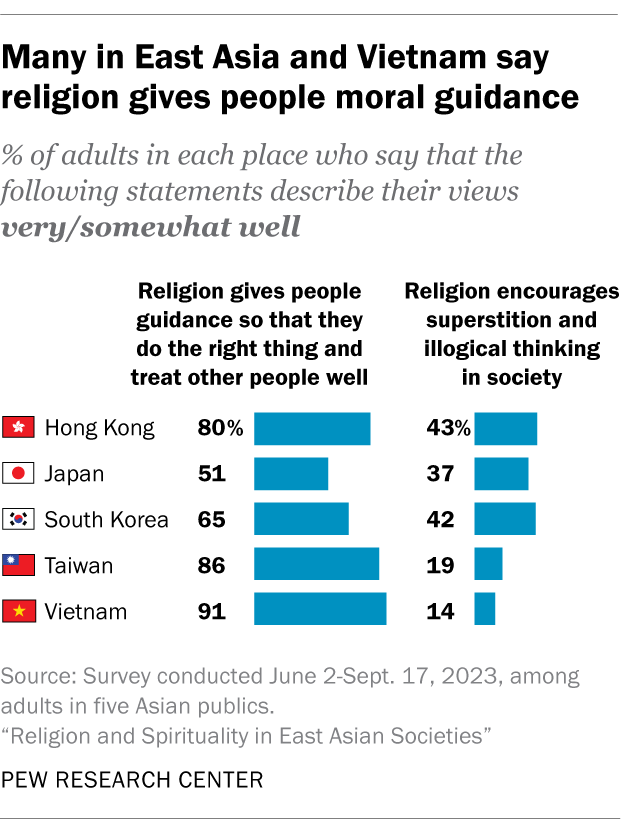
Across the region, Christians are somewhat more likely than other groups to see religion as a positive thing for society: in Hong Kong, for example, 89% of Christians say religion leads people to behave well and be kind to others, compared with 78% of Buddhists and 76% of non-religious people.
Negative views of religion’s role in society are less widespread. Yet roughly four in ten people in Hong Kong, Japan and South Korea each say religion fosters superstition and illogical thinking.
In these regions, the word “religion” is often understood to refer to organized, hierarchical religious forms such as Christianity or new religious movements, and not to traditional Asian spirituality. (“Religion” is commonly translated as: Muneyoshi In Chinese, Training Japanese and Jeonggyo (It’s in Korean.)
Religious identity in the region is changing dramatically. Many adults in East Asia and Vietnam have left a religious upbringing to become non-religious or to switch to another religion: 17% of adults in Vietnam, 53% in Hong Kong, and 53% in South Korea.
Most of these religious switches are ex-religionists. In parts of East Asia, more than three in 10 adults say they were raised in a religion but now have no religious affiliation. These rates of ex-religion are among the highest in the world. In Vietnam, ex-religionists are less common.
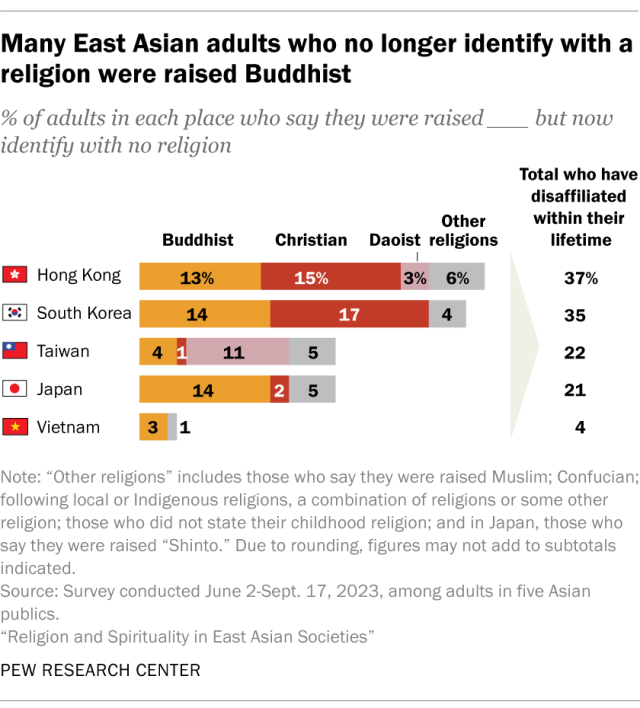
Those leaving are primarily from Buddhism, Christianity and Taoism. For example, 14% of adults in South Korea and Japan said they were raised Buddhist but no longer belong to any religion.
Other adults in the region have switched from the religion of their childhood to another religion: 12% of adults in South Korea and 9% of adults in Hong Kong, for example, now identify as Christian but were raised in a different religious tradition or without any religious identity.
Note: For more details, see the report methodology and full survey questionnaire.
