

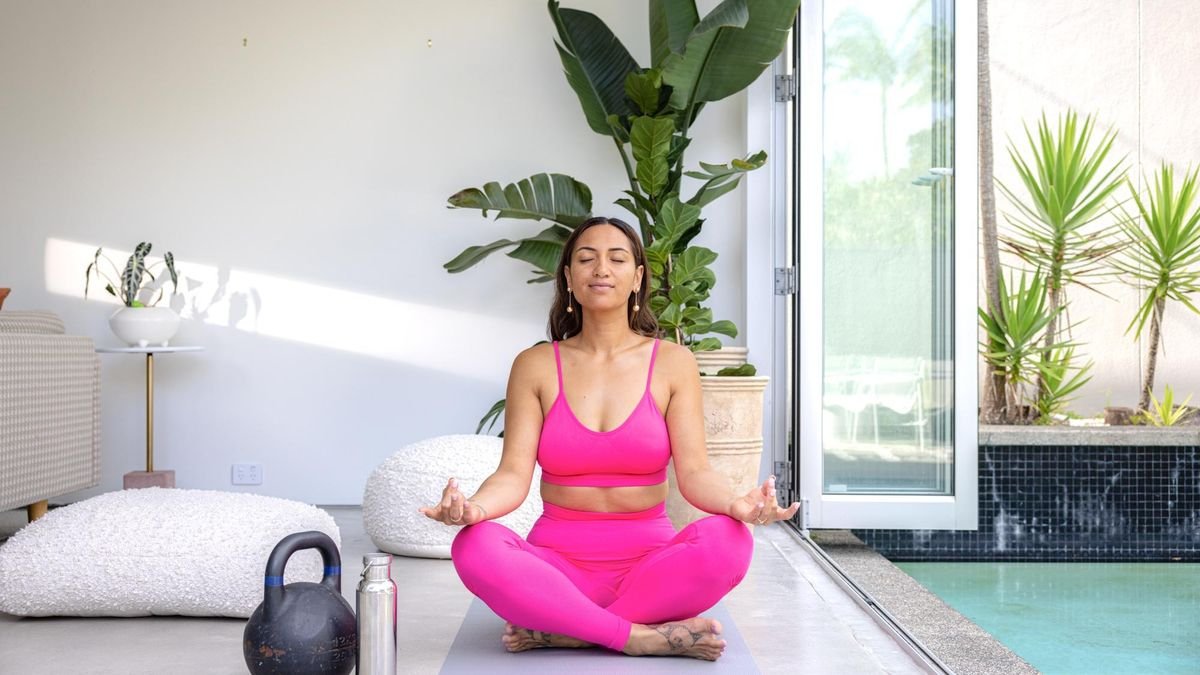
At the beginning of this year, I decided to make continuous meditation one of my health goals. And since incorporating it into my nightly routine, I’ve noticed less muscle tension and a much more in tune with my body.
Seeing these positive physical changes got me thinking about using meditation as a daily pre-workout warm-up. Can the same exercises that are proven to reduce stress and improve concentration help you prepare for intense exercise?
I downloaded Headspace (one of the best relaxation apps), searched for a good guided meditation, laced up my sneakers, and took a few minutes to focus and close my eyes before heading to the gym. Here’s how pre-workout meditation affected my performance.
What are the benefits of meditating before training?
Meditation has long been noted as a way to manage anxiety and boost mood, but its benefits go far beyond mental well-being.
A study in the journal Neural Plasticity found that meditation had a positive impact on endurance and cognitive function in college athletes. But you don’t have to be training for a big game to benefit from a little meditation before your activity.
Improved endurance and cognitive function will also improve your treadmill runs and barbell sets, leading to more efficient workouts and improved overall health.
How to meditate before training
You don’t need any equipment, extra space, or previous experience to start a meditation practice. All you need is a few minutes and a relatively quiet room. If you’re new to meditation, guided sessions can be helpful.
I found Headspace’s library to be particularly powerful, with guided meditations for regulating sleep, processing anger and sadness, dealing with stress, and improving athletic performance.
I decided to do a guided 10-minute movement meditation focused on motivation, training, and recovery before my morning workouts for the week. Here’s what happened to my mind and body during the challenge.
I became more aware of my body.
I feel a little guilty trying to endure pain when I exercise. As you can imagine, I have suffered the effects of various injuries, doctor visits, and much needed rest.
During my pre-workout meditation, I was prompted to take inventory of my body and position in space. During that scan, I noticed a slightly painful throbbing in my right knee.
It wasn’t so intense that I skipped leg day, but it was serious enough that I remembered it when I started the squat portion of my workout. Remembering that little pain, I decided to slow down the tempo of some of my exercises and pay more attention to my form.
Of course, I don’t know if this would have prevented an impending injury, but by being more aware of my body, I was able to focus on executing each movement correctly. But if I hadn’t meditated before my workout, I probably would have ignored my right knee and pushed through leg day as originally planned.
Proper body awareness is important for everyone, but especially for those starting a new training routine or recovering from an injury. Pre-workout meditation can be a game-changer for people who need to pay close attention to their form.
I was focused and attentive.

I’m also a little guilty of picking up my phone between sets and getting hooked on texting, email, and social media. But during a week of pre-workout meditation, I noticed far fewer distractions and more alertness.
I was also able to complete the entire workout several minutes faster than my previous attempts. And while you shouldn’t just worry about calorie consumption (most ways to measure calorie consumption are inaccurate anyway), I was consistently consuming more calories than normal.
Most of us sometimes get distracted while exercising or struggle to find the energy to get through a difficult set. Meditating before your workout may help you focus and work more efficiently.
Recovery is faster
Generally, the faster your heart rate drops after exercise, the better your cardiovascular endurance and conditioning. My heart rate typically decreases by about 90 beats per minute in the first two minutes after exercise.
After several rounds of challenging aerobic exercise with pre-meditation, heart rate dropped an additional 10 beats per minute on average. This faster recovery and improved endurance were the biggest takeaways from a week of pre-workout meditation.
I didn’t get stronger or faster.
When I started my pre-workout meditation experiment, I expected to be able to lift a little heavier and run a little faster by the end of the week. However, other than faster recovery, no significant improvement was observed.
That being said, legitimate strength, speed, and endurance gains take much longer than a week. If you continue to meditate before training, you should start seeing improvements in your performance within a few weeks.
It’s hard to know whether these improvements are due to meditation or just adaptation to the activity (referred to in the fitness world as the “principle of adaptation”), but why continue to meditate during your warm-up? There are many more. programming. I will definitely keep it inside me.
