

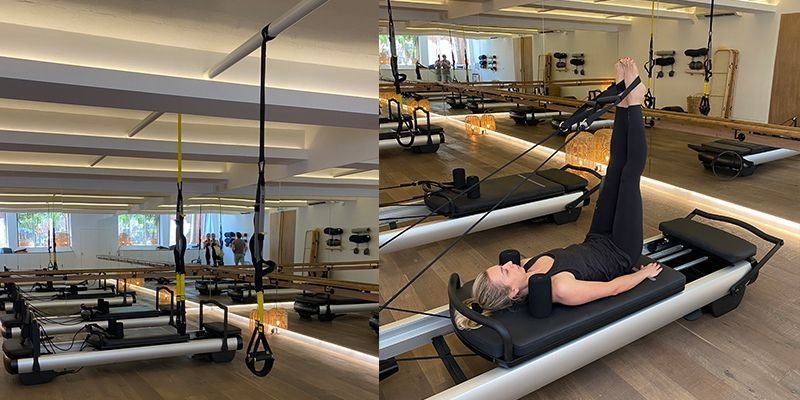
While I’m well aware of the benefits of Reformer Pilates (improved mobility, core tone, strengthened mind-body connection, etc.), it’s not a mainstay of my training routine. Instead, for years I’ve preferred the immediate benefits of running over stretching-based training – the ease of putting on my kit, heading outside and getting my endorphins flowing alone.
But with more and more people raving about the transformative effects of Reformer Pilates (Adele, Hailey Bieber and Margot Robbie are all now enthusiastic fans), and my stress levels and flexibility trending down as well, I decided it was time to see what all the fuss was about.
So I signed up for a one-month course of Reformer Pilates, and here’s what happened:
What is Reformer Pilates?
Unlike mat Pilates, it uses a large piece of equipment (a reformer machine) with a system of springs and pulleys that creates resistance. This equipment has a surface, foot bars, and front and back static platforms that allow for a variety of exercises and movements.
“The cushioning, height, and instability of the rolling carriage with its varying spring resistance provide a variety of stability challenges that engage your deep core and improve your balance and coordination,” explains Jesse Blum, PT and founder of HeartCore. “It works the whole body, integrating breath and movement, and is a low-impact way to activate your deep core muscles.”
Remember: This is a total-body exercise that engages all the muscles, big and small, from your deep abs to the sides of your hips, back, glutes, and pelvic floor. The diaphragm also plays a key role in keeping you healthy while you exercise, Bloom reminds me. The objective? To engage your core, strengthen your muscles, and challenge your balance and flexibility.
Reformer Pilates classes may also use Pilates balls, Pilates rings, ankle weights, and resistance bands.
Can anyone do Reformer Pilates?
Yes. Beginners and professionals alike can benefit from Reformer Pilates, and you can customize your practice to make it beginner-friendly. “You can apply the same principles, but with different spring tensions and settings, it’s completely adaptable for beginners. The stronger you get, the more challenging you can make it,” Bloom asserts. “If the springs are on a lighter setting, some of the movements will put more strain on your core, requiring more effort to control and stabilize the movement.”
Every Reformer class is different and every trainer has a different approach, so if you have any injuries or health issues it’s a good idea to research them before booking a class. Similarly, if you have any spinal problems it’s best to speak to a professional beforehand to avoid aggravating any existing issues.
Check out our complete guide to Reformer Pilates for more information, including which classes are best for you and the kit you’ll need.
So how did my 1 month Reformer Pilates Challenge go?

My Reformer Pilates Challenge took place at Heartcore, one of London’s most respected reformer studios. Heartcore is a place that prides itself on doing things differently. With locations across London, Heartcore’s ambience alone is enough to draw you in (sleek décor, soft lighting, and high-tech reformer machines). But the real draw is the skilled PTs and practices that create innovative, dynamic Pilates classes that draw on a foundation of traditional Pilates and yoga.
I booked two one-hour classes a week for a month (which is a lot for me, by the way) to see what physical and mental benefits I could get.
What happened the first time I tried Reformer Pilates?
I was nervous when I first arrived at the St. John’s Wood studio. Not only was I a complete beginner, but it had been years since I’d attended a group fitness class, so I’d agree with some that the Reformer machines look a little intimidating. How hard could it be, I asked myself? And it was.
My first Dynamic Pilates class left me breathless, moving through slow, precise movements that left my core burning, my heart pounding, and me feeling out of sync with the rest of the class. There were squats and lunges, downward dog and frog pose. How did I feel after? I couldn’t believe my eyes.

5 Things I Learned After Trying Reformer Pilates
1. Reformer Pilates is difficult, but with practice you can see results
There’s no hiding the fact that Reformer Pilates is tough. It’s the kind of exercise that leaves you feeling physically exhausted but energized afterwards. Not only will the movements feel effortless after a few sessions (I highly recommend taking a PT session to understand the movements better), but you’ll see results much quicker than you’d expect.
After about 3 weeks, my arm muscles looked leaner (I don’t do much upper body training so that’s probably why I saw a *slight* difference right away, but it could also have been due to the muscle pump – when blood rushes to your muscles to repair them, they look leaner but don’t last long), and my energy levels were noticeably higher too, which brings me to my next point.
2. Reformer Pilates increases your energy levels
For some reason, I didn’t expect Reformer Pilates to give me the same high that running gives me, but it did. In contrast to running, I left each Reformer Pilates session feeling energized and without that addictive running high. Instead, I felt calm, motivated, and positive.
3. Reformer Pilates is gentle on your joints
My joints have been really hurting from running around town every week and recently running a half marathon. And you know what didn’t help? Not doing enough stretching and yoga after my workouts. After a few Reformer Pilates sessions, I noticed my knee pain had decreased, which is a big win. This is due to the low impact nature of Pilates. It strengthens the joints and surrounding muscles without putting pressure on them, allowing anyone who needs recovery to recover.
4. Reformer Pilates is amazing for “tech neck”
The stretches and breathing techniques of Reformer Pilates have been extremely helpful in relieving tension in the neck muscles caused by stress and staring at a screen for long periods of time (known as tech neck). “When you hold stress and tension, your body’s physiological response is to expand your stomach and tighten your neck and shoulders,” explains Bloom, which is why breathing exercises and core strength are so important.
5. You can combine Reformer Pilates with home workouts
Reformer Pilates is great but expensive to practice regularly every week, and I love being able to apply what I learn to my at-home workouts, like using a Pilates ring to work on my abs on my mat.
Now that I have completed the Reformer Pilates Challenge, what I am going to do next is one class per week and one Pilates workout at home.Who will I run?
You might also like
