

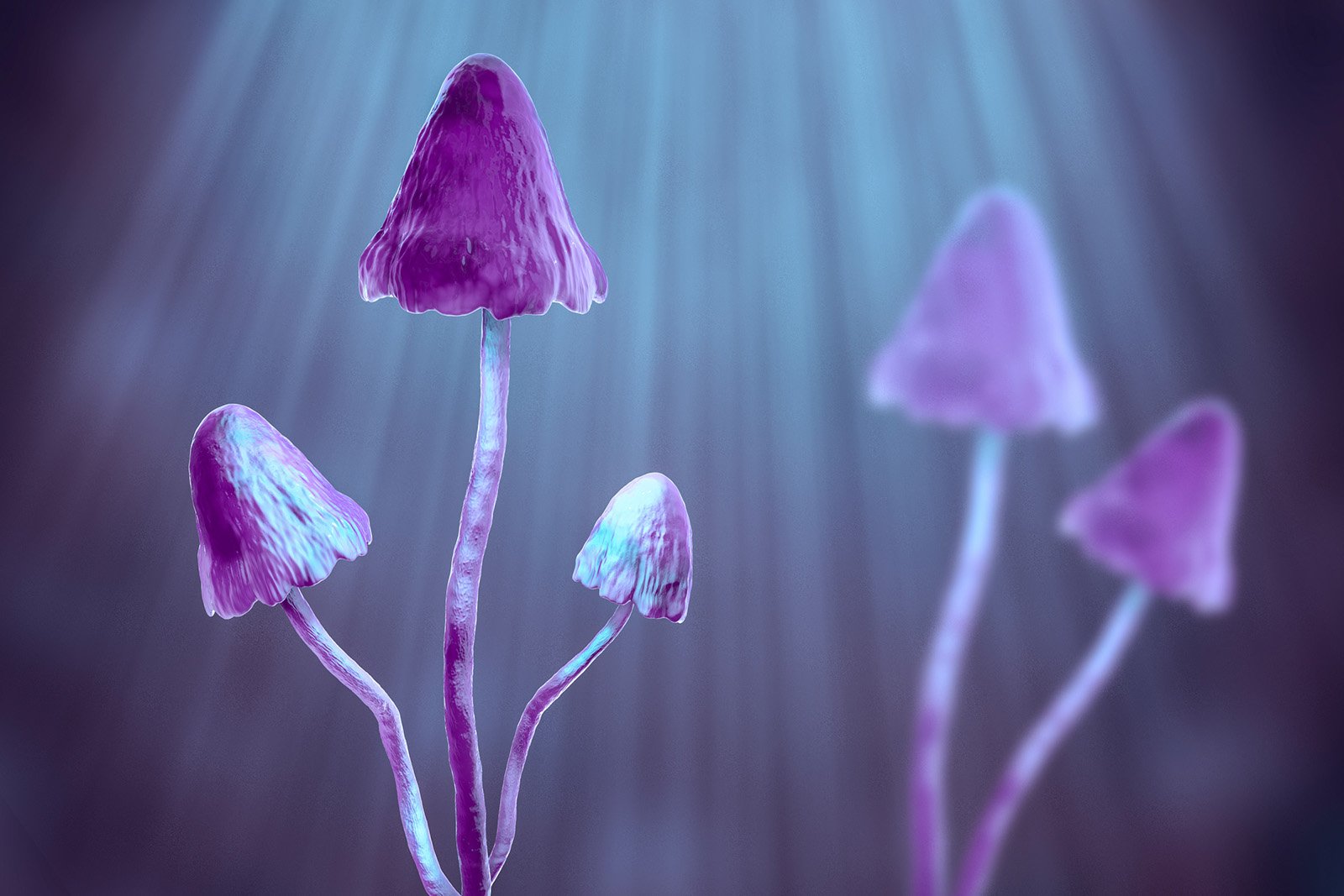
Drugs are forbidden in Islam, but a growing number of Muslims are experimenting with psilocybin mushrooms to treat depression and get closer to God.
Sughra Ahmed had never even heard of psychedelics when a friend told her about a study that was bringing together religious leaders and giving them all two doses of the powerful drug psilocybin, known as magic mushrooms. At the time, Ahmed, who was associate dean for religion and spiritual life at Stanford University in San Francisco, was skeptical at first, but her curiosity was piqued.
After much thought and discussion with trusted friends, she signed up. Key to her decision was her assessment that the intentional use of psychedelic drugs aligned with Islamic principles of growth, expansion, and becoming the best version of oneself to better serve God.
Ahmed never thought he’d reach spiritual nirvana, but it happened in 2018 through two “amazingly energetic experiences” involving visions saturated with soft light and color in a living room-like setting at Johns Hopkins University (JHU) in Maryland.
“I feel more connected to God in everything I do now,” says Ahmed, who is originally from Peterborough and is now an honorary research fellow at the University of Birmingham’s School of Theology after returning from the US. “It’s more pronounced than I expected. I’m more aware of God.” Central to her awakening was her growing realization of the importance of expressing love and “heart-to-heart” communication in her daily life. “For me, it was a reminder to get back to that truth,” Ahmed says. Six years on, her life is completely different, but she says she’s still more focused on thriving rather than just slogging along.
She was the only Muslim among 24 religious leaders who took part in the study, led by psychologist William Richards of Johns Hopkins University and supported by the RiverStix Foundation. Participants took two doses of psilocybin, roughly a month apart, which was larger than most recreational users. The idea behind the study, which has yet to be published, is that mystical experiences are at the heart, even the origin, of most religions. The academics who conducted the study kept data for several months after the participants’ trips and wanted to see whether the religious leaders’ lives had been changed by their encounters with psychedelics.
Ahmed was the last to join after attempts to attract other Muslims failed. Many organized religions are uneasy about or outright opposed to the use of illegal drugs. Drugs and alcohol are “clearly forbidden” in Islam, Ahmed said, and their consumption can “shroud the mind” and turn people into something they’re not. But psychedelics can lift the shroud and provide emotional and spiritual benefits, Ahmed learned through his research as he was deciding whether to take part.
“As a religious leader and a woman, I didn’t want to raise the drawbridge behind me,” she said. “I really wanted to feel that this was elevating Islam in my life in a way that nothing else could. I wanted our allies, Muslims and women of color, to be involved in this trial, because these trials don’t typically include people like me.”
Ahmed has spoken publicly about her journey, psychedelics and Islam at events such as the 2023 Psychedelic Science Conference in Denver. Fellow Muslims have since approached her to share insights from their own psychedelic journeys, ask how they can “make this truth of what we’ve experienced public,” and discuss how their trips have changed and deepened their expression of Islam. There’s even a WhatsApp group with more than 20 members.
“It’s about emotional and psychological growth,” Ahmed says of psychedelic drug therapy, “it’s about trauma, it’s about healing. All of this speaks to my religious expression of what medicine should be.”
Trials investigating the potential of psilocybin mushrooms in treating depression, and MDMA in treating PTSD, have reported large effects, suggesting that the psychedelics may be more effective than current medications prescribed by medical professionals. However, experts say that larger randomized trials with more diverse treatment groups and longer follow-up are needed to fully understand the therapeutic effects of psychedelics.
But research also suggests that in some Western countries, Muslims may be more likely to suffer from depression and may experience symptoms for longer periods than the general population.
Raad Seraj, originally from Bangladesh and now living in the US, said his first mushroom trip helped him find a way to get “outside” his own mind.
A difficult upbringing, which included xenophobic abuse as a child in Saudi Arabia, left him harboring anger and resentment, which he believes are symptoms of depression, although he has never been formally diagnosed. “In my culture, there is no time for depression,” says Seraj, a manager at a technology company.
Thanks to psilocybin mushrooms, which he began taking with a group of friends in 2016, he was able to release “latent, toxic emotions” that had been building up inside him. “My life and relationships are so much richer because I wasn’t just bottling everything up. I’m more self-aware.”
Since starting his podcast about psychedelic drugs two years ago, Seraj has confessed to his family that he’s been using mushrooms as well as LSD and 5-MeO-DMT. “They didn’t understand,” he said, adding that his family has a history of substance abuse. “They didn’t really know what psychedelics were. All they knew was that they were drugs, bad drugs.”
Soon they were gaining wider acceptance. Seraj’s parents were in New York last year when Seraj was speaking at the educational platform Psychedelics Today. “They didn’t just hear me talk about my personal experience,” he says. “That’s when they understood I was talking about medicine, not about drugs. It’s still hard for them, but they understand my motivations, and I think that helps them respect me.”
Others have had similar experiences. Ibrahim, originally from Pakistan but now living in the US, was diagnosed with acute stress disorder, anxiety and depression during the COVID-19 pandemic. He discovered mushrooms while researching for a cancer treatment company, and then watched the Netflix documentary Fantastic Fungi. “Honestly, it was a major turning point for my mental health,” Ibrahim says. “Everything became clearer and I started to feel happy with the way my life was unfolding. I finally started to deal with all the things I’d been avoiding.”
Then, like Seraj, he began spreading the message. “I couldn’t wait to get my suffering friends and family to try it,” he recalls. Ibrahim, who asked to give only his first name, recommended the drug to more than 20 close friends and relatives, and oversaw their journeys. Most of them, he says, suffered from depression, anxiety and stress. “It was amazing how this drug helped them face parts of themselves that they had been avoiding.”
His conservative father, in Pakistan in November 2022, was the first. “I took him on the trip,” he says. “He resisted because he’d caught me doing haram things in the past, like drinking alcohol and smoking marijuana.” But Ibrahim impressed upon his father that “the beauty of mushrooms” is that your prearranged intention helps define the experience. “I said, ‘Watch these two documentaries with me and judge for yourself.’ He watched it and said, ‘Okay, you can give it a try on me.'”
Though initially skeptical, Ibrahim says his father, and others who tried mushrooms, completely changed their minds about psychedelics after the trip. “My son came back amazed,” Ibrahim says. “He had a very clear vision and it gave him a whole new perspective. My mom and uncle did the same thing. People started calling me a doctor.” He has now founded a mushroom microdosing company.
“Psychedelics have opened my eyes to how to best live life as a Muslim,” says Marwan El-Gamal, director of a UK-based creative agency that advocates for cannabis legalization. He says some believe Islam’s mystical roots suggest a possible lost history of psychedelic use. The Quran mentions the use of unidentified fungi. In the Sahihhan, a collection of hadith, the Prophet is quoted as saying that qama (the mushroom truffle) is a kind of manna, and its juice is medicine for the eyes. El-Gamal suggests, “Maybe eye medicine can also change perspective. I feel that these tools are God-given to us to understand things.”
One British Muslim woman, who did not want to be named, said her grandfather had told her stories of eating hallucinogenic mushrooms that grew naturally in Pakistan, but that drug taking of any kind remained taboo in her family.
“I can’t tell my family that I’m microdosing,” she says. “None of my Muslim friends do psychedelics. We don’t talk about it.” Drugs are all lumped together, she adds. “But I think everyone should try psychedelics. I see the world differently now and I feel more connected to people.” At the time of writing, she was on a psychedelic retreat.
But Ahmed hasn’t taken psychedelics since the study, and has no plans to do so anytime soon. Still, she says, “I feel like the drugs keep speaking to me. I’m still so connected to those experiences, it feels like it was just recently. I’m not prejudiced, but I don’t just want to do it. It’s sacred.”
topic

Subscribe to Hyphen weekly
Subscribe to Hyphen’s weekly roundup for insightful reporting, commentary and the latest arts and lifestyle coverage from across the UK and Europe.
