

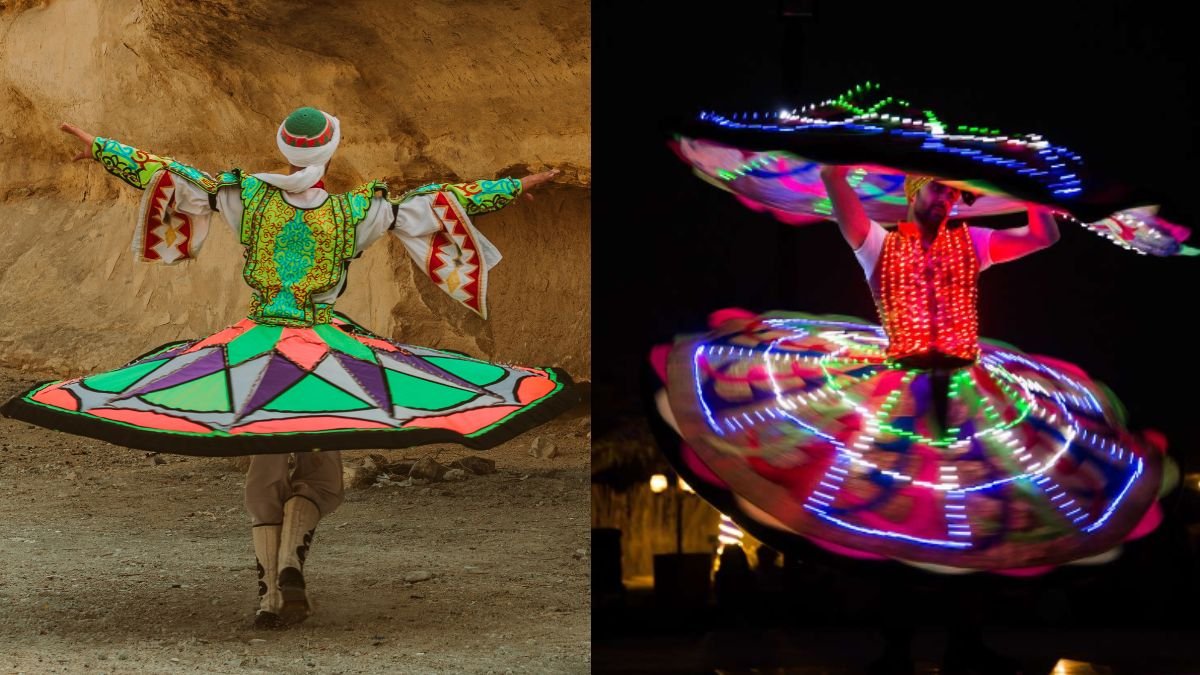
During a trip to Egypt, as a belly dancer left the performance hall, I turned to friends to discuss her performance and her eye-catching outfit. Then I saw another artist enter and take his position in the center of the hall. “Tanoura dance!” someone at the next table yelled. The audience applauded rhythmically as young people wearing large colorful skirts with lights began spinning to an Arabic song.
egyptian tanoura dance
Tanoura dance#Renbo#Dowcruise pic.twitter.com/VVDvcqLmkQ
— 🌹हिम रानि 🌹 (@punamsiri1) June 10, 2023
Tanoura dance is a vibrant and captivating traditional Egyptian dance. Characterized by colorful, voluminous skirts and swirling movements of the dancers, this dance is not only a mesmerizing spectacle, but also a highly spiritual and symbolic performance. It has its roots in Sufi practice and reflects a rich cultural heritage spanning centuries.
Tanoura’s dancer took off one of her skirts, folded it, and held her in her arms like a baby, the layers of her skirt swirling as the show continued. Just before the end of the performance, the dancer took off her skirt, twirled it over his head, and moved from table to table, spinning the skirt over the heads of the audience. I later learned that some people believe this represents Almighty God’s blessing on the participants.
The dancers, usually men, wear the distinctive tanoura skirt and begin their performance with slow movements. As the dance progresses, the pace quickens and the swirls become more intense. The dancer often keeps his arms outstretched. One of his hands points up towards the heavens and the other hand points down towards the earth. The sight of rotating skirts is a visual feast. The skirt flares out in concentric circles. The colors and patterns change and evolve with the dancers’ movements, like a kaleidoscope. When spun rhythmically to traditional Sufi music, it creates a hypnotic effect.
Also read: 48 hours in Cairo, Egypt’s historic capital: A guide to exploring the city for first-timers
tradition and significance
Tanoura dance on a dhow in Dubai pic.twitter.com/PX4tFWoM7l
— KU Thankachen (@Thankachen) December 18, 2023
Tanoura’s spiritual foundations are deep. The origins of this dance date back to the Sufi traditions of Egypt, where this whirling practice was adapted and developed into Tanoura dance. While retaining the spiritual essence of the original Sufi ritual, Tanoura has incorporated more theatrical elements, making it a popular performance art.
Each element of the dance has a symbolic meaning. The swirling motion represents the constant movement of the universe and the cycle of life. The act of spinning is also a metaphor for shedding worldly attachments and reaching a higher state of consciousness. A multi-colored skirt, or “tanoura”, is also an important element. It is usually made up of multiple layers, each layer representing a different realm or level of understanding in your spiritual journey.
In contemporary performances, dancers may also incorporate additional elements into their skirts, such as LED lights, to give traditional dance a modern twist. These adaptations help keep dance relevant and exciting for new generations. Through evolution and adaptation, Tanoura continues to thrive…
Cover image credit: Canva
