

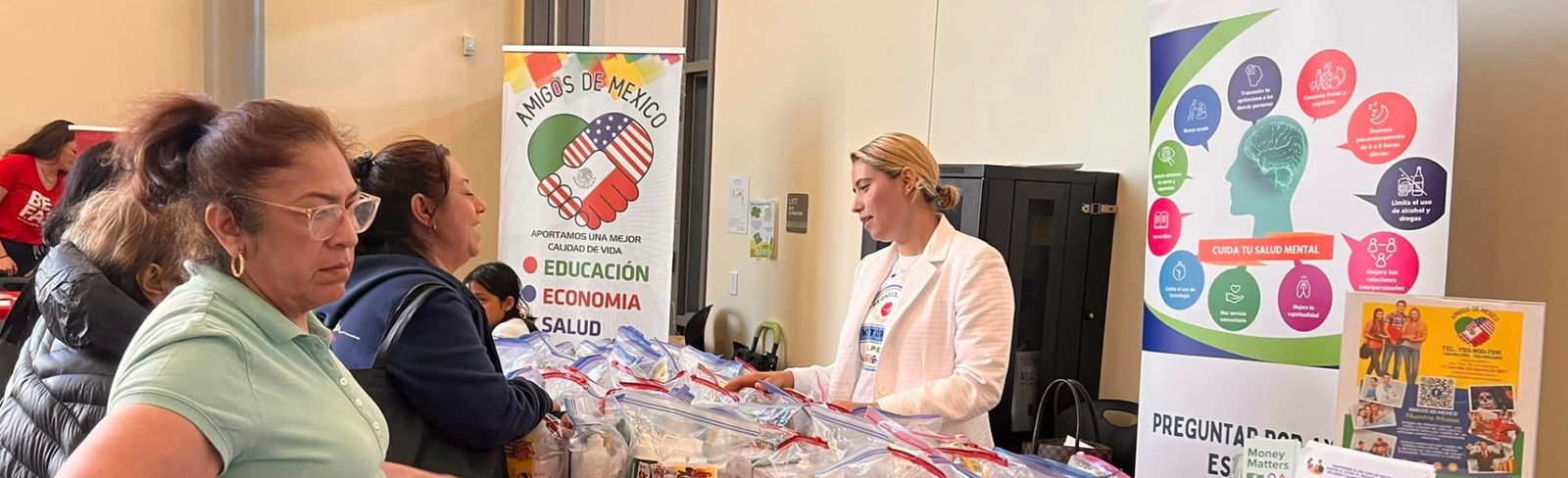
A health fair hosted by the Aurora Wellness Community (AWC) this spring reaffirmed what AWC staff and volunteers have known for years: There is a real need for free, accessible health care resources in the Aurora community.
“As soon as the event was over, community members started asking questions like, ‘When is the next one? Will this become an annual event? Will I be able to get additional testing?'” says Griselda Pena Jackson, AWC Engagement Strategist and staff member in the Department of Family Medicine at the University of Colorado School of Medicine. “Communities want more events like this. They need services to be comprehensive, diverse and free. Most of the community members who attended the events either don’t have insurance or medical care, or they need specialized care and don’t know where to get it.”
The AWC is a partnership between the Aurora region and the CU School of Medicine aimed at building the health, wealth and well-being of residents in the areas closest to the CU Anschutz Medical Campus, some of Colorado’s most medically underserved zip codes.
The nonprofit plans to open a permanent clinic in the community in August, and its health fair, held March 30 at Aurora Science and Technology Middle and High School, was a proof of concept of sorts, bringing together in one place such services as skin cancer screenings, distribution of colorectal cancer screening kits, routine blood tests, rheumatology screenings, pediatric and adult vaccinations, dental and hearing exams, HIV and STD screenings, blood pressure checks, pharmacist consultations and even children’s crafts and face painting. Services were provided by departments within the CU School of Medicine and by community partners.
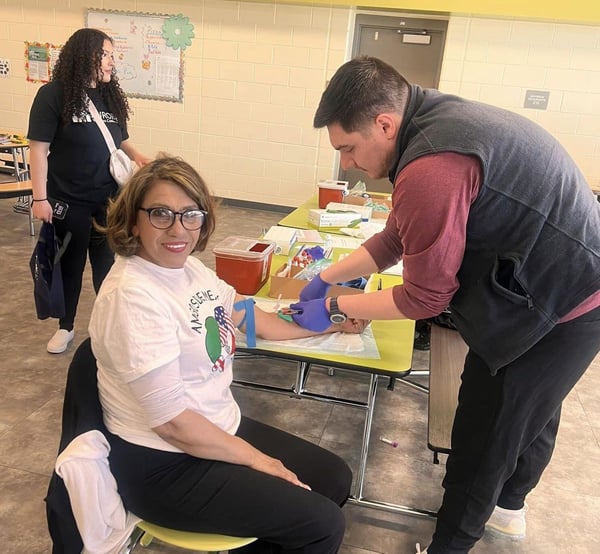
Visitors are getting vaccinated at the AWC Health Fair.
Centers and departments from the CU Anschutz Medical Campus and CU School of Medicine participating in the health fair included the CU Cancer Center, Department of Otolaryngology, Office of the Vice President for Research, Multidisciplinary Center on Aging, CU Anschutz Health and Wellness Center’s Community Nutrition Program and BfitBwell Cancer Exercise Program, Rudeman Family Center for Women’s Health Research, Center for Health Equity, CU School of Dentistry and the Helen and Arthur E. Johnson Depression Center in the Department of Psychiatry.
“It was a great opportunity for our university colleagues and community members to come together and work together to help fill a gap in the health care issues in our community,” Pena-Jackson said. “We also had our pharmacy and dental students come in and provide services, and the Aurora University of Science and Technology students got to experience the different stages of becoming a health care professional.”
A total of 42 organizations provided resources and services at the event, including community partners such as Xcel Energy, Salud Family Health Center, Qwest Diagnostics, City of Aurora Office of International Migration and Hunger Free Colorado.
Inviting these groups to participate in the event sparked further collaboration between the AWC and community organizations, Pena Jackson said.
“We want to be a focal point for making those connections and bringing the community’s voice to the university,” she says, “to let people on the Anschutz campus know what services they need and that community organizations want to collaborate and partner with them. Health equity and lack of health care in the immediate community around campus is a huge issue, and it’s important to show that we’re in this together.”
Dramatic impact
The health fair’s impact on the Aurora community was significant and immediate, says Maureen Macecco, AWC’s communications and marketing director. Children were vaccinated and eligible to attend daycare; adults were vaccinated and able to enter full-time employment; dental care and blood pressure checks that had been postponed, in some cases for years, due to language and other socio-economic barriers, could now be done in a welcoming, non-judgmental environment in the heart of the community.
“This was a wonderful opportunity to provide community members with services that may have been difficult to access in the past, both in terms of basic resources like transportation, money, insurance, and also psychological factors like fear, past bad experiences, not being listened to, or the medical team not understanding their unique situation,” Macecco says. “Community partners and campus partners worked together to create an entire health service within a small high school that people could walk around and access.”
Barbara Pena, a business specialist with AWC, added that while she was serving as a translator in the dental area of the health fair, a group of children from Venezuela, ages 7 to 9, came in for a dental checkup.
“Many of them had never been to a dentist before and were in need of follow-up dental care,” Pena said. “This highlights the importance of the work being done and the need for continued support in these communities.”
Bridging the gap
Having organized and participated in community events for the past two years, AWC began the planning process for the health fair by reaching out to community members and asking about gaps in their community’s access to healthcare. The end of the 9Health Fair (later known as 365 Health) in 2023 also influenced the planning.
“The lack of testing offered locally left a big gap,” Pena-Jackson said, “and the initial thought was, how do we fill that gap? From there, we went out into the community and talked to organizations that were already operating within their zip codes and had reach in the community. There was a lot of effort put into focusing resources that were available to the community after the health fair.”
Event organizers also teamed up with Aurora-based DAWN Clinic, a free clinic staffed by professors and students from the University of Colorado School of Medicine, to provide follow-up services after the fair ended.
“We weren’t just going to go out, do the test and say, ‘thank you,’ and go away,” Pena-Jackson said. “We had support from the DAWN Clinic and the CU Department of Family Medicine. If there was anything obviously abnormal in the cancer screening or blood work, local residents would be contacted by a medical professional.”
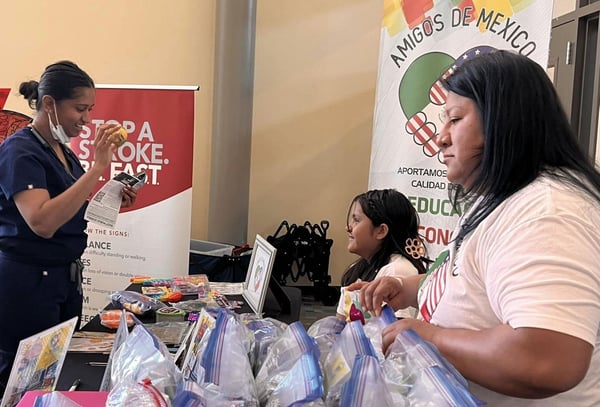
Families interact with volunteers at the AWC Health Fair.
AWC leadership hopes that the AWC Clinic, which opens in August, will provide long-term care for health care workers.
“We hoped that the health fair would help build relationships with the community,” says Macecco. “A lot of thought went into making it an inclusive event. Griselda arranged inclusive training for volunteers and everyone who works there, and also had language interpreters and translators. We wanted people to be able to come, experience the services, and access follow-up care, but at the same time, we wanted to start building relationships between AWCs in the community and AWCs on campus.”
Campus and community connections
Several faculty from the University of Colorado School of Medicine volunteered at the fair, including Colleen Conley, MD, professor of family medicine, and Kellett Robinson, MD, medical director of AWC and visiting associate professor of family medicine. Neil Kraus, assistant vice president for initiatives and community engagement in the Office of Diversity, Equity, Inclusion and Community Engagement, was also on hand to support, and Anne Flubrigge, MD, senior associate dean for clinical operations, also worked at the registration table throughout the day.
“We had some notable people from the university who came out to volunteer and help out,” Pena-Jackson said, “and I think that speaks to the desire of the university and the community to work together to make a difference for a healthier community for all of us.”
The AWC also engaged local residents as volunteers, including students from Aurora University of Science and Technology, who were able to spend the day with doctors and other medical professionals, sparking their interest in a career in medicine.
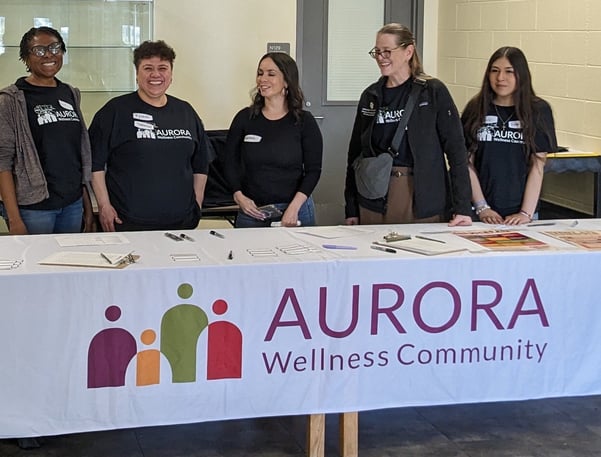
AWC staff working at the health fair.
“We see our approach as helping the community, not just handing it over to them,” Pena-Jackson said. “Many community members volunteered the day before to help with the set-up, and some even helped with the clean-up after the event was over. It was a real community effort.”
Next steps
What’s next for the AWC Health Fair? Organizers say they’re still looking at the data and considering their options, and are waiting to see what changes when the AWC Clinic opens later this summer.
“While we don’t have our next fair scheduled yet, we are working with the community to determine how best we can continue to provide some of these services,” Pena-Jackson said. “The AWC Clinic will be a hub for the health of the community, so once it’s up and running it will help us determine if we want to continue this effort or if it needs to take a different form in the future. Either way, we will continue to work with the community as always.”
