

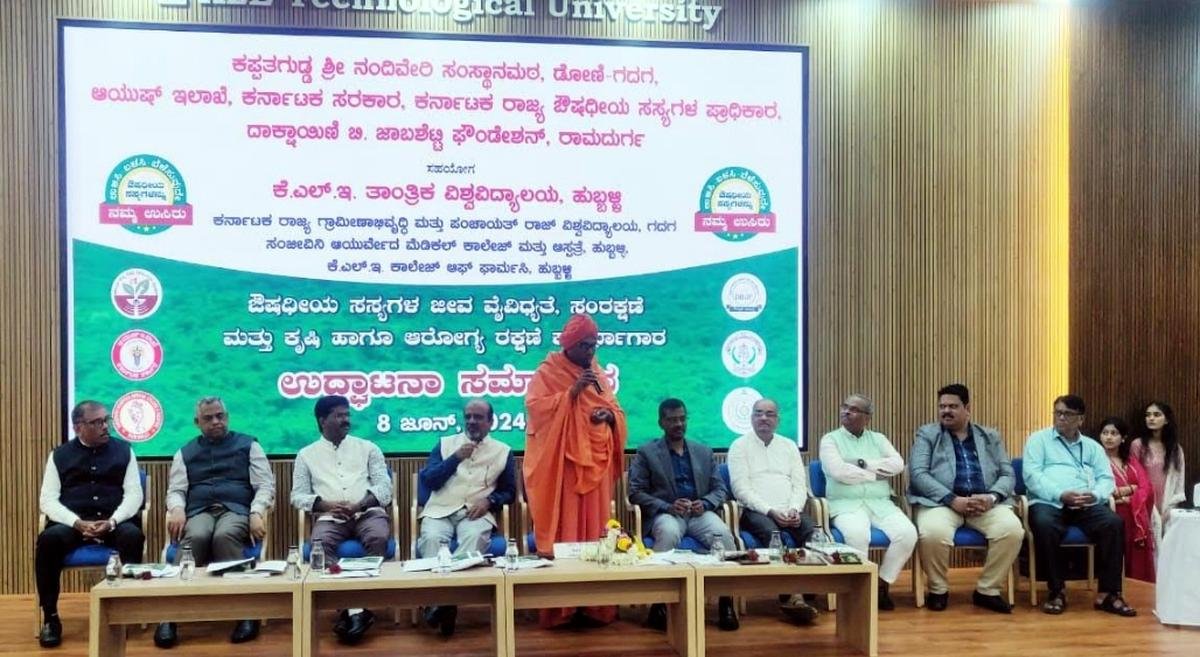
Commissioner of AYUSH (Ayurveda, Yoga and Naturopathy, Unani Siddha and Homoeopathy) Mr. Srinivasulu emphasised the need to develop the Kappatagudda hill range, which is a treasure trove of medicinal and aromatic plants, as a hub for traditional medicine system.
Speaking at the inaugural session of a two-day state-level workshop on ‘Medicinal Plant Biodiversity, Conservation and Cultivation and Health Protection’ at Biotechnology Hall of KLE Institute of Technology, Hubballi on Saturday, Srinivasulu said the biodiversity of Kappathaguda hills should be efficiently utilized.
Srinivasulu also stressed the need to encourage farmers around Kappathaguda to cultivate medicinal plants and said companies manufacturing Ayurvedic medicines should come forward to set up factories near the hilly areas.
However, production has not kept up with the demand, he said, noting that demand for Ayurvedic and herbal products has increased in recent years.Farmers should be encouraged to take advantage of this opportunity, which could bring them more income than traditional crops.
Tie-ups with Ayurvedic pharmaceutical companies will help farmers earn good returns, he said.
Elaborating on the importance and effectiveness of traditional medicine, he said there was a need to go back to traditional systems for the treatment of non-communicable diseases such as diabetes, obesity, blood pressure and cancer.
Venkatesan S, chief executive officer of Karnataka State Medicinal Plants Authority, stressed the need to bridge the gap between growers, industry and users, and pointed out that some pharmaceutical companies have stopped production of some medicines due to unavailability of raw materials.
He said traditional medicine systems have the potential to treat deadly diseases like cancer and that is why people are attracted to it. Farmers should diversify their agriculture by engaging in cultivation of medicinal plants and thereby earn sustainable profits, he said.
Professor Jagannath Rao from the Transdisciplinary Institute of Health Sciences and Technology stressed the need to generate scientific evidence for India’s ancient traditional medicine system.
The turnover of the Ayurvedic medicine industry is around Rs 2 trillion, but cultivation of medicinal plants remains an unorganised sector, he said.
Presiding over the opening ceremony, Vice Chancellor of KLE University of Technology Ashok Shettar regretted that valuable traditional knowledge had been lost due to lack of documentation. However, he said that awareness of the efficacy of traditional medicine has increased in the last decade and there is still a long way to go to further develop it as a better alternative to modern medicine.
Nandiveli Samsthan Mutt Sivakumar Swami, a sage from Kappatagudda who has dedicated his life to the conservation of Kappatagudda, spoke about the need to make cultivation of medicinal plants a viable option for farmers in the region.
Chancellor of KSRDPR University SV Nadagoudar, Chief Administrator of Sanjivini Ayurvedic Medical College Srinivas Bannigol, workshop coordinators CC Hiremath, Balachandra Jabashetti, MR Patil and BS Malwad were among those present.
This is a premium article available only to our subscribers. To read over 250 premium articles every month,
You’ve reached your limit for free articles. Support quality journalism.
You’ve reached your limit for free articles. Support quality journalism.
You have read {{data.cm.views}} from {{data.cm.maxViews}} Free articles.
This is the last free article.
