

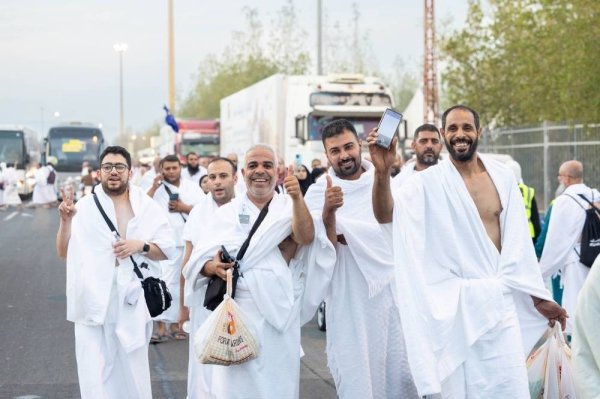
Saudi Gazette reports
Mecca — Whatever the hardships and sacrifices the pilgrims undertake, the journey to the Holy Kaaba and the holy city of Mecca is a journey that every believer aspires to. Those who take action to serve God’s Guest in the Holy Land share moments of joy and self-realization in having had the opportunity to perform a great act of altruistic service in their lifetime.
This multi-stage pilgrimage is a journey that fulfills a heartfelt desire to visit the House of God, see the Holy Kaaba and witness the place where Prophet Muhammad (peace be upon him) spent his youth and childhood – an experience that leaves an indelible mark on the soul.
To achieve this lofty goal, the Kingdom has implemented several measures and, as highlighted by Minister of Hajj and Umrah Dr. Tawfiq Al Rabeeah, 35 companies are now competing to provide services to pilgrims, which has significantly improved the quality of services and pilgrim satisfaction.
Additionally, the establishment of the Hajj Project Management Office, which coordinates over 50 government agencies to provide services to pilgrims, marked a milestone.
The “Makkah Route Initiative” was also launched and expanded to seven countries and 11 airports. This year, more than 316,000 pilgrims cleared immigration procedures at their home airports and traveled easily to their accommodation in Makkah and Madinah upon arrival at airports in Jeddah and Madinah.
Indonesian pilgrim Mariam Muhammad Munir reminisced with Saudi Press Agency (SPA) at the Mecca Route Lounge at Surabaya airport in Indonesia, about her first pilgrimage 60 years ago, when she and her family took a primitive boat through India, the Arabian Sea and the Red Sea, taking five to eight months to reach the Islamic port of Jeddah, a journey fraught with danger, hardship and great expense.
Now, the Hajj and Umrah journeys have been shortened to just a few days, and Maryam noted that the Saudi Arabian government is making every effort to make the pilgrimage easier, safer and more fulfilling, giving pilgrims a sense of security, satisfaction and happiness.
Jamil Al-Hassan, a Syrian journalist from northwestern Syria, expressed his gratitude to Saudi Arabia, saying the quota allocated by the Saudi Ministry of Hajj enabled him to perform the Hajj, a dream left unfulfilled by his father, who passed away after battling cancer. Jamil said he once thought he would never be able to perform the Hajj.
Another pilgrim from Morocco recounted the indescribable emotions he felt when he performed Hajj with his elderly mother and aunt, a once-in-a-lifetime journey that left him shedding tears of joy. He stressed that nothing could compare to performing Hajj with his mother and hearing her pray in the holy land.
In contrast, a Saudi Arabian soldier in charge of caring for and organising the pilgrims said: “Even if we don’t understand their language, it’s enough if they pray for us.”
Fawziya Al Baqeet, a Saudi volunteer from Hail, came to Makkah with her friend Latifa Al Rashidi to work at the Health Volunteer Center. They feel proud and happy to serve the pilgrims and consider it a celebration for them and their families.
The exceptional efforts and quality of service the Kingdom provides to pilgrims continues to improve year after year, as evidenced by the testimony of pilgrimage secretaries such as Sheikh Sami Al-Masoodi, Chairman of Iraq’s High Committee for Hajj and Umrah, who said: “No other country can undertake such a large-scale effort, as we have the experience and capacity to organize millions of people.”
Now, having completed the Hajj and hoping that their sins would be washed away like white clothes that have been washed clean of their dirt, the pilgrims felt that all the hardships and difficulties of the journey had vanished, leaving behind an indelible spiritual mark.
