

Posted by: Lewis Greenstein May 3, 2024 | 5 minutes.read |
share

Residents gain clinical experience while rotating through specialized fields such as general internal medicine, emergency medicine, and critical care. However, they have fewer opportunities to learn about medicine practiced in cultures different from their own.
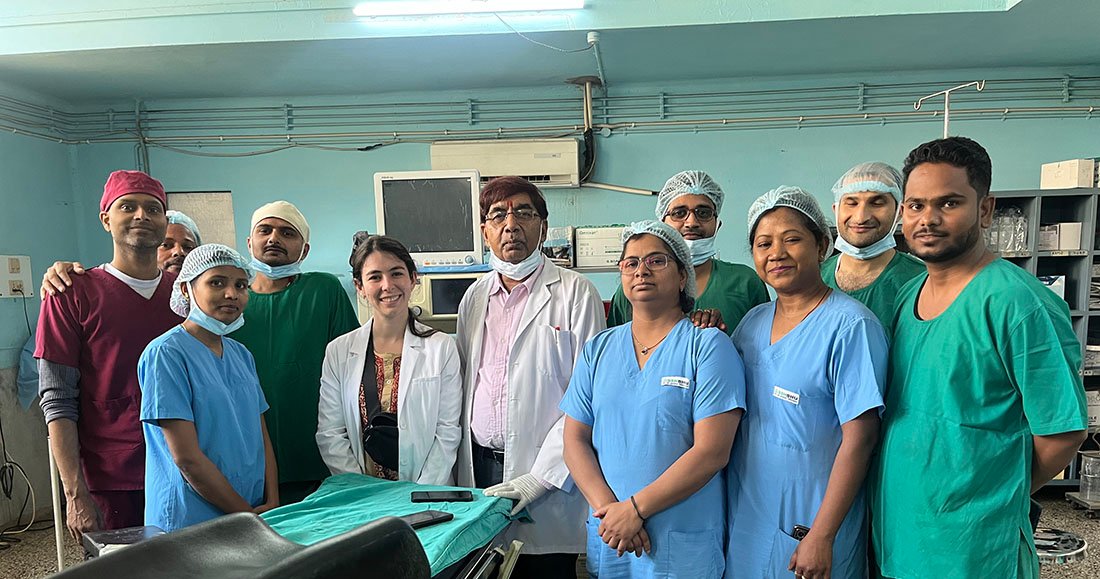
Dr. Gala Godoy-Brewer, a third-year internal medicine resident at the University of Miami’s Miller School of Medicine, took advantage of the opportunity last year to spend a month at Banaras Hindu University in Varanasi, India. The future gastroenterologist observed and participated in Western medicine and traditional Indian medicine at the Ayurvedic school. Among the oldest known medical systems, Ayurvedic treatment is a holistic approach to health that focuses on diet, exercise, and lifestyle, as well as natural products such as plants.
Medicine from a cross-cultural perspective
Dr. Brewer’s experience in India was through the Global Health Pathways offered by the Miller School’s Global Institute. Trainees learn aspects of global health, policy, and cultural competency before being assigned to a global health experience at the National Institutes of Health, a U.S. hospital, or abroad.
“I wanted to go somewhere to learn how different cultures approach medicine,” Dr. Brewer said.
India was perfect because many people rely on traditional approaches, she added. Banaras Hindu University is one of the few universities in India that combines allopathic medicine and Ayurvedic medicine. The departments are next to each other. Patients can choose one or both.
“This integration was very interesting to me because I could see a culturally competent approach for patients who want Ayurvedic medicine in the kind of allopathic medicine that we are used to. Because of that,” Dr. Brewer said.

She was impressed with the Ayurvedic rotation.
“Ayurveda has a gynecological approach,” she said. In the allopathic department, she says, she “does C-sections as well, but the Ayurvedic post-care comes from plants and other things. It’s a really good integration.”
The Ayurvedic approach is not just about treating symptoms.
“Ayurveda has a medical part and a spiritual part,” Dr. Brewer said. “They take care of patients’ lifestyles.”
Lifestyle recommendations range from moderate exercise to consuming ginger daily for three months. Dr. Brewer says the goal is to balance your body, mind, and emotions.
Early contact with indigenous cultures
Growing up in rural Venezuela, Dr. Brewer witnessed poverty up close. She saw people in need of a doctor and learned about indigenous culture from her grandfather Charles Brewer, who was an explorer, naturalist, and writer.
“My grandfather lived with Indigenous communities,” said Dr. Brewer, whose first experience with Indigenous medicine was traveling with his grandfather. “He has written many books on anthropology.”
As a high school student, Dr. Brewer volunteered to help rural children with their homework. There was a small community clinic next to the school.
“They had very few doctors,” she said. “We saw that there was a great need for health care in that area. Through health care, we felt we could provide a part of ourselves to those people.”
Western culture has made great strides in expanding our understanding of alternative approaches to health, but the work is far from over, she said.
“We can provide the best health care to Indigenous people while respecting their beliefs,” she said. “I believe in medicine, but I approach it with respect and cultural competency.”
Dr. Brewer is planning her second global health rotation at a primary care clinic in Antigua, Guatemala.
“I wanted to live in South America, somewhere with a lot of indigenous people,” she said. “Although I plan to primarily practice Western medicine, I would like to see the approach to health care in a clinic in a low-income, rural area. I want to understand the distrust and hesitation. I want to see how they approach that.”
tag: Global Institute for Regional Medical Development, Internal Medicine Training, Resident Training
