

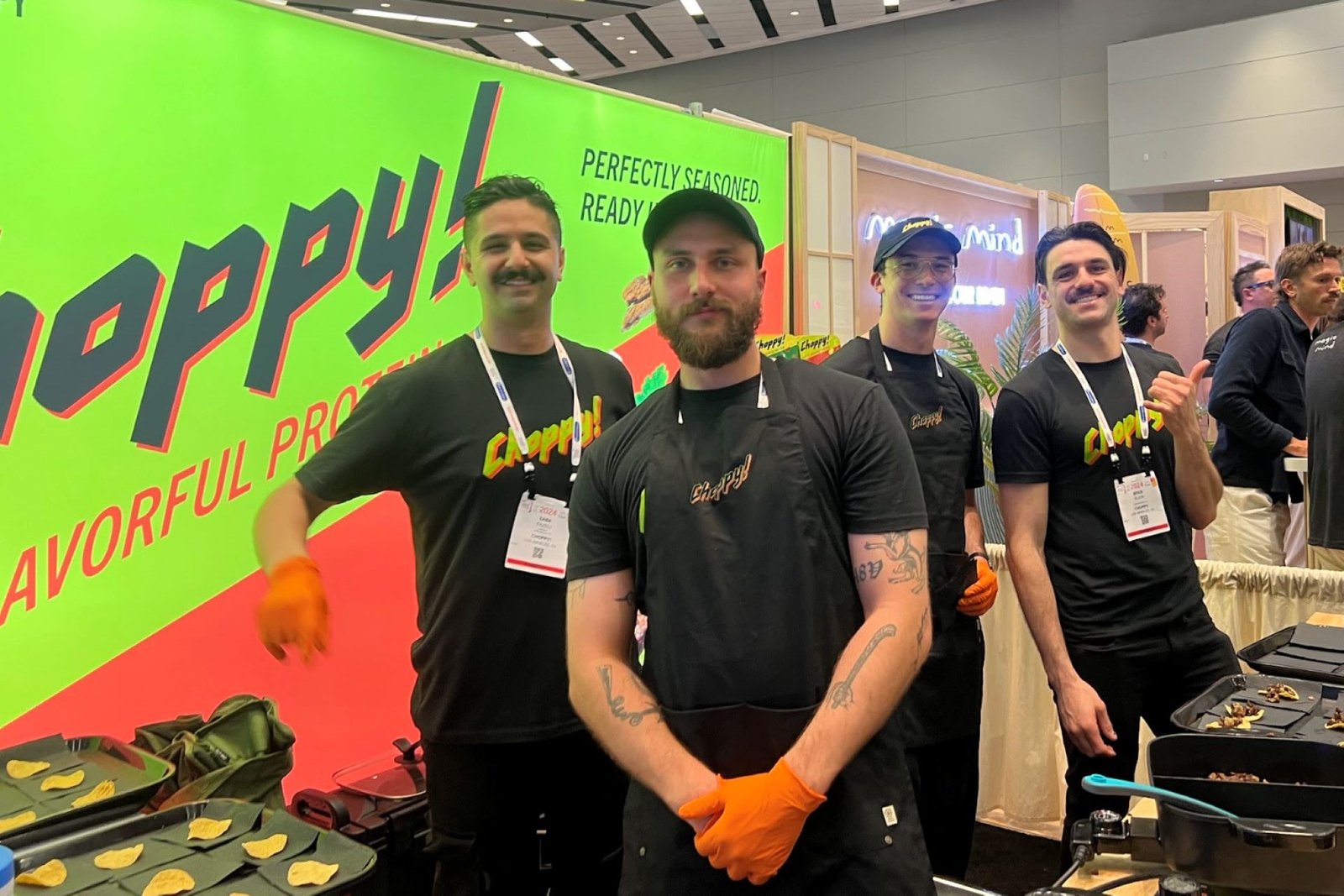
When we think of engineers, we tend to think of buildings, bridges and bionic body parts, and the fact that engineers are making them safer, but two Stanford University engineers have attached their name to making food safer in a new way:
Choppy! founders Saba Fazeli and Bryce Klein have created a hybrid meat concept that’s better for both people and the planet.
Choppy! is a Jetstream-backed startup that makes convenient protein products that are 90% plant-based – the remaining 10% is beef tallow, bone broth and collagen – based on the idea that most people like to eat meat, but would prefer it if there was a healthy, tasty and sustainable option available.
Prior to founding Choppy!, both Fazeli and Klein worked in research and development – Fazeli at Beyond Meat and Klein at vertical farming company Plenty. From their experience developing and scaling textured proteins, Fazeli realized that most plant-based meat companies didn’t have a clear path to improving product quality and reducing costs, and that 96% of people who regularly eat meat are more concerned with cost, health and taste than whether a food is vegan.
This led the pair to develop a primarily plant-based product that’s nearly indistinguishable from meat, cheaper and better for the planet. By focusing on convenience and adopting a hybrid strategy, they explained, they’ve created a product that’s a Trojan horse for sustainability.
“Food is an emotional decision for people,” Fazeli told The Cool Down. “We don’t want people to feel like something they know and love is under attack. We care deeply about the climate, but the downside to the alternative meat category is that it’s near the bottom of the list of things a lot of people care about, even though its main benefits are being good for the climate and animals.”
When developing their product, Fazeli and Klein took a two-pronged approach. First, they solved the problem of meeting expectations for the health benefits of meat. One of the main expectations is for food to be GMO-free, and they are working to get their product certified.
The second is learning how processed foods compete with single-ingredient products like beef patties and the logic, as Fazeli explained, that “one thing is better than many.”
The duo said the key to offsetting meat consumption is meeting the needs of meat eaters and figuring out what it would take, from their perspective, to make it easier to choose primarily plant-based products, even if just for one day a week.
The duo say that many 100% meat products sold in the prepared foods category are much more highly processed than Choppy!’s products, which have relatively clear ingredient lists, so when it comes to presenting their products in an easy-to-understand way and getting people to read the back of the packaging, it’s important that they can understand everything that’s inside.
By using small amounts of the highest quality animal parts, “we can eliminate a lot of the synthetic ingredients that you have to use in plant-based products,” Fazeli explained.
The duo went on to explain that their product isn’t so much about who wants it, but when they want it: “If people want something quick, tasty, and healthy, this is a really good way to do that,” Fazeli said.
“It’s better for 10 times as many people to eat a product that contains 90% of the ingredients than for 1 in 10 people to eat a product that contains 100% of the ingredients.”
Marketing such hybrid products poses challenges for both sellers and consumers, but the duo said the biggest advantage is getting people to taste the product.
The company recently signed a deal with a major grocery chain in the Midwest, where meat consumption is at its highest. Fazeli and Klein are up for the challenge. “We’re going to work hard and see success there,” they said.
“We often assume, and I think that’s arrogant, that only people who live on the coast care about what they put in their bodies and the climate,” Klein said.
“There’s a lot of people on the coasts who are extremist either way,” Fazeli added. “We want this product to be for the Midwest, and we want it to be that way. If it doesn’t work in the Midwest, it’s not going to work.”
What’s more, many vegans dislike the very idea of meat, so they say, they wouldn’t like a meat substitute that tastes like meat. These people don’t need help switching to a partially plant-based diet.
“There are jobs for all of us,” Fazeli said. “We don’t see meat going away. We want to build a future where meat is a special occasion for people.”
“The answers to climate change are far from simple,” Fazeli said. The pair stressed that in pursuit of a more sustainable future, “we need to start building middle-ground solutions that are compatible with capitalism and don’t ignore the needs of consumers.”
I highly recommend reading “The Ministry of the Future” for anyone trying to reduce their meat intake or simply wanting to learn more and understand the state of our climate.
“We have the power to make a difference,” Fazeli said. “Now is the time to do it.”
Sign up for our free newsletter Cool News and Practical Information It’s easy Please eat it. While helping the planet.

