

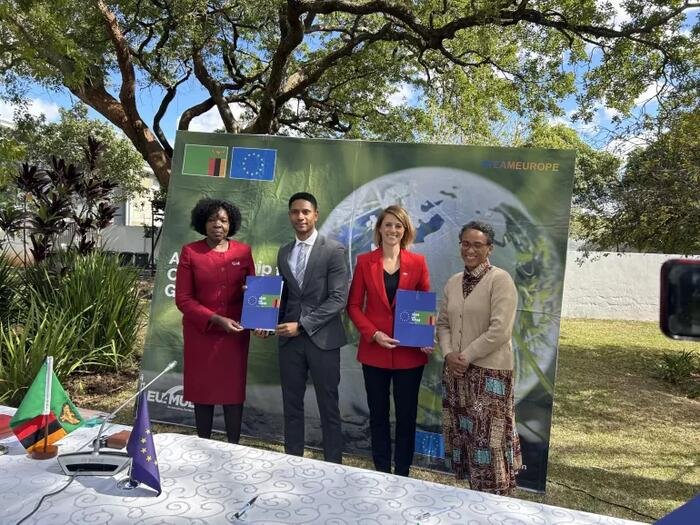
The donation is in addition to the Improved Nutrition Phase II (SUN Phase II) initiative which aims to solve malnutrition in Zambia.
Lusaka, 25 June 2024 – The European Union and UNICEF today signed a cooperation agreement totalling €4,528,750 (approximately 125 million Zambian and Kuwaiti) to prevent acute malnutrition in the drought-hit districts of Zambezi, Shangombo, Kalabo, Mongu, Choma and Monze. The new effort leverages the SUN-II Alliance, led by UNICEF and supported by key UN agencies including WFP, WHO and FAO.
“The impact of the drought on our communities has been devastating, affecting livelihoods, food security and access to clean water. In these difficult times, the support from the European Union is more than just financial assistance; it is a ray of hope that reassures our people that they are not alone. Your aid will go a long way in alleviating the suffering and rebuilding resilience in our communities,” said Dr Gabriel Pollen, National Coordinator of the Disaster Management and Mitigation Unit (DMMU).
The donation, which supports the Government of the Republic of Zambia’s (GRZ)-led drought response, will mean that approximately 89,741 women and children will benefit from food assistance, cash transfers, nutritional supplements and treatment for severe wasting, the deadliest form of malnutrition.
“Climate change knows no borders and its impacts are felt across continents, so international cooperation is not only beneficial but essential. It is our shared responsibility to respond quickly and effectively, mitigate the effects of this drought and build a path to resilience and more sustainable development for Zambia. The European Union calls for a climate-safe and coordinated response to this historic drought that leaves no one behind. Climate change is real and the drought is a wake-up call to take more decisive action to adapt to and mitigate climate change. There is no time to waste and we need to act now,” said Karolina Stasiak, European Union Ambassador to Zambia.
On 29 February 2024, a national state of emergency was declared in Zambia as the onset of El Niño and climate change has caused widespread drought in the country. In total, 84 districts across seven provinces are affected, with over 6.6 million people, including 3.5 million children, in need of humanitarian assistance.
“This drought requires a concerted effort. So many families in the key affected districts are struggling to put food on the table. Evidence shows that unless timely and concrete preventive measures are taken now, a nutritional crisis is likely to occur in provinces where hunger and malnutrition are severe. We therefore cannot thank the European Union enough for taking such a crucial step in the right direction. Your support is timely and will make a major contribution to improving the lives of pregnant and lactating mothers and children under five,” said Beatrice Mutali, UN Resident Coordinator in Zambia.
The May 2024 SMART survey results, released last week, assessed nutritional status and nutrition risk factors in six provinces and found that more than half of households are already experiencing moderate to severe hunger. An estimated 51,948 children under five years of age in 84 drought-affected districts in Zambia are expected to suffer from severe wasting (the most deadly form of malnutrition) within the next 12 months. An additional 276,000 children under five years of age will suffer from moderate wasting. The SMART survey also found that about 112,000 pregnant and lactating women are estimated to suffer from wasting during the same period, while about 13,000 suffer from the most severe form of wasting. Notably, the SMART survey data, conducted during the expected harvest season, indicates that a nutritional crisis for children under five years of age could occur in Zambia’s Western, Southern, Central and Northwestern provinces if immediate appropriate measures are not taken.
The Strengthening Nutrition Phase (SUN Phase II) is an initiative aimed at reducing stunting in children under two years of age by 7% in 17 districts in Zambia. The SUN-II programme is a multi-sectoral nutrition programme supporting Zambia’s national flagship programme, the Critical Days for Reduction of Stunting Programme (MCDP-II). SUN-II is jointly funded by the Government of the UK, Government of Sweden (SIDA), Government of Germany (BMZ/KfW), Government of Ireland (Irish Aid) and the European Union. UNICEF, in partnership with FAO, WHO and WFP, is focusing on a multi-sectoral approach to maximise the impact of nutrition including health, water and sanitation, agriculture (including livestock and fisheries), food security, early childhood development (ECD) and social protection.
For further information, please contact:
Mark Maseko, National Information Officer, United Nations Information Centre (UNIC), Lusaka: maskom@un.org; +260 955767062 Mweemba Nchimunya, Public Information Officer, EU Delegation to Zambia and COMESA: nchimunya.Mweemba@eeas.europa.eu; +260 970007092
