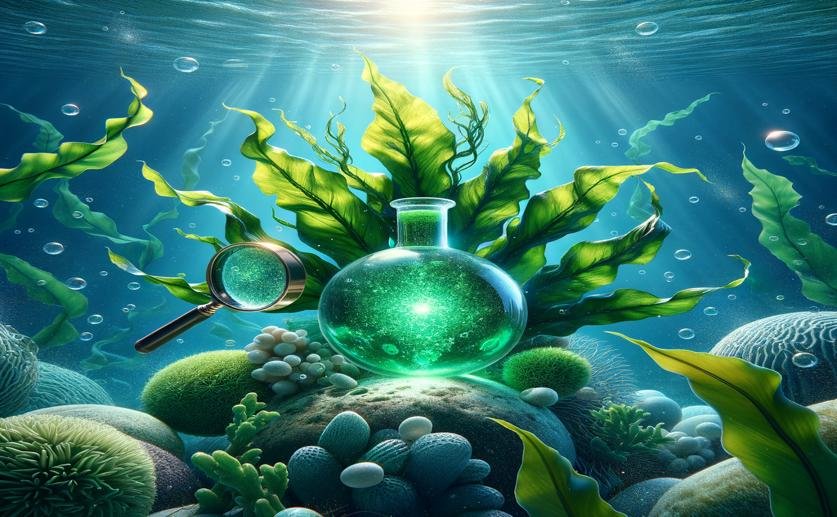
Image source: Natural Science News, 2024
Main findings
- Researchers from South China University of Technology studied the anti-aging effects of brown algae on the skin
- They found that modified seaweed polysaccharides can protect skin cells from UV damage.
- This treatment improved skin cell survival, increased collagen, and reduced signs of aging.
Seaweed, a simple marine plant, has been essential to the diets and medical practices of many cultures for centuries. Beyond their culinary uses, seaweed is home to a treasure trove of bioactive compounds whose potential health benefits have attracted the attention of researchers. These benefits range from fighting oxidative stress to anti-inflammatory and even anti-cancer properties.[2]. South China University of Science and Technology recently shed light on a specific component found in seaweed that contributes to one of its most promising applications: preventing skin aging caused by sun exposure, also known as photoaging.[1]. Photoaging is a process in which the skin ages prematurely due to repeated exposure to ultraviolet (UV) radiation, primarily from the sun. This can lead to wrinkles, loss of skin elasticity, and other cosmetic problems that are undesirable for many people. The search for natural and effective anti-photoaging agents is an important area of dermatological research aimed at finding safer alternatives to synthetic compounds. In a groundbreaking study from South China University of Technology, researchers looked closely at the anti-photoaging properties of polysaccharides extracted from a type of brown algae called Sargassum. Polysaccharides are long-chain carbohydrates that play a variety of roles in biological processes. Prior to this study, it was understood that these seaweed-derived molecules had beneficial effects on skin health, but the exact components responsible for these effects were not well defined. . The results of this study are particularly interesting because they identified a specific composition within the seaweed that combats the effects of photoaging. This discovery not only improved our understanding of how natural products can protect our skin, but also opened the door to the development of new skin care products and treatments. It is important to note that marine algal polysaccharides (MAPs) are structurally different from those found in land plants and cannot be broken down by human digestive enzymes.[3]. This uniqueness extends to the interaction of MAPs with the human gut microbiota, where MAPs may promote the growth of beneficial bacteria and the production of health-promoting metabolites. Its potential as a prebiotic is only just beginning to be explored, suggesting that the benefits of seaweed polysaccharides extend beyond skin health. However, the applications of seaweed polysaccharides have been limited due to their high molecular weight and low solubility. This is where South China University of Science and Technology’s research made great progress. By employing a technique that combines ultraviolet light and hydrogen peroxide (UV/H2O2), researchers are able to break down polysaccharides into smaller, more soluble molecules without altering their beneficial functional groups. I was able to do.[4]. This process not only made the polysaccharide more accessible but also enhanced its anti-photoaging activity. When tested on human skin cells damaged by UV radiation, these modified polysaccharides improved cell survival and increased production of hydroxyproline, a key component of collagen. Collagen is a protein that gives skin firmness and elasticity, and its breakdown is a characteristic of photoaging. The study also revealed that the optimized polysaccharide was able to upregulate collagen production while reducing the levels of inflammatory cytokines that contribute to skin aging.[4]. This dual action of promoting skin repair and reducing inflammation is a powerful combination in fighting photoaging. The implications of this research are far-reaching. It not only validates the use of seaweed in skin care, but also provides ways to increase the effectiveness of its bioactive compounds. Furthermore, it emphasizes the importance of sustainable natural ingredients in the development of functional foods and medicines.[3]. In conclusion, the South China University of Technology research presents a convincing case for the power of seaweed polysaccharides to protect our skin from sun damage. This bridges the gap between traditional uses of seaweed and modern scientific understanding and shows how targeted treatments can be developed from natural resources. As we continue to search for safe, effective and sustainable ingredients for health and wellness, seaweed polysaccharides stand out as a promising resource with a wide range of applications.
Health Biochemistry Marine Biology
References
Main research
1) Isolation, structural characterization, and anti-photoaging activity of sulfated polysaccharides isolated from Sargassum
Published May 6, 2024
https://doi.org/10.1186/s40538-024-00587-9
Related research
Related article
Source link