

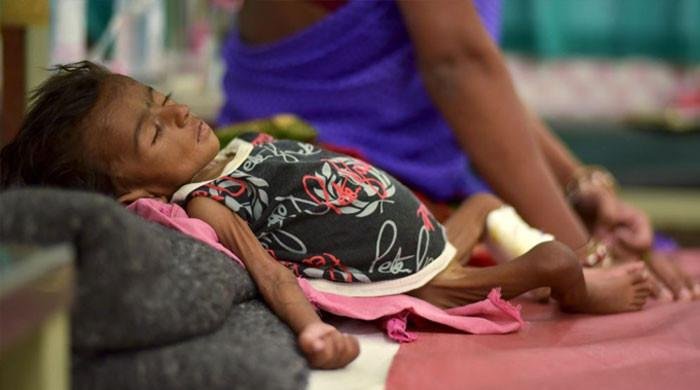
Pakistan has made significant progress in tackling acute malnutrition among children under five.
The lack of equal education and health opportunities, combined with the denial of equal access to basic nutrition, increases the misery of the already disadvantaged and creates lifelong disadvantages for both the cognitive and physical health of youngest children, especially “youngest girls.”
Failing to provide basic nutrition to the majority of the country’s future children means the entire country depends on hundreds of thousands of “bright boys” who attend top private schools, are well-nourished, and have access to the best health care.
The only injustice that society inflicts is that most of the future generations will not enjoy their right to be free from hunger, disease and illiteracy. Will the politics, economy, public institutions and bureaucracy of this unfortunate country of 230 million people always be dominated by the “First Boys”? The key question is whether the wisdom of a very few “First Boys” can lead the country and find the best solutions to complex world problems, or should such injustice not end for the benefit of all?
Pakistan has made considerable progress in addressing severe malnutrition among children under five years of age. The country has the highest rate of malnutrition in South Asia. All key nutrition indicators, including rates of stunting, underweight and wasting, remain significantly higher than other South Asian countries. In Pakistan, stunting rates among children under five years of age are 40 percent.
According to the 2018 National Nutrition Survey, 40.2 percent of children under five are stunted, 17.7 percent are wasted, and 28.9 percent are underweight. Even the prevalence of stunting, wasting and underweight in war-torn Afghanistan is lower than in Pakistan.
The national average stunting rate hides wide variations across provinces, urban and rural areas, and income groups. The stunting rate in Pakistan’s urban areas is 34.8 percent, compared to 43.2 percent in rural areas, highlighting the urban-rural gap. There are also wide disparities between provinces. Punjab’s stunting rate of 36.4 percent is lower than the national average, while KP’s rate of 40 percent is closer to the national average. Sindh and Balochistan have child stunting rates of 45.5 percent and 46.6 percent, respectively, higher than the national average.
The stunting rate of children in rural Sindh is alarming at 62 percent. Six in 10 children under the age of five in rural Sindh are stunted, the highest among all provinces. The stunting rates in rural Punjab, KP and Balochistan are 32 percent, 42 percent and 47 percent respectively.
Geography and income are crucial drivers of child malnutrition: for example, 22 percent of children in the top 20 percent of income groups are stunted, compared with 62 percent of children in the lowest income groups. The same is true for urban-rural disparities, particularly in Sindh.
Reducing stunting in Pakistan has been slow. According to the 2018 National Nutrition Survey, the prevalence of stunting was 41.6% in 2001-2002, but it had fallen to 40.2% in 2018, a mere 1.4% decrease over 16 years. The Pakistan Demographic and Health Survey showed improvement from 2012-13 to 2017-18. In 2012-13, 45.6% of children under five were stunted. By 2018, this had fallen to 39.7% (a change of 5.9 percentage points), a rate of just over 1.0% per year. Even with this rate of progress, it will take another 40 years to achieve zero stunting. This means that Pakistan will not be able to improve child nutrition by 2047, i.e., by age 100.
The good news is that there is little difference between boys and girls when it comes to stunting. Girls are less likely to be stunted than boys, which is a bit of good news. However, sex-disaggregated data for different income groups is not available.
Nutritional status of women also contributes to poor birth outcomes and low birth weight. In Pakistan, 5.0% of women are short and 9.0% are underweight. Rural women tend to be shorter than their urban counterparts. In Sindh, 6.2% of women are short, compared to the national averages of 5.0% and 5.4%, respectively, and in Punjab, KP and Balochistan, 1.9% and 4.2% respectively.
Nutrition is a complex and multifaceted issue, with many factors contributing to malnutrition. Poverty and food insecurity are not the only contributing factors, as the prevalence of stunting is also high in the second and middle wealth groups. Other factors that affect a child’s nutritional status include poor quality drinking water, poor sanitation and hygiene practices, poor access to or difficulty in using health services, and lack of parental awareness about the importance of early childhood nutrition.
Provincial and federal governments need to prioritize child health, education and nutrition to reap the benefits of a young population in future. Without serious investment, organized response and well-coordinated efforts by federal and provincial governments, Pakistan may not make any leap forward. Without sufficient female participation in the future workforce, which will be underskilled, undereducated and malnourished, nothing will be gained. Among all provinces, Sindh lags behind in all three key indicators of education, health and nutrition. Hence, there is an urgent need to redouble efforts to catch up with clear policies, organized roadmaps, investments and improved governance.
Given the current political turmoil, low or even negligible priority given and investment in education, health and nutrition, and poor governance including poor performance of public and judicial institutions, hope is slim until this conversation becomes prevalent in society and mass mobilisation forces those in power to act without delay.
end
The author is an Islamabad-based environmental and human rights activist.
