


There’s something about the solstices that seems to connect with something deep and fundamental about the human psyche, and it’s more pronounced the further away from the equator we go and the more extreme the imbalance between day and night. The solstices are moments when the world takes its breath away. The sun remains motionless overhead or disappears below the horizon, then crosses the boundaries of the year, going from light to dark and back to light.
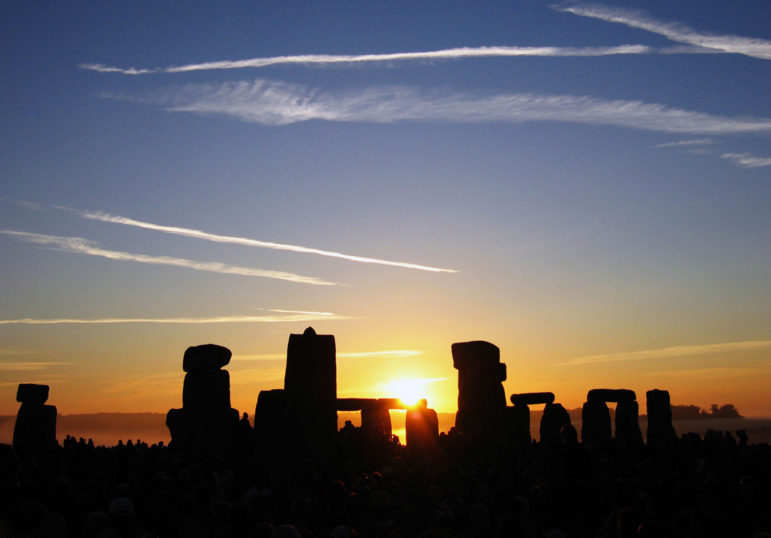
This recognition and connection can be seen in the Neolithic monuments our ancestors built, in the way the sun rises and sets on the longest and shortest days of the year, and in the way new solstice celebrations are continually created as changing religions proscribe old ones. The solstice calls to us, and especially the solstice calls us to get outside and celebrate together all that life and the Earth has to offer.
CC BY-SA 2.0, https://commons.wikimedia.org/w/index.php?curid=195581
In the Northern Hemisphere, summer solstice celebrations are a rich tapestry of Christian and pre-Christian local customs that blended with the mores of the early church and have since merged and evolved over the last 1500 years. Each local approach to the solstice has its own unique characteristics, but fire, water, food, fertility and communal celebrations are usually all present to a greater or lesser extent.
Oh, and lots of alcohol. But that’s not unique to the summer solstice and is a given at almost any event or festival in parts of Europe where it’s not culturally prohibited.
In most of Europe, the summer solstice is associated with the feast day of Saint John the Baptist, and there is some debate as to whether the water element of the summer solstice tradition is derived from that date, or whether the Church sought to redirect it towards a more sacred form by establishing a festival at the summer solstice.
Similarly, the incredible wildfires that occur every year in Austria, arranging themselves to form shapes and patterns visible from the ground, are said to be variously attributed to the medieval Sacred Heart cult and the pre-Christian Alpine sun cult that the Church tried to snuff out with the former. I’m not going to try and legislate on this, because unless some very enlightening (no pun intended, but I’m sticking with the word) manuscript suddenly appears from the Vatican archives, there isn’t enough evidence to give a definitive answer. I’d also argue that it doesn’t really matter which came first, because one certainly influenced the other, either way.
This blending of Christianity and paganism is easy to see in places like Spain, where festival-goers jump over bonfires and bathe in the sea to purify themselves for the year and ward off evil spirits. One of these things may have something to do with St. John and the church, the other not so much.
Seeking such protection at the summer solstice is not unique to Spain. The summer solstice is seen as a particularly liminal time when supernatural occurrences are unusually high and where fairies are particularly powerful in areas where they are present, so it is a traditional time to seek protection against fairies, not just for that night but for the rest of the year. The ubiquitous bonfires, which are tiny echoes of the sun on earth, are an important part of this. Burning effigies, jumping through flames, and storing and using the ashes for a year are all traditional methods of protection. Similarly, bathing in the sea or in morning dew are common means of protection and purification found throughout Europe. Another very common method is to take a pinch of St. John’s Wort (also syncretistic) and wear it on yourself or place it under your pillow.
But what about food? After all, this is a column about food. Well, the abundance of the land and people is an integral part of many solstice celebrations, as is the abundance of food available at this time of year. Plus, annual celebrations always develop their own food traditions, even if they’re not food-focused festivals. So there are plenty of options for different delicious ways to celebrate the magic of the shortest of nights.
Walnuts
In Italy, the summer solstice is traditionally the day to gather green walnuts and make Nocino, a walnut liqueur to be drunk on the winter solstice. Walnut trees have been associated with witches in Italy. Witches are believed to gather under walnut trees on the summer solstice to make potions, and walnut gatherers (usually young virgin women) would compete against the witches. If you want to get into the spirit of your witches on the night of the summer solstice, eating walnuts seems like the best way to do it, whether you try making your own Nocino or not.
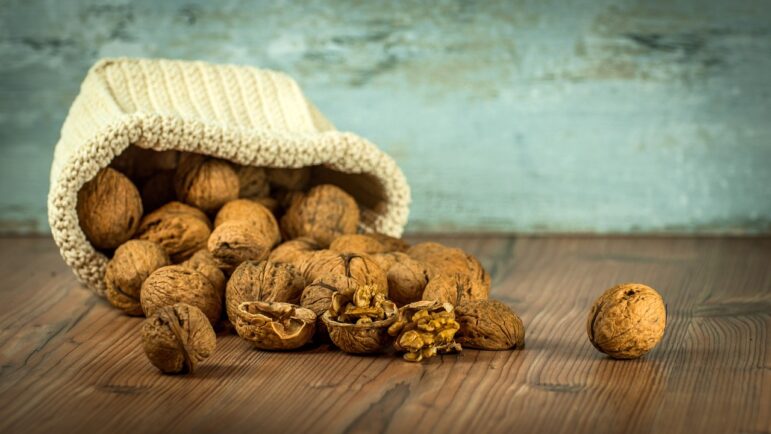
Walnuts [LubosHouska, Pixabay]
Walnut Praline
- 2 cups walnuts
- 100g granulated sugar
Place the walnuts on a baking tray (don’t forget to line it with oiled paper) and toast at 375 F/190 C for 5-10 minutes. Keep an eye on the walnuts during this time as they will burn quickly. Remove the tray from the oven as soon as the walnuts have browned and smell toasty.
Slowly melt the sugar in a saucepan over medium heat. Do not stir until all the sugar is dissolved, or you’ll end up with crystallized chunks instead of a smooth caramel. Gently shake the pan if the sugar is not melting evenly.
Once you have a smooth caramel syrup, add the walnuts and stir, then remove the nuts so they don’t stick and place them back on the greaseproof paper to set.
strawberry
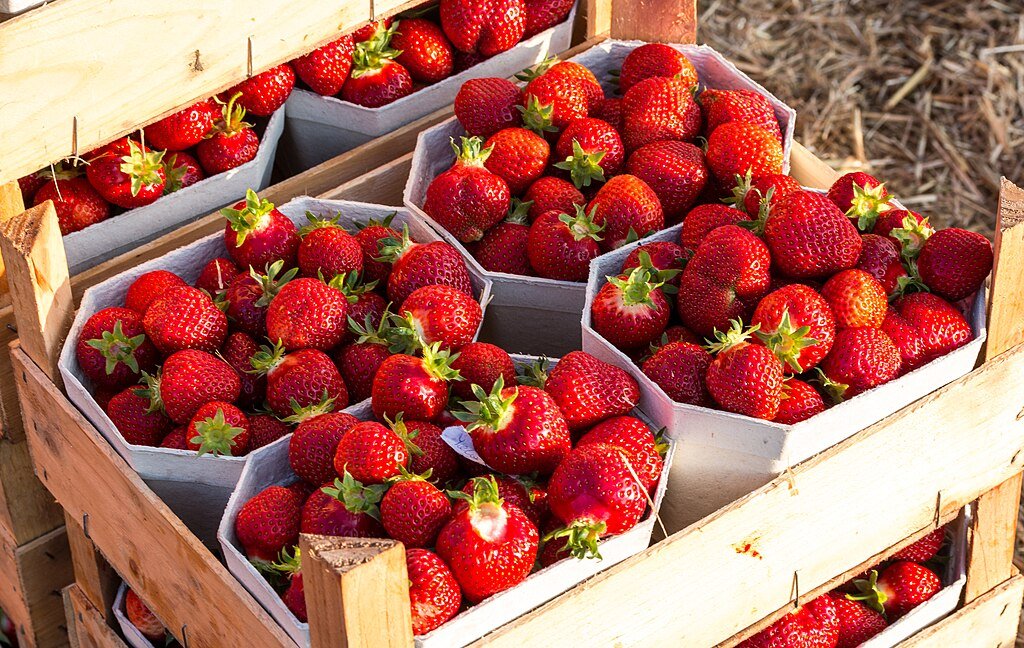
What better way to celebrate the bounty of the earth on the summer solstice than with juicy, delicious strawberries? Out-of-season strawberries taste almost like sour water, are totally flavourless and completely meaningless. In-season strawberries, grown outdoors and not in a polyhouse, create a magical explosion on the tongue.
It’s an essential part of any Scandinavian midsummer feast and you can’t go wrong serving it on the table as the centrepiece of Strawberry Midsummer Cake, on its own or with fresh cream.
Like the spiced tea I make on the winter solstice, mindfully eating strawberries, experiencing all the sensations that come with it, and silently expressing the deep gratitude we should all feel for the earth is a wonderful way to connect with this time of year. (And don’t forget the fruit pickers and other migrant farmworkers who grow our produce, and act on their behalf next year.)
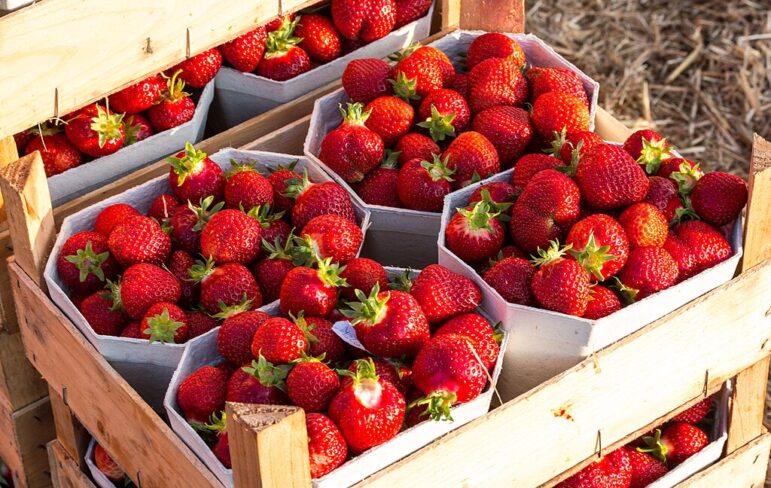
Harvesting in a strawberry field in the village of Dörnekamp in Kirchspiel, Dülmen, North Rhine-Westphalia, Germany (2015) [Dietmar Rabich, Wikimedia Commons, CC 4.0]
Midsomer Tarta
- 40g unsalted butter
- 3 large eggs
- 75g sugar
- 65g self-rising flour
- 10g cornstarch
- Whipped cream
- 2 packs of strawberries
Preheat oven to 350F or 176 C. Melt the butter and let it cool. Carefully sift the flour and cornstarch to make sure there are no lumps.
Whisk the eggs and sugar until tripled in volume, then release the whisk and check to see if a ribbon of dough forms and sticks together for at least 3 seconds – if it does, it’s ready. Gently fold half of the flour into the egg-sugar mixture, then slowly pour in half of the butter and mix until combined – then repeat both steps until everything is combined.
Line two 6-inch cake pans with parchment paper, divide the batter into each, and bake in the preheated oven for 22 to 25 minutes (if you know your oven is slow, check after the 22 minute mark). Allow to cool on a cake rack before proceeding to the next step.
Spread whipped cream on one of the cakes and layer sliced strawberries on top. Place the other cake on top and spread more cream on top, then decorate the top with whole or sliced strawberries. If you’re feeling extra fancy, garnish with edible flowers.
milk
In some parts of Europe, offerings of milk are made to river spirits on the midsummer solstice to appease them and stop them from capturing and drowning people. In Connacht, milk is also the main ingredient in a traditional dish called goody, which is made in a cauldron on the night of the midsummer solstice.
Goody
- Equal parts brown bread and milk
- Honey or sugar (optional)
- cinnamon
- nutmeg
Place the milk and bread in a cauldron (don’t worry if you don’t have a cauldron or fire pit, a saucepan on the stove will do) and place over medium heat until the milk comes to a boil. Stir constantly until the mixture is homogenous, and add your favorite sweeteners and spices to taste.
