

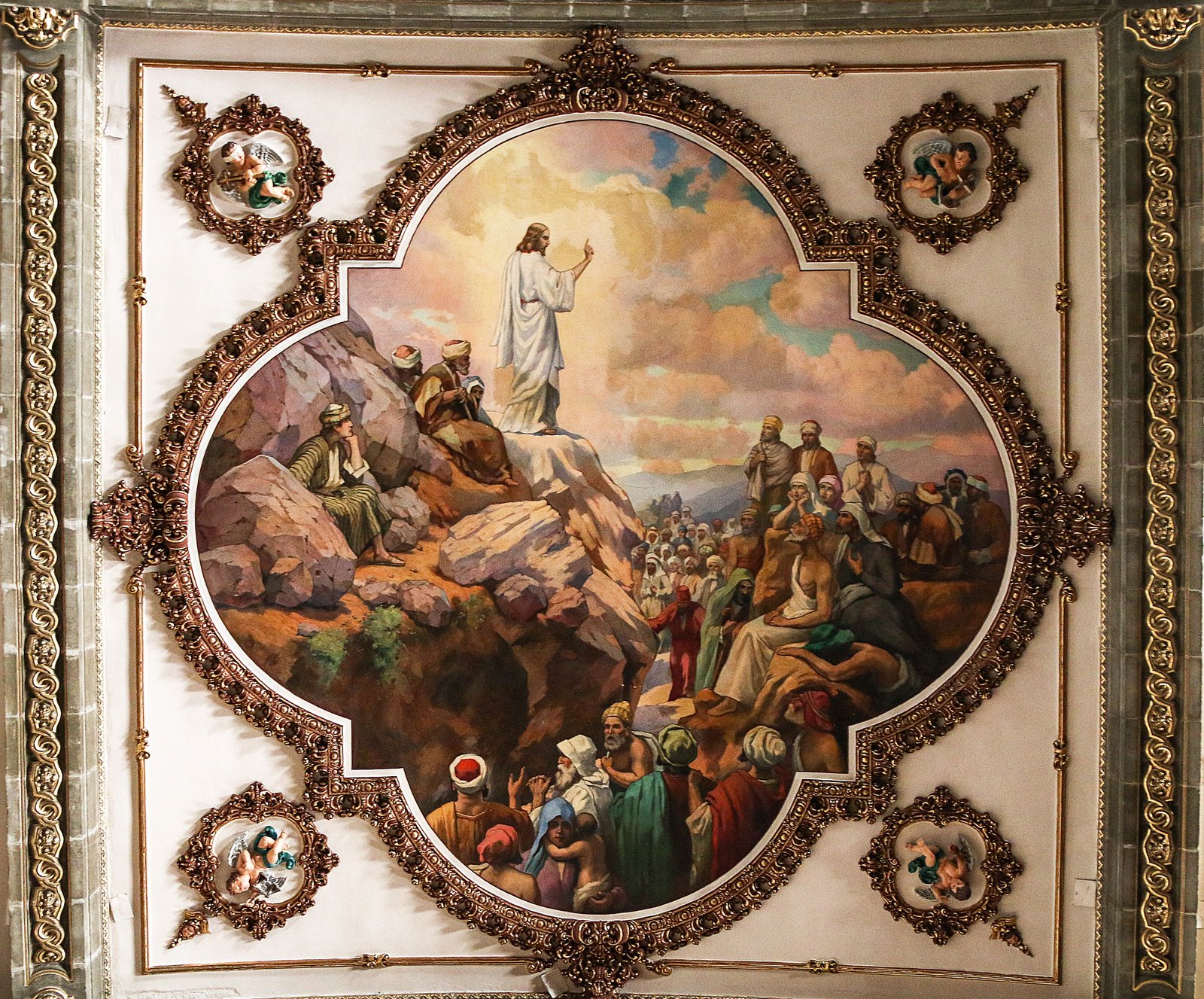
Based on a paper read at the All Souls Club, London, on June 5th.
This article grew out of two extended silent meditations at St Beuno Jesuit Spiritual Centre in North Wales. My wife Alison and I go there twice a year, usually in August.
Sometimes going into eight days of deep silence with God and coming out of it feels a bit like jumping into a pool, swimming underwater for a while, and then resurfacing.
We both make notes in our spiritual journals and then over the next few days of vacation we tell each other about our encounters with God in the silence.
In August 2019, two of the scriptures my spiritual director asked me to meditate on that week were the Beatitudes in Matthew 5 and the astonishing encounter with Christ in “the least of these my brethren” in Matthew 25.

In August 2023, in the silence of the day, I wrote some poems. I will interweave four of these poems with thoughts on “blessings” and “encounters.” Today I will focus on blessings, and tomorrow I will talk about encounters.
As an introduction to “Blessing,” I begin with a poem called “Christ of the Oboe,” which I hope will have a positive impact on ecumenism.
Christ of the Oboe
For tuning the orchestra,
The oboe plays the note A.
There are many different instruments,
Tune in to Alpha.
In harmony with each other,
They are ready and waiting.
Attentive and warm,
Concert accompaniment.
In a 1977 four-part TV movie series directed by Franco Zeffirelli, Jesus of NazarethRobert Powell played the role of Jesus, and he said that the blessing scene required multiple takes because he repeatedly broke down and cried every time he pronounced those very simple, yet powerful words.
We will look at each of the eight blessings, my suggested synonyms and antonyms, the orchestral instruments that I think resonate with them, how they are resolved, the one word that is the focus of the resolution, and finally an illustration from one of Jesus’ parables.
The indicative mood is used at the beginning of the Sermon on the Mount, then the imperative mood is used in the rest of chapters 5-7. “This is who you are” precedes “And thus should you live,” and is further dramatized in Luke’s version of the benediction in Luke 6. Grace and justification precede ethics. A similar order is found in the Pauline epistles.
Aramaic scholar Joachim Jeremias discovered a particular style of speech that Jesus preferred and outlined it in his book. New Testament Theology, Vol.He translated many of Jesus’ words from the Greek New Testament back into his own language and discovered that many of the memorable passages, including the benedictions, have a particular rhythm and meter.
One of my favorite commentaries on Matthew is by H. Benedict Green. MatthewIn his preface, he writes, Kaismus (“A sandwich arrangement of ABBA, which is his material”), and on the celebration he commented:
These are placed in harmony with one another, rather than simply juxtaposed: the poor and the meek, the sorrowing and the hungry, the merciful and the peaceable, the honest and the one who suffers for justice.
The result was an eight-line rhythmic hymn: ABABCDCD. justice The last line of each quatrain, Heaven is theirs From the first line to the last line (Green, p. 76).
- The poor in spirit
Blessed are the poor in spirit, for theirs is the kingdom of heaven.
The synonyms I suggest are Humble Antonyms are I am proudMy orchestra instrument is the double bass. Blessings are Kingdom And the focus of the solution is, in a word: HarmonyThe parable is “The Seed that Grows in Secret” found in Mark 4:26-29.
- sad
Blessed are those who mourn, for they will be comforted.
My synonyms are Survivors Antonyms are All is wellMy instrument is the cello. Blessings are comfort And if you focus on one word comfortableThis parable is about Dives and Lazarus, found in Luke 16:19-31.
- kind
Blessed are the meek, for they shall inherit the earth.
I love the graffiti added to a church poster with this blessing as its headline: “If it is OK with you.”
My synonyms are pious, Flexibleand Absorb And the antonym is Reactive, difficultand terribleMy instrument is the viola. Blessings are Earth And the focus is on the word “house.” The parable is the parable of the prodigal son in Luke 15:11-32.
- Thirst for justice
Blessed are those who hunger and thirst for righteousness, for they will be filled.
My synonyms include Concentrated, Decidedand Patient Antonyms are Laissez-faireMy instrument is the violin. Blessings satisfaction And the focus word is fullThe parable is “The Persistent Widow” from Luke 18:1-8.
- Showing Mercy
Blessed are the merciful, for they will receive mercy.
My synonyms are considerate Antonyms are strictMy instrument is the clarinet.
This choice was made by Francis Spafford. No apologyIn “The Great Passage,” he describes being in a café in a desperate situation, hearing the slow movement of Mozart’s Clarinet Concerto as background music, and feeling a sense of divine mercy. Spafford then quotes another writer:
Novelist Richard Powers has written that the Clarinet Concerto sounds like a mercy, and that is exactly what I experienced in 1997.
The blessing is resolved Receiving mercenariesy and the focus word I felt relievedAn obvious parable is the Good Samaritan in Luke 10:25-37, where Jesus typically ends the parable by responding to the lawyer’s question, “And who is my neighbor?” with the question, “Who has acted as my neighbor?”
- Hearts Pure
Blessed are the pure in heart, for they shall see God.
My synonyms are Integrated and Pure and, A bell that emits a clear toneMy antonym is fake and SplitMy instrument is the French horn. Blessings are Seeing God And the focus word is joyThat parable is “The Sower” in Mark 4:1-9: “…other seed fell on good soil and became fruitful, grew and multiplied, and bore fruit some thirtyfold, some sixty, and some a hundred.”
- Peace Maker
Blessed are the peacemakers, for they will be called children of God.
My synonyms are Conciliator Antonyms are WarmongerMy instrument is the flute. Blessings depend on being called. child of God And the focus word is AffiliationThis parable is the story of the workers in the vineyard in Matthew 20:1-16, and their generosity is enclosed in parentheses at the beginning and end of the book along with a summary of Jesus’ Gospel. Because of the division of the chapters, we usually don’t notice Matthew’s clever bracketing.
Matthew 19:30, “But many who are first will be last, and the last first.” Matthew 20:16, “So then, the last will be first, and the first last.”
- Persecuted
Blessed are those who are persecuted for righteousness’ sake, for theirs is the kingdom of heaven.
My synonyms are stress Antonyms are attackerIn the Anglican book I edited, Escape from the Abyss: Hope in Troubled Times (2016) , we proposed a spectrum of persecution that can be described as ranging from “oppression” to “crushing” as follows:
‘harassment’People are under constant, subtle pressure. ‘Conquest’They are legally oppressed as an inferior class.”persecution“Physically and violently attacked by individuals or states”MartyrdomThere, people are killed for their beliefs or for standing up for what is right. ‘Disappearance’where entire ethnic groups become extinct. “Erase”In other cases, such as the destruction of Armenian churches and artifacts in Turkey, Holocaust denial, and the destruction of churches by the so-called Islamic State, the original existence of exterminated peoples is denied or “erased” from the picture.
The instruments are timpani. The final blessing, like the first, resolves to the kingdom and has the same focus in one word as the first blessing – harmony. This parable is about the wicked farmers of the vineyard, Matthew 21:33-44, “And the farmers seized his slaves, and beat some, and killed some, and stoned others.”
To conclude this article on “Blessing,” I will talk about “Encounter” tomorrow, and I would like to introduce a second poem as a bridge between the two.
Did you notice that the words of the blessing actually describe the character of Jesus?
“Herbert’s Hillary” was born from my discovery of the understated demeanor expressed in George Herbert’s poem “Love (III),” which begins with “Love hath welcomed me,” combined with the effortless talent of my friend of forty years, Hillary. I have published it on my site, and with her permission, quote it here.
Helen Wendler, a Harvard English professor who passed away earlier this year, concluded her book with the following: George Herbert’s poems Comments on Love (III):
Observant, clear-eyed, polite, eloquent, smiling Love is itself a mystical creation, quite different from any other representation of God in literature… Like an elegant minuet, the poem leads its characters through delicate, floating steps: forward, backward, slack, approach, lack, satisfaction, drooping glances, meeting of the eye, reluctance, offering, refusal, protest, insistence, and finally sitting down at the banquet… To think that such a poem was constructed on a “source” of just nine words – “And the Lord will make them sit down to eat” (Luke 12:37) – is astonishing.
Love
Love welcomed me, but my soul withdrew.
Guilty of dust and sin.
But Love, with her keen eyes, watched me grow sloppy.
From the first time I came in,
He approached me and asked gently,
If I’m missing something.
I replied that he was a worthy guest.
Love said, You will be his.
Am I unkind and ungrateful? Oh, my love,
I can’t see you.
Ai took my hand and smiled as she answered.
Who else but me made the eyes?
It is true, Lord, but I have hurt them.
Go to the right place.
And love says, “Know thou not, who is the one who bore the sin?”
Then, dear friend, I am at your service.
Love says, “Sit down and taste my food.”
So I sat down and ate.
Herbert’s Hillary
In her psychotherapy,
Hillary plays a role
She usually performs at parties.
“Quick-Ied Love”
Realizing that you are not being noticed
A kind welcome,
Liberate the silent person.
Loved by love, she loves.
Simone Weil, in her spiritual autobiography: Waiting on Goddescribes how Herbert’s love (III) led her to faith in Christ: The following is an excerpt from a letter written in Marseille, France, around May 15, 1942, to Father Perrin, Weil’s close friend:
In 1938 I spent ten days in Solesmes, from Palm Sunday to Easter Tuesday, taking part in all the liturgies. I was plagued by severe headaches…
There was a young English Catholic there, and after receiving Holy Communion, by the angelic radiance with which he seemed to be clothed, I first understood the supernatural power of the sacraments. Chance – and I always prefer chance to divine providence – made him my emissary, for he introduced me to the existence of English poets of the 17th century, who were called metaphysical. Later, reading them, I found a poem, which unfortunately is very poorly translated. It is called “Love”. I learned it by heart. Often, when a violent headache is at its peak, I recite it over and over, concentrating all my attention on it, clinging with all my heart and soul to the tenderness it contains. I thought I was only reciting it as a beautiful poem, but unwittingly, the recitation had the effect of a prayer. As I have told you, during these recitations Christ himself descended and took possession of me… Moreover, when Christ suddenly took possession of me, neither my senses nor my imagination were involved at all. In the midst of my suffering, all I felt was the presence of love, readable in the smiles on the faces of my loved ones.
We will resume the “conference” tomorrow.
