

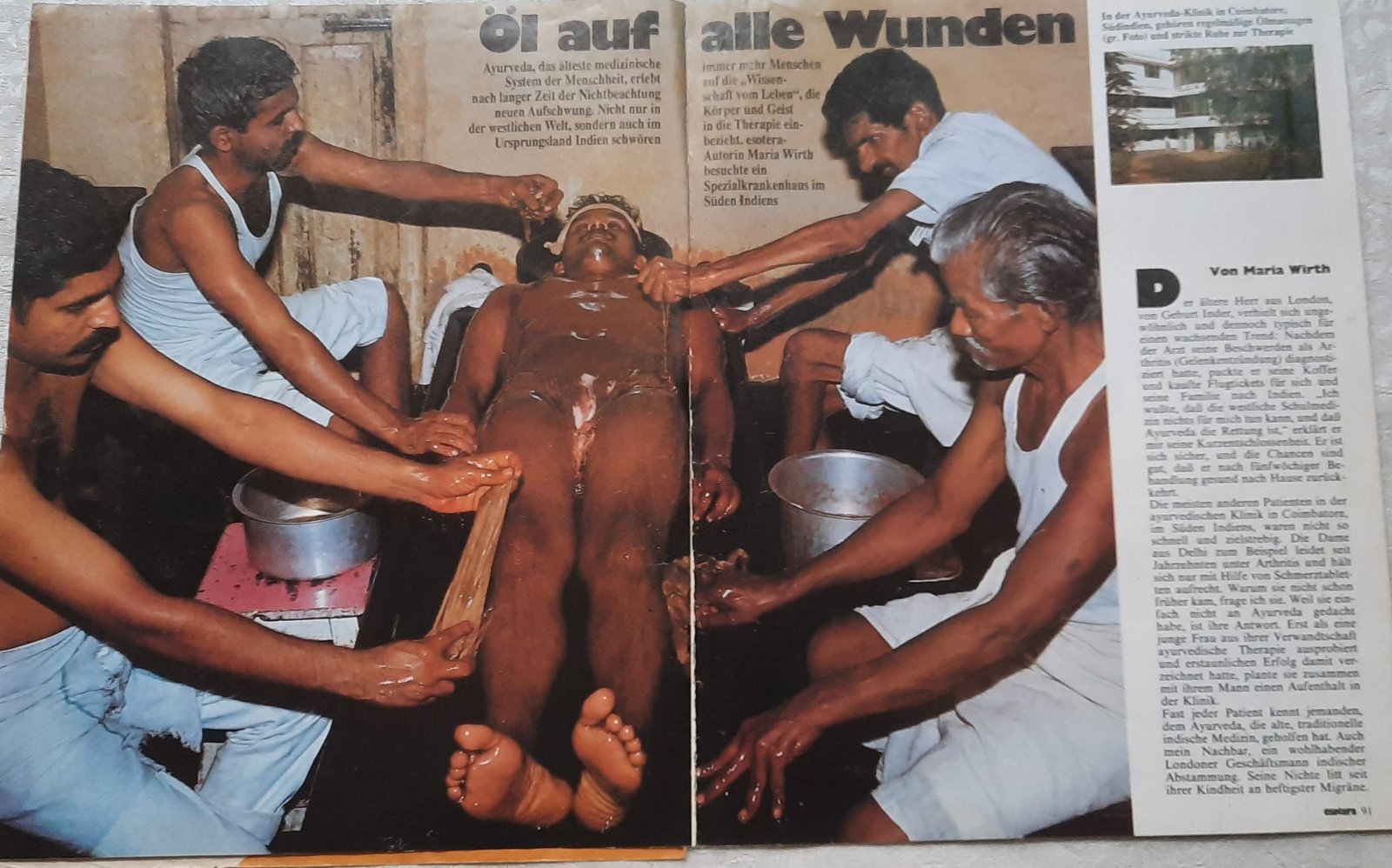

 Written by Maria Wirs
I wrote this article in German in 1990. This was well received and prompted the German hospital owner to add an Ayurvedic department to one of his clinics.
Seeing how Ayurveda and Baba Ramdev have been maligned on social media lately, I translated it into English. Baba Ramdev’s achievements in encouraging healthy living are commendable. He should be praised, not cornered.
The following was published over 30 years ago.
This older gentleman from London, originally Indian, had a strange reaction, but typically on the rise. After doctors diagnosed his problem as arthritis, he packed a suitcase and bought a plane ticket to India for himself and his family. “I knew that Western medicine could not help me, and Ayurveda would be my savior,” he said, explaining his quick and firm decision. He is confident that after five weeks of treatment he will recover and be able to go home.
Many of the other patients at Ayurveda clinic in Coimbatore were not so quick and focused. For example, a woman from Delhi has been suffering from arthritis for decades and has been cured only with the help of painkillers. “Why didn’t you come earlier?” I asked her. “Because Ayurveda had never occurred to me,” she answered. She came here only when her young relatives had amazing results with Ayurveda.
Almost every patient knows someone who Ayurveda has helped. This includes my wealthy NRI girlfriend from London who lives next door. His niece had suffered from excruciating migraines since childhood. He tried everything for her, consulted the leading doctors of several countries, but in vain. Finally, he gave a chance to Ayurveda. He came here the year before with his niece, but something he least expected happened. My migraines have completely stopped. So this year, he returned with his wife, who has diabetes, and his daughter, who also suffers from migraines.
After a long time when Ayurveda was ignored, the ancient ‘science of life’ is once again gaining trust and respect. According to Indian media reports, the number of patients has increased by 60% in the past two years (1988/89).
What is surprising is that despite the British colonialists’ best efforts to wean Indians away from their “primitive indigenous system” and force them to adopt a “modern scientific system,” the Indian elite is returning to Ayurveda. Perhaps the British really believed this, but if they did, it was without knowing the classical texts of Karaka, Vagbhata and Susruta, who are undoubtedly the authorities on Ayurveda.
The British stripped the support of Ayurvedic institutions and gave it to Allopathy. No wonder, the results of modern medicine were swift and astonishing. No wonder then Western-oriented elites supported allopathy. The Vaidya continued to take care of the poor people of the village.
“What is valuable is recognized for its own sake. It does not lose its value even if it is considered worthless,” opined a student of Ayurveda.
And it seems he’s right. Ayurveda is in rehabilitation. This process is supported by an unexpected aspect: modern scientific medical research. Researchers in India have discovered interesting clues about medicines in ancient Ayurvedic texts. Drugs like Gugrip for high cholesterol and Reserpine for high blood pressure are the result of such research.
Confidence in the efficiency of traditional systems grew, and so did the desire to study ancient texts without prejudice. At the same time, trust in allopathy also declined. No wonder, then, that some Indian doctors have gone from just advising Ayurvedic medicine occasionally to switching completely to the Ayurvedic camp. For example, Dr. Mehta, the founder of the famous Ayurvedic University in Jamnagar, Gujarat, was an allopathic physician who earned numerous medical degrees in the UK. He did not take this step lightly.
What are the advantages of Ayurveda?
First of all, it is certainly an inclusive and non-materialistic view of humanity. Karaka asserted over 2000 years ago that humans and the universe are one. As he read the first chapter of Karaka Samhita, he got the impression that he was reading a philosophy book.
It states: Human beings are essentially pure consciousness: infinite, unchanging, and eternal. From this pure consciousness emerges the body and mind with thoughts and emotions. Consciousness (Atman) is still pure and infinite, but it is localized in the body and mind and therefore experiences itself as finite and mortal.
For the Atman, there is neither health nor disease. It is a blissful realization. However, the mind and body are either healthy or sick. The mind is more important than the body. It penetrates the whole body in a minute form and becomes the source of our immunity.
But why does disease occur when all we want is good health? Because something has a negative effect on the mind and body, disrupting the harmony of the elements necessary for optimal functioning. It’s from.
Ayurveda therefore deals with what is good and what is not good for the body and mind. The question is how can we maintain balance?
This preventive aspect is most important. Knowing how to avoid getting sick is more important than knowing how to cure it after you get sick.
However, since disease cannot always be prevented, Ayurveda also has ways to restore balance. Interestingly, Karaka already demanded 2000 years ago that the treatment should not have any harmful side effects.
This framework is vast and still valid today. But maybe you have doubts. Did the ancient rishis have sufficient insight into the complex functioning of the human organism in the light of modern science? After all, they did not have the technology to examine the body deeply .
It would be a worthwhile task for researchers to find out whether Ayurvedic theories are wrong. more More relevant than modern scientific theories…Ayurveda is comprehensive, yet highly complex and differentiated. The article cannot do it justice.
I read in one article that students of Ayurveda need to “meditate deeply on fundamental principles.” This advice assumes that good intuition can lead to deeper insights than a microscope. The ancient rishis certainly had great intuitive powers, and those who know Ayurveda can explain not only the composition and function of the body, but also its interactions with various mind-body types and substances from the environment. I don’t doubt that theory.
If scientists study Ayurveda, modern medicine as a whole will benefit. Some, like Boston endocrinologist Dr. Deepak Chopra, are already doing it and making waves in the medical world. He points out that Ayurvedic claims about the close connection between mind and body are confirmed by modern neurological research on neurotransmitters.
Happy thoughts create happy molecules
Ayurveda assumes that intellectual impulses like thoughts are expressed as chemical molecules throughout the body. “When you think of something, you create molecules,” Dr. Chopra says simply. “And when you have happy thoughts, you create happy molecules.”
Could Ayurveda and Allopathy complement each other in the future? There is hope as more and more doctors are taking an interest in Ayurveda, not just in India but around the world. This interest is primarily due to Maharishi Mahesh Yogi’s efforts to introduce Ayurveda to the West. He had asked Dr. Chopra for help. Since then, Dr. Chopra has traveled, lectured, and written books all over the world. He is also the medical director of the Ayurveda Center and president of the American Ayurvedic Medical Association.
The growing interest in Ayurveda is welcomed in India. However, the way it is sold in Western countries has been criticized. I have heard several times that you should not make a lot of money with Ayurveda. That’s true. The prices for Ayurvedic treatments at Maharshi clinics are exorbitant. In America, it costs between $2,000 and $4,000 a week. In comparison, her five-week treatment in Coimbatore cost him less than $400.
Stay at a clinic in Coimbatore for some time and see the treatment.
First, there is detailed diagnosis, which is the heart of Ayurveda. Vaidyas “need to get into the patient’s mind and fully understand their specific condition,” Karaka said.
Lubricate your body with daily oil massages and cleanse your intestines with enemas and laxatives. This is followed by two weeks of intensive individual treatment. Absolute rest is required. Don’t write, read, or go outside. This is followed by two weeks of recovery with daily oil massages.
This treatment is most effective for diseases related to the nervous system, such as arthritis, joint pain, back pain, migraines, etc., and at the same time strengthens and rejuvenates the body.
As mentioned earlier, Ayurveda places great emphasis on preventative measures that preserve health, vitality, and joy in life. The best “prevention method” according to Ayurveda is to lead a dharmic and noble life.
How does a rich and noble life affect health?
According to Ayurveda, three elements determine the mind: sattva, rajas, and tamas. Too much rajas or tamas creates negative emotions, which have a negative effect on the body. But there is no such thing as “too much” for sattva.
Ayurveda asserts that sattva increases in a dharmic life where wealth is procured through fair means and desires are in harmony with the goal of knowing one’s Self.
This type of Ayurvedic preventive medicine has become available to us in the West as well, until treatment at Ayurvedic clinics becomes more affordable.
(Myra Virs is the author of ‘Thank You India’ which was launched at Dehradun Litfest.)
