

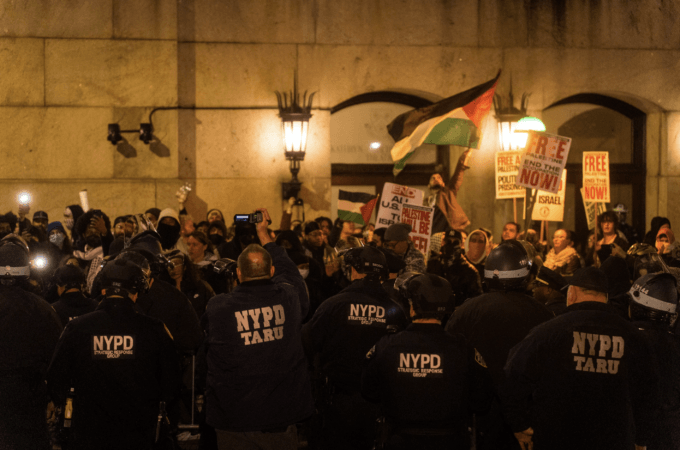
Image by Honey Osman, Columbia University.
Something is happening here. . .
Consider, for example, the recent announcement by Union Theological Seminary, affiliated with Columbia University, to divest from “companies profiting from the war in Palestine/Israel.” Not only that, but we fully support Columbia University’s student camps. And we condemn the arrests and police violence that wreaked havoc on peaceful and culturally diverse protests.
In fact, the seminary issued a statement that undermined the quiet conviction of those in power: that money matters above all else. Financially supporting damaging and immoral investments. ”
Values over profits? The seminary has long diversified investments from industries such as weapons manufacturers, for-profit prisons and fossil fuels. But that’s not all. . . Apparently, we understand and value education itself, which is certainly a phenomenon worth noting.
In an interview with Democracy Now!, seminary president Serene Jones said the school “opened its campus to all surrounding campuses at a time when students were being expelled and events were not allowed to be held.” “I did,” he pointed out. . . . Our doors are wide open, and this is what a university should be like in times like these. ”
She also said, “We support students in finding their voice and learning what it means to speak up for justice and freedom.”
That’s the word that surprised me the most. For God’s sake, this is what education is all about! It’s more than just attending lectures, taking notes, and absorbing data. It means finding your voice, finding your deepest values and expressing them in real life, presenting them not as abstractions but as principles by which to live. Entering the world as an adult woman or an adult man means more than just finding your place. It means to challenge when you enter that world, to create that world by God, to create the future.
Of course, I’m not saying this in a simplistic way. I speak as an aging baby boomer who came of age as the civil rights movement shook and shattered national norms and as the Vietnam War entered our consciousness. What a wounded and deeply flawed world! Something was wrong. Growing up meant finding our voice and taking on, or challenging, this flawed world.
For example, in October 1967, I rode a bus with many friends to participate in the first anti-war march on the Pentagon. This included pushing the boundaries of social and legal decorum. We didn’t just listen to speeches. We were determined to occupy the Pentagon, and thousands of us walked on the grass to confront the soldiers defending the Pentagon. At one point, all of a sudden, a group of soldiers seemed to rush towards us. I ended up hitting him in the head with the butt of a rifle. I was beaten to the ground but uninjured, and I continued to protest for several more hours, eventually leaving the Pentagon sit-in just before the arrests began.
My friends and I returned to Western Michigan University in Kalamazoo feeling that our lives would no longer be the same. We immediately took matters into our own hands. we fell out.
I ended up delaying my eventual graduation for many years. No, I haven’t “changed the world” in the way I idealistically imagined, but this period of my life was full of protests, drugs, a few arrests and a lot of mistakes – and that’s how my college turned out. It was the core of my learning experience. At the same time that all of this was happening, I was also realizing that I was a writer and, ultimately, a journalist. I highly value the support, practice, and guidance of Western University’s many professors. Continuing to create the world is not simply a matter of us versus them, the young versus the old. It is a multi-generational endeavor.
All of this reminds me of this moment and the words of Selene Jones, who has not abandoned, or become cynical about, the values emanating from student camps across the country. Much of the mainstream coverage of the protests simply defines the phenomenon in terms of us versus them. The protests are “pro-Palestinian,” seeming to imply that there are two equal (and equally brutal) sides to this war, and that being pro-Palestinian means being anti-Israel. It can easily turn into anti-Semitism. However, the protests are not just pro-Palestinian. They are pro-humanity (and anti-genocide).
And while the participants are culturally and religiously diverse, they are also spiritually diverse. Jones wrote in Religion News Service:
“First and foremost, these encampments are filled with students from a variety of religious traditions: Jews, Muslims, Christians, Buddhists, unaffiliated students, and students who are spiritual but not religious. find comfort and courage in each other.
“It’s just who these protesters are: a community united by a larger common cause: to stop the mass murder of besieged Palestinians.”
Jones’ essay, titled “What we need to learn from students who are leading the way for justice,” is persuasive in its own right. Do university systems, financial systems, and political systems have something to learn from the protesters? Do you love your enemies?
The world these protesters are entering is one reinforced by cynicism. In such a world, the real world, “love” and other values are appropriate to be uttered in a religious setting with pews and fancy windows, but in a world of daily wins and losses. It makes little sense. -Losses, gains, and losses. That’s why police are rushing in, beating and arresting demonstrators and destroying encampments.
But Jones boldly tells us that this isn’t the real world, just the current world we’re currently building.
