



Source: Rick Rodriguez/Pexels
While corruption within religious institutions is well known, what is rarely discussed is how religious abuse overlaps with the victim-blaming tactics of narcissistic abuse, the herd mentality of cults, the racialized myths that shape eugenic rhetoric, and/or the (often militarized) mass media, secular higher education, Enlightenment values, and the suppression of democratic political opposition by authoritarian regimes.
This particular convergence is the very essence of religious fundamentalism, a political religious doctrine that combines adultism, child abuse, misogyny, right-wing authoritarianism, and xenophobic neo-fascism. Research also shows that religious fundamentalism of all faiths is associated with brain damage, less cognitive flexibility, susceptibility to conspiracies and propaganda, low self-esteem and narcissism, delusions of persecution, and unhealthy perfectionism.
In the United States, religious fundamentalists are the largest and best-organized voting group opposed to movements for reproductive justice, racial justice, (related to the pandemic) disability justice, LGBTQ+ rights, gun control, climate justice, and other social justice issues. Disturbingly, their ideological aggression mirrors that of religious fundamentalists around the world. The New York Times Activist, designer and rapper MIA’s documentary covers a range of reports, from Hindu extremists rallying around calls for the annihilation of Muslims in India to Sinhalese Buddhists and Muslims terrorising Tamils in Sri Lanka.
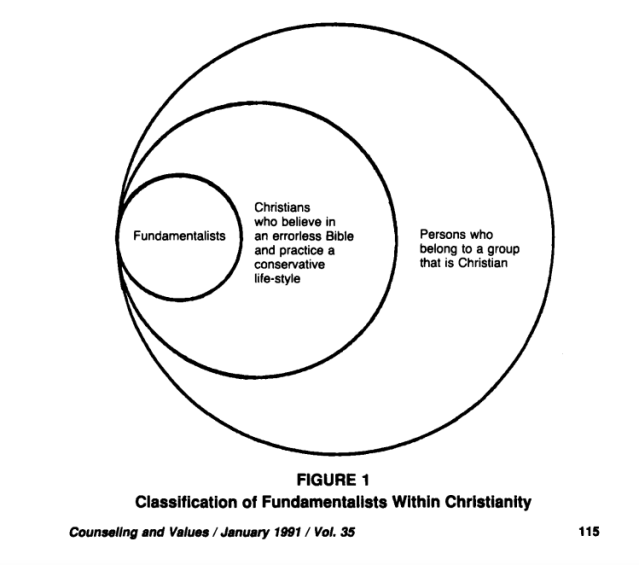
Source: Douglas Harvey Spinney/Counselling and Values
As mental health advocates who recognize the interconnectedness of all systemic injustices, it is essential that we understand how religious fundamentalism threatens democracy. This public study is intended to be used as a condensed primer that deconstructs this ideology to explain 1) how and why it is pervasive across all religious teachings, and 2) how it differs from healthy spirituality. This will help forestall legitimate criticisms of fundamentalism from being confused with anti-theism. (Note: “Gd” is spelled this way to honor Jewish traditions regarding uttering God’s name.)
Foundations: Fundamentalist Doctrine
Religious fundamentalism is a meta-belief that issues strict edicts relating to the sinfulness of every act. It is often believed that the top priority is not people’s well-being in the here and now, but surviving Judgment Day or its equivalent.
So often the rule book has little regard for humanism or relationships. Yet research shows that some people derive a sense of control and self-regulation from ideological normativity.
My conceptual framework of religious fundamentalism (currently) includes seven pillars.
- The belief that religious pluralism is corrupt and that only one religion is legitimate
- Blaming society’s problems on secular modernization and the younger generation
- Strong in-group bias and rigid distinctions between “us” and “them”
- Apocalyptic fears and fantasies about an accelerating rapture (e.g., excitement over climate destruction)
- Coercive evangelism, with or without the consent of others
- A constant “spiritual battle” with the “enemy”
- Authoritarian expectations of leaders (unquestioned control) and followers (total submission)
Some argue that religious fundamentalism is less focused on God and more on exerting power and control internally, interpersonally, organizationally, and politically.
The Difference: Fundamentalism vs. Healthy Spirituality
It could be said that the most striking differences between healthy spirituality and religious practice and religious fundamentalism emerge with regard to authority, leadership, institutional power, and the censorship of knowledge.
beginningFundamentalist leaders often instill self-doubt through the doctrine of total depravity. This position positions human beings as inherently fallen, evil, and in opposition to God’s will. It also contrasts prayer and faith with self-help, initiative, and proactivity. Atonement and continued submission to God’s will (often limited by leaders) are the only ways to overcome depravity.
Denying the inherent human potential for altruism and ignoring the possibility of actionable faith only creates a false religion-activism dichotomy at the societal level. Moreover, the historical influence of many religious leaders, such as CT Vivian, James Lawson, James Cone, Joseph Lowry, Ralph Abernathy, activist Rabbi Abraham Joshua Heschel, and the father of liberation theology Gustavo Gutierrez, make it clear that this dichotomy is false.
Spirituality Must-Reads
The impact of this fundamentalist doctrine is both personal and political. Whereas healthy spirituality can foster introspection and intuition, particularly through mind-body awareness, fundamentalism inculcates emotional separation by separating the mind and body. And, both personal and political, fundamentalism enables learned helplessness and spiritual bypassing. As a result, fundamentalist activism often advocates for negative rights over positive rights.
Number 2Fundamentalist leaders often espouse authoritarianism. Marlene Winnell conceptualized the Religious Trauma Syndrome (RTS) to describe how autocratic leadership styles and narcissistic abusive tactics converge in fundamentalist clergy. Victims are often pathologized and scapegoated, while clergy successfully protect their own image by playing the victim. RTS overlaps with “The Abusive Church,” “25 Signs of Spiritual Abuse,” and other models of religious abuse.
Whereas healthy spirituality promotes consensual, individual spiritual journeys, religious fundamentalism mandates that an authority unilaterally dictate and examine the spiritual awareness of all members.
The authoritarian dynamics of fundamentalism, combined with members’ feelings of guilt and gullibility, allow leaders to weaponize shame and fear-mongering to thwart autonomy and independent thought.
Authoritarian logic can also justify the imposition of painful and humiliating punishments to which authorities would never agree, resulting in unwavering deference to leaders who cover up evidence of abuse and protect their own reputations above their people.
lastlyFundamentalist leaders often promote a literal interpretation of the Bible, a method of biblical interpretation that ignores figurative language and follows the strictest connotations of word choice. Underlying this approach is a strong bias against secular explanations of history (such as archaeology) and the notion that the Holy Scriptures came into being supernaturally, and were not handwritten on scrolls by scribes over a period of approximately 1,500 years. This position fosters both ahistoricism and superstition, as pseudohistory can sow seeds of conspiracy.
For example, the film 1946: Mistranslations that Changed a Culture reveals how the Revised Standard Version publishing committee replaced the Greek words “malakoi” and “arsenokoitai,” meaning “perverts,” with “homosexuals.” And in 1983, Biblica, the copyright holder of the NIV Bible, mistranslated a German Bible by replacing “boy shanders” with “homosexuals,” alluding to the widespread practice of pedophilia by Catholic priests, just as the media portrayed AIDS as a “gay plague.”
So it came as no surprise to many when former President Trump’s Bible teacher suggested that COVID-19 was caused because gay men had incurred the “wrath of God.” Nor was it a huge shock when televangelist Pat Robertson, founder of the Christian Broadcasting Network and host of “The 700 Club” for 55 years, said on air that gay men wear sharp rings and shake hands in order to purposely spread HIV.
Whereas healthy spirituality seeks to balance faith and reason, religious fundamentalism promotes anti-intellectualism, an over-spiritualization of oppression and tragedy, and an unconditional acceptance of pseudohistory and pseudoscience. Given this demographic’s high susceptibility to misinformation, their political fluidity, and their strong moral motivation to transform secular governments into theocracies, the implications for the struggle to protect what degree of democracy we currently have are enormous.
