

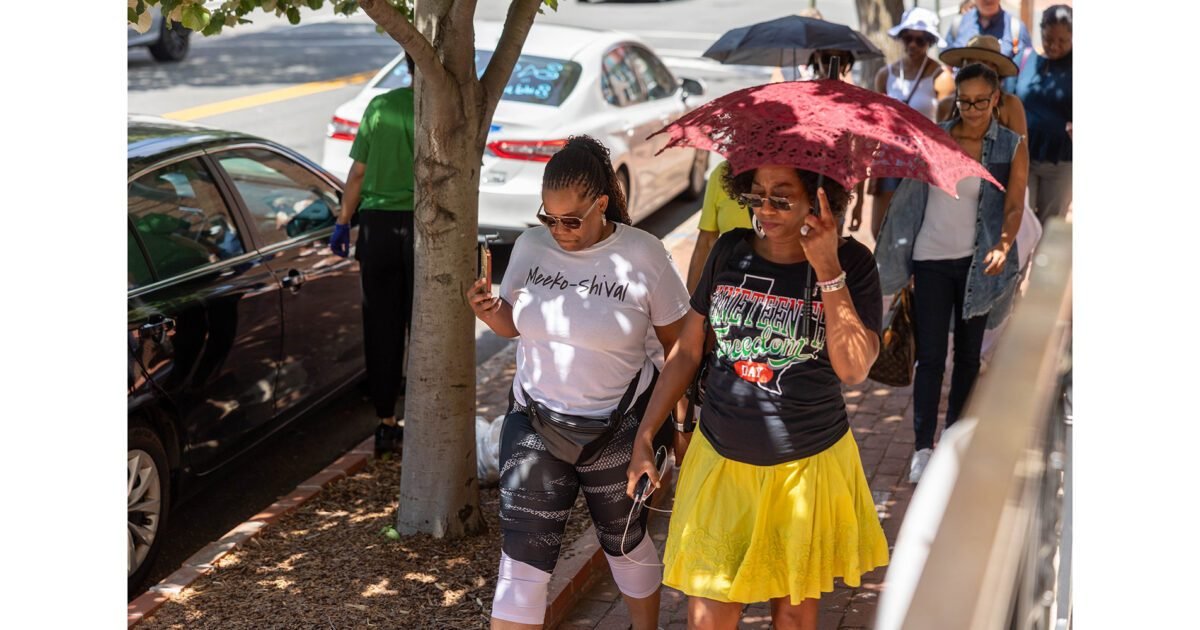

Julie Hawkins Ennis, right, led a spiritual walk for descendants of GU272 on June 20, 2024, from the Freedom House Museum in Old Town Alexandria, Virginia, to the shore where the ship Katherine Jackson was likely docked. That ship transported some of the 272 enslaved men, women and children sold by the Maryland Jesuits in 1838. The sale helped ensure the financial survival of Georgetown College, now known as Georgetown University. (Catholic Standard photo by Mihoko Owada)

Hawkins, Pike, Mahoney and Mason are just a few of the surnames held by hundreds of descendants of people who were enslaved by Jesuit priests in Maryland during colonial times and the early decades of the U.S. On June 19, 1838, Jesuit Maryland signed a contract to sell 272 enslaved men, women and children, now known as GU272.
Julie Hawkins Ennis, founder of Southern Maryland Voices LLC and organizer of the walk, spoke to several dozen descendants and other participants outside the Freedom House Museum on Duke Street in Alexandria, Virginia, on the morning of June 20, the day after the Juneteenth Freedom Day anniversary. Ironically, June 19 is both the date the Jesuits signed the sale deed in 1838 and the day in 1865 now known as Juneteenth when emancipation was announced to enslaved black Americans in Galveston, Texas, more than two months after the end of the Civil War and more than two years after President Lincoln issued the Emancipation Proclamation.
“That was the day the Jesuits made a deal with the sugar plantation owners… they made a deal to sell over 272 people from Southern Maryland to the sugar plantations. It was literally hell,” Hawkins Ennis said. “How could this happen? Georgetown was financially bankrupt, it was getting ready to close, and it needed money.”
In 2019, her son was a student at Gonzaga University High School, a Jesuit preparatory school in Washington, D.C., when he learned he was a descendant of slaves owned by the Jesuits.
“I tried to pull him away, but I didn’t, and it just came back because of the way I was raised. Being Catholic wasn’t just a religion, it was a way of life for us,” Hawkins Ennis said. “Even though all this happened, there were good things that came from being Catholic… I’m still a Catholic, so today I decided to follow in their footsteps and go see where they were being held.”

Before the June 20 start of the Freedom House Museum and Spiritual Walk of Old Town Alexandria tour, Julie Hawkins Ennis, center, gave opening remarks to attendees, including descendants of GU272. She spoke about the 272 enslaved men, women and children sold by the Maryland Jesuits in 1838 and the history of the museum building, which once served as a slave pen. Hawkins Ennis also spoke about how she has had to confront this history with her own Catholic faith. (Catholic Standard photo by Mihoko Owada)
Freedom House in Old Town Alexandria is now a museum surrounded by tenement buildings, but according to museum educator Karen Wilkins, the building was once used to traffic men, women and children into “the largest and most profitable slave trading business in the United States” from 1828 to 1851.
Leading up to the pilgrimage, Ms. Wilkins, who guided the descendants around the museum, told them about Isaac Franklin, John Armfield and Rice Ballard, all of whom were important partners in the domestic slave trade in the United States. She spoke of how plantations in the Southern United States harvested crops of sugarcane, cotton, rice and indigo. The South was once known as the “cotton kings.” “They supplied about two-thirds of the cotton, not just for the United States, but for the world,” she said.

Karen Wilkins, who works at the Freedom House Museum in Alexandria, gave a private tour to participants in a spiritual walk on June 20, including descendants of 272 slave men, women and children sold by Jesuits in Maryland in 1838. Here, she reads from a facsimile of Katherine Jackson’s shipping manifest, which transported slaves from Virginia to Louisiana. (Catholic Standard photo by Mihoko Owada)
Wilkins went on to explain the function of Freedom House and how slaves were housed in “outdoor enclosures” on either side of the building. He said the city recently approved restoration of the building during what he called a “critical period,” including closing off non-existent windows to better replicate how it functioned in the 1800s.
After a short stroll through the museum, the group returned outside to begin a spiritual walk of just over a mile from Freedom House to the waterfront, the path their ancestors walked before boarding the Katherine Jackson, where a replica of the ship’s manifest is on display.

Melisande Colombe offers water to honor her ancestors who were enslaved and sold by the Jesuits in Maryland and to acknowledge the suffering they endured at the end of a spiritual walk for descendants of GU272 in Old Town Alexandria on June 20, 2024. (Catholic Standard, photo by Mihoko Owada)
At the water’s edge, Melisande Colombe, a research and community engagement associate at Georgetown University’s Institute for Global Performance and Politics, poured water.
After the libation, the names on the register were read out.

During a spiritual walk in Old Town Alexandria on June 20, the names of enslaved men, women and children trafficked aboard the Katherine Jackson after its sale by the Maryland Jesuits in 1838 were read aloud during a water offering by various descendants. (Photo by Mihoko Owada, Catholic Standard)
“The libation is an acknowledgment of our connection to our ancestors. The libation can be pure water or alcohol, but we just choose water. Water ties it all together. When Franklin and Armfield were in business, when human trafficking was the American program, they traveled by water. Everything was by water,” Colombe said. Catholic StandardsNames of GU272 descendants connected to her family include Queen and Mahoney, but she thinks there may be others.
Colombe said education about this history needs to be improved going forward.
“I hope Americans will learn more about America and who we are as Americans. We have a tendency, with a generous heart, to ignore our own problems and go out into the world and appoint ourselves as the people who will right the world’s wrongs,” Colombe said.

Participants in a spiritual walk June 20 in Old Town Alexandria included descendants of GU272, who prayed in memory of the 272 enslaved men, women and children sold by the Maryland Jesuits in 1838. After being sold, some of these ancestors were taken to the Alexandria waterfront before being transported to Louisiana where they endured hard labor on sugar plantations. (Catholic Standard, photo by Mihoko Owada)
Julie Hawkins Ennis standard
This was her second time on the walk, but the first time she walked from Freedom House to the pier she was with Gonzaga University students and social studies teacher Edward Donnellan.
“They (our ancestors) followed the same footsteps that we did to get here, to this pier. Can you imagine that? It’s sad,” said Hawkins Ennis, who grew up in southern Maryland and has lived in Maryland and the Washington, D.C., area, reflecting on how much history she’s learned about the popular site in recent years.

Julie Hawkins Ennis, who teaches local history through her group, Southern Maryland Voices LLC, organized a spiritual walk for descendants to remember their ancestors, GU272, enslaved men, women and children sold by the Maryland Jesuits in 1838. The sale helped ensure Georgetown College’s financial survival. “This story is known by many of us and many of us need to know it,” Hawkins Ennis said. (Catholic Standard photo by Mihoko Owada)
“We came here to eat. I used to work not far from here. I used to walk up and down Duke Street almost every day. I had no idea this was where slaves walked. I didn’t even know this was a slave port. We didn’t know,” Hawkins Ennis said. “It’s amazing to me that we’re standing on sacred ground. It’s funny, it seems like everywhere I go in this area there’s some kind of connection to the DMV. It’s so magical. It’s like my ancestors sent me to discover these places.”

Descendants of GU272 and other participants pose together after taking part in a spiritual walk in Old Town Alexandria on June 20, 2024. The walk follows in the footsteps of the ancestors of 272 enslaved men, women and children sold by the Maryland Jesuits in 1838. (Catholic Standard, photo by Mihoko Owada)
Copy permalink
printing
Recommended reading
