

We recently reported on the Frontiers in Neuroscience paper by Luo et al.Balloon dilation plus acupuncture for post-stroke cricopharyngeal achalasia: a meta-analysis of randomized controlled trials(Luo et al., 2023). The authors conducted a meta-analysis and concluded that acupuncture combined with balloon dilation may be an effective treatment for cricopharyngeal achalasia after stroke. In particular, the authors explored the factors influencing this combined treatment from different perspectives through three subgroup analyses. However, we would like to further improve this important study from two aspects.
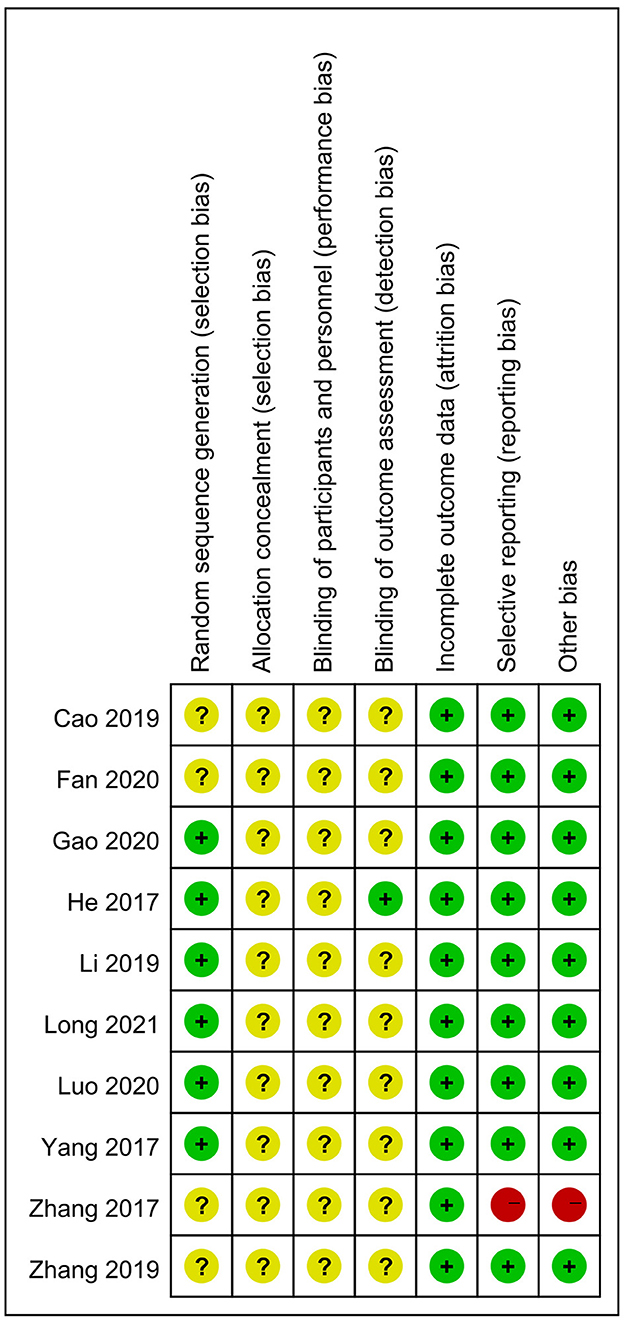
The authors emphasize that two reviewers independently assessed the methodological quality of each study using the Cochrane Consortium’s risk of bias tool. Our main concern was the lack of precision in the risk of bias assessment of the included studies. For example, in some studies (Zhang, 2017, 2019; Cao et al., 2019; Fan et al., 2020), the researchers did not report the randomization method used, so the risk of randomization should have been unclear, rather than low as the authors described. In Zhang’s (2017) study, the method section was too brief, did not provide specific operational details of the observation and control groups, and did not provide specific outcome measures. Therefore, there was a high risk of selective publication bias and other biases. Therefore, we reassessed the methodological quality of all articles and presented them in Figure 1.
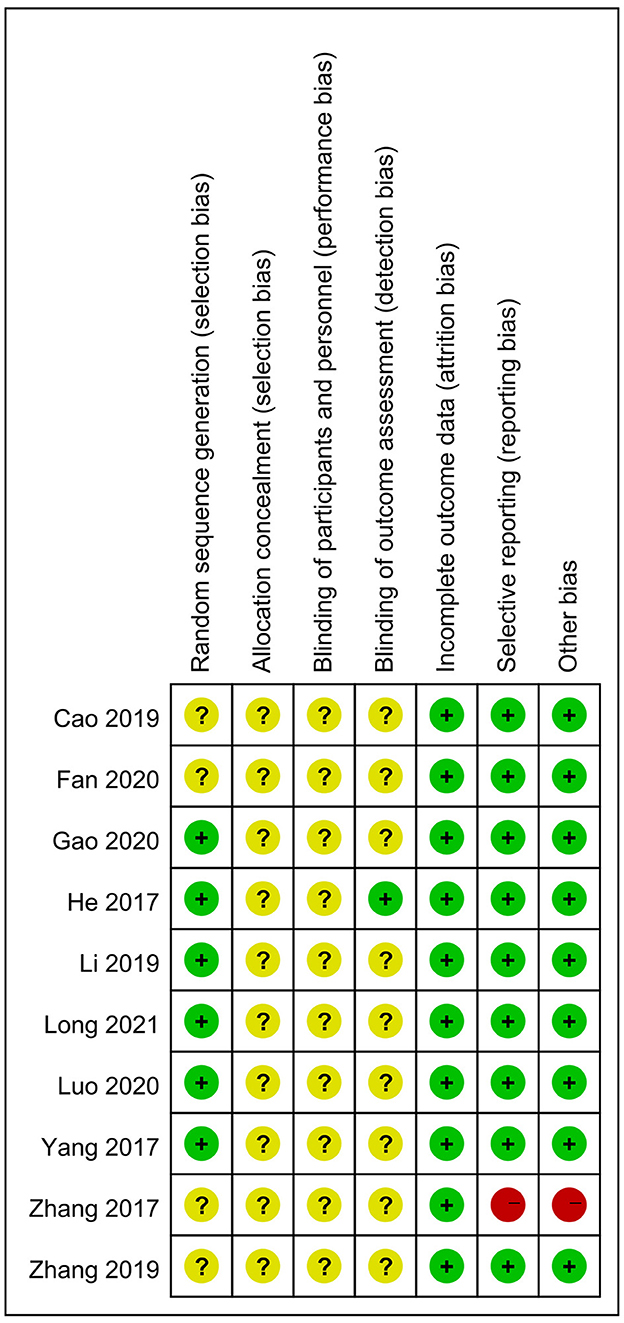
Figure 1Summary of risk of bias.
The included studies used two methods to evaluate the treatment effect: water swallow test (WST) and videofluoroscopic swallowing study (VFSS). However, the authors only evaluated the difference between the two groups in VFSS, not WST. Therefore, based on the WST data from three studies (Yang and Lei, 2017; Cao et al., 2019; Long et al., 2021), we found that the intervention group performed better in WST (Figure 2).

Figure 2Forest plot of WST scores.
Despite these shortcomings, the benefits of combined balloon dilation and acupuncture therapy on the swallowing function of stroke patients still deserve recognition. The results of this meta-analysis provide solid evidence for including this combined intervention in various stroke patients with dysphagia. In future clinical practice, researchers need to standardize the best acupuncture treatment to monitor long-term clinical outcomes. Meanwhile, considering the homogeneity of the study population (limited to Chinese patients), future studies should continue to extend to populations in other countries and regions.
Author contributions
HJ wrote the paper. HZ wrote the tables. XZ wrote the graphs. YX reviewed the paper.
Funding
This paper was supported by the Natural Science Foundation of Gansu Province (23JRRA1247).
Conflict of interest
The authors declare that the research was conducted in the absence of any commercial or financial relationships that could be construed as a potential conflict of interest.
Publisher’s Note
All claims made in this article are those of the authors themselves and do not necessarily represent those of their institutions, publishers, editors, or reviewers. Any products evaluated in this article, or claims made by their manufacturers, are not endorsed or approved by the publishers.
References
Cao, X., Xiu-Ling, PU, Gang, XU, Cui-Li, Z., Ding, Z., and Wei-Hua, Z. (2019). A clinical study of four-stage open bridge lichen eye acupuncture and balloon dilation for dysphagia due to cricopharyngeal achalasia after stroke. Shanghai Acupuncture Clinic38, 1205–1208. doi: 10.13460/j.issn.1005-0957.2019.11.1205
CrossRef Full Text | Google Scholar
Fan, P., Bin, LI, Yan, H., and Ling, Y. (2020). Application of lingual three-needle acupuncture and temporal three-needle acupuncture combined with balloon dilation for dysphagia after stroke. Liaoning Journal of Traditional Medicine47, 177–179. doi: 10.13192/j.issn.1000-1719.2020.05.053
CrossRef Full Text | Google Scholar
Long, X., Hao-Ran, C., Pei-Yang, S., Hong-Liang, C., Ling, Z., Guo-Qing, Z. (2021). Clinical efficacy of electroacupuncture combined with catheter balloon dilation in treating dysphagia due to cricopharyngeal achalasia after stroke. Anhui University School of Medicine40, 45–48. doi: 10.3969/j.issn.2095-7246.2021.05.012
CrossRef Full Text | Google Scholar
Luo, J., Huang, B., Zheng, H., Yang, Z., Xu, M., Xu, Z., et al. (2023). Balloon dilation combined with acupuncture for post-stroke cricopharyngeal achalasia: a meta-analysis of randomized controlled trials. Front. Neuroscience. 16, 1092443. doi: 10.3389/fnins.2022.1092443
PubMed Abstract | CrossRef Full Text | Google Scholar
Yang, F., Lei, C. (2017). A clinical study of tongue acupuncture and balloon dilation for dysphagia due to cricopharyngeal achalasia after stroke. Shanghai J.Acup36, 261–264. doi: 10.13460/j.issn.1005-0957.2017.03.0261
CrossRef Full Text | Google Scholar
Zhang, F. (2017). Effect of combined acupuncture and catheter balloon dilation on patients with cricopharyngeal achalasia after stroke. Releasing monitoring control 11, 838-839.
PubMed Abstract | Google Scholar
Zhang, Y. (2019). Efficacy of acupuncture combined with catheter balloon dilation in treating cricopharyngeal achalasia after stroke. A digest of the latest medical information from around the world 19, 252–253. doi: 10.3969/j.issn.1671-3141.2019.06.134
CrossRef Full Text | Google Scholar
keyword: Acupuncture, Balloon dilatation, Stroke, Cricopharyngeal achalasia, Meta-analysis, Commentary
Quote: Jiang H, Zhang H, Zhang X, Xu Y (2023) Commentary: Acupuncture combined with balloon dilation for post-stroke cricopharyngeal achalasia: a meta-analysis of randomized controlled trials. Front. Neuroscience. 17:1214834. Source: 10.3389/fnins.2023.1214834
received: April 30, 2023; approved: July 24, 2023;
release date: August 24, 2023.
Reviewed by:
Zhaoqin Wang, Shanghai University of Traditional Chinese Medicine, China
Copyright © 2023 Jiang, Zhang, Zhang, Xu. This is an open access article distributed under the terms of the Creative Commons Attribution License (CC BY). Use, distribution, or reproduction in other forums is permitted, provided the original author and copyright holder are credited and the original publication in this journal is cited in accordance with accepted scholarly practice. Any use, distribution, or reproduction not in accordance with these terms is not permitted.
*correspondence: Xu Yanlong, xiaolong88772022@163.com
