

HARARE, Zimbabwe — After her son, the family’s light and sole breadwinner, was arrested last year, Tambudzai Tembo’s mental health took a toll. In a country where clinical mental health services are scarce, her chances of getting professional help were slim to none. She considered suicide.
“I didn’t want to live anymore. People who see me would think everything is fine, but inside my head was spinning,” says the 57-year-old. “I was all alone.”
A wooden bench and a caring grandmother saved her.
Older adults are the focus of a mental health treatment that originated in Zimbabwe and is now being adopted in countries such as the United States.
The approach involves setting up benches in quiet, discreet corners of local clinics, churches, poor neighborhoods and universities, where older women with basic training in problem-solving therapy sit patiently, ready to listen and engage in one-on-one conversations.
The therapy is inspired by traditional Zimbabwean practices in which grandmothers were trusted sources of wisdom during difficult times. Urbanization, the breakdown of close-knit extended families, and modern technology caused the practice to fall into disuse, but now, as mental health needs grow, it is proving useful again.
“Grandmothers are the keepers of local culture and wisdom. They are rooted in their communities,” says Dickson Chibanda, the initiative’s founder and professor of psychiatry. “They never leave their communities. And they have an incredible ability to make people feel respected and understood, using what we call ‘expressed empathy.'”
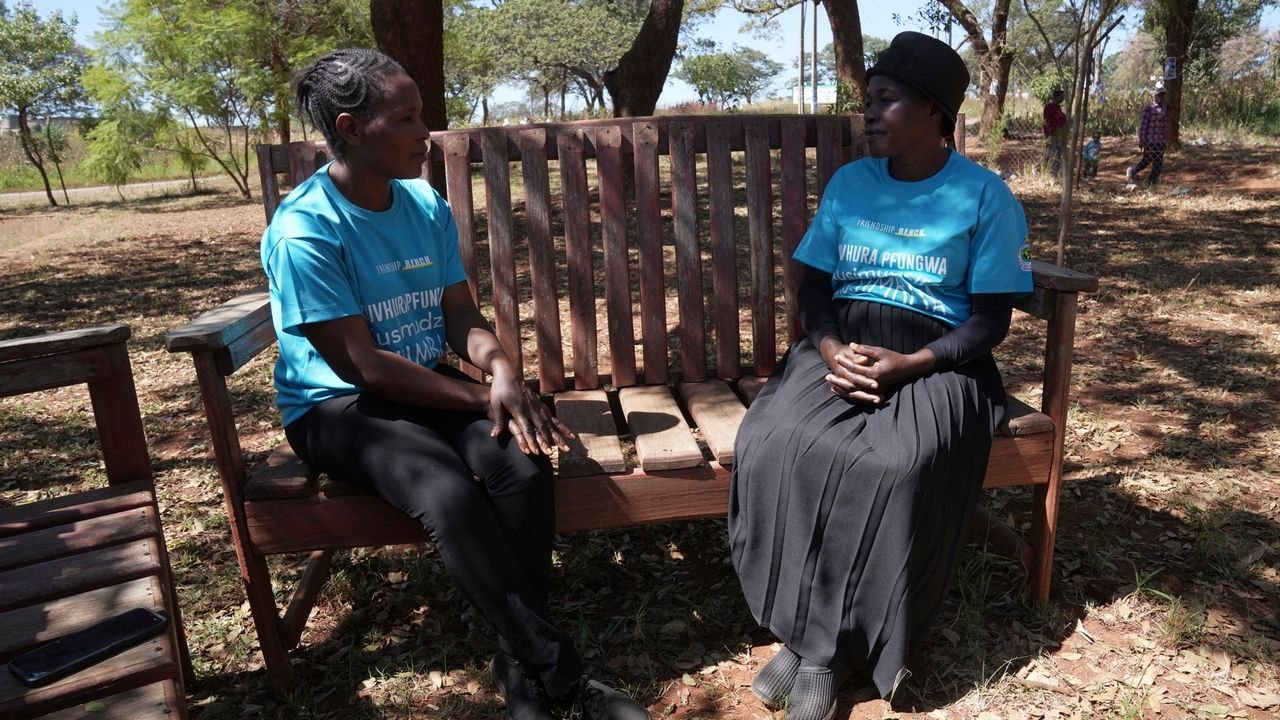
Grandmother Shirizai Zukwa, right, talks with Tambudzai Tembo outside their home in Hatcliff, a suburb of Zimbabwe’s capital, Harare, on Wednesday, May 15, 2024. Talk therapy using park benches and a network of grandmothers has become a lifeline for people with mental illness in Zimbabwe. The concept is now being adopted in parts of the United States and elsewhere. Credit: AP/Tsvangirayi Mukwazhi
Last year, Chibanda was awarded $150,000 by the US-based McNulty Foundation for revolutionising mental health care. Chibanda said the concept had taken root in parts of Vietnam, Botswana, Malawi, Kenya and Tanzania, with “preliminary formative work” taking place in London.
In New York, the city’s new mental health plan, launched last year, says it was “inspired” by what it calls “friendship benches” to address risk factors such as social isolation. Orange benches are now being installed in neighborhoods including Harlem, Brooklyn and the Bronx.
In Washington, an organization called HelpAge USA is piloting the concept as part of its “DC Grandparents for Mental Health” initiative, which began in 2022 as a COVID-19 support group for people over the age of 60.
Cindy Cox Roman, president and CEO of HelpAge USA, said so far 20 grandmothers committed to “eliminating the stigma around mental health and making it okay to talk about feelings” have been trained by the Friendship Bench Zimbabwe team to listen to others, empathize and empower them to solve problems.
Grandmother Shirizai Zukwa, right, talks with Tambudzai Tembo outside their home in Hatcliff, a suburb of Zimbabwe’s capital, Harare, on Wednesday, May 15, 2024. Talk therapy using park benches and a network of grandmothers has become a lifeline for people with mental illness in Zimbabwe. The concept is now being adopted in parts of the United States and elsewhere. Credit: AP/Tsvangirai Mkhwazi
The benches will be installed in places of worship, schools and health centers in low-income communities across Washington, bringing together people who have been “historically marginalized and more likely to have mental health issues,” she said.
Cox-Rohman cited factors that limit access to treatment, including fear and distrust of the health care system, lack of social support and stigma.
“People are hurting, and my grandmother always makes them feel better,” she said.
“Older people have a lot of wisdom and open arms. I reject ageism. Sometimes age brings wisdom that you can’t learn until you’re older,” one of the grandmothers, 81-year-old Barbara Allen, said in a promotional video.
According to the National Institute of Mental Health, more than one in five American adults live with a mental illness.
“The mental health crisis is real. The real crisis after the pandemic is a lot of clinicians are leaving the workforce,” said Dr. Jehan Elmayoumi, a specialist with HelpAge USA and founding director of the Rodham Institute for Health Equity at Georgetown University, who has struggled to find psychiatrists for her seriously suicidal patients.
El Mayoumi said the Zimbabwe concept gives people “someone they can trust, open up to and confide their innermost secrets to”, adding: “And for that you need trust. That’s the beauty of the Friendship Bench.”
The idea was born out of tragedy: Chibanda was a young psychiatrist, and in 2005 there were just over 10 psychiatrists in Zimbabwe. One of his patients wanted to see him but couldn’t afford the $15 bus fare. Chibanda later learned that he had committed suicide.
“We realized we needed to have a stronger presence in the communities,” says Chibanda, “and in fact, we realized that one of our most valuable resources are our grandmothers, the keepers of our local culture.”
He recruited and trained 14 grandmothers from near the hospital where he worked in the capital, Harare. In Zimbabwe, they received $25 a month to help with travel and phone costs.
Now partnering with the Ministry of Health and the World Health Organization, the network has grown to more than 2,000 grandmothers across the country, and it says that by 2023, more than 200,000 Zimbabweans will have sat down for therapy from trained grandmothers.
Tembo’s grandmother, Sirizai Zukwa, who had dissuaded him from suicide, visited him at home recently to check on his progress using questionnaires. She heard him tell her that he has found new energy in life and now sells vegetables to make a living.
Zukwa has become a familiar figure in the area: People stop to say hello and thank him for his help, some even asking for home visits or writing down his phone number.
“People are no longer ashamed or afraid to openly stop us on the street and ask to talk,” she said. “Mental health is no longer something to be ashamed of.”
___
The Associated Press receives funding for its global health and development coverage in Africa from the Bill & Melinda Gates Foundation Trust. The AP is solely responsible for all content. For AP’s philanthropic collaboration criteria, a list of supporters and areas of coverage funded, visit AP.org.
